Preventing Canine Bloat in Puppies: A Complete Puppy Care Guide
Learn how to prevent canine bloat in puppies with age-specific feeding schedules, exercise rules, and milestone timelines from weeks 4 through 12 months.

Understanding Canine Bloat in Puppies: Why Prevention Starts Day One
Gastric dilatation-volvulus (GDV), commonly called bloat, is one of the most dangerous conditions a dog can face. While most owners associate bloat with adult large-breed dogs, canine bloat in puppies is a real and under-discussed risk. Puppies of deep-chested breeds — Great Danes, German Shepherds, Standard Poodles, Irish Setters, Weimaraners, and Doberman Pinschers — inherit the anatomical risk factors for GDV from birth. Their rapid growth phases, enthusiastic eating habits, and developing digestive systems create a perfect storm for gastric distress.
According to the Merck Veterinary Manual, GDV occurs when the stomach fills with gas, food, or fluid and then twists on its axis, cutting off blood supply. Mortality rates range from 10% to 60% even with treatment. While full GDV is less common in puppies under six months, gastric dilatation (bloat without torsion) can and does occur in young dogs, often triggered by rapid eating, exercise around mealtimes, or feeding from elevated bowls.
This guide covers everything you need to raise a bloat-prone breed puppy safely — from the moment you bring them home through their first year — with feeding protocols, milestone timelines, and prevention strategies woven into every stage.
When Should I Bring My Puppy Home?
For bloat-prone breeds, the timing of your puppy's homecoming matters more than most owners realize. Bring your puppy home between 8 and 10 weeks of age — never earlier than 8 weeks. The AVMA recommends that puppies remain with their litter until at least 8 weeks for critical behavioral development.
For breeds at high GDV risk, an extra two weeks with the breeder (up to 10 weeks) can be beneficial. Responsible breeders of large breeds often feed multiple small meals and model calm eating behavior in the litter, which gives your puppy a foundation for the anti-bloat feeding habits you'll continue at home. Ask your breeder specifically:
- How many meals per day are the puppies receiving? (Should be 3-4 at this age)
- Are puppies fed from floor-level bowls? (Elevated feeders increase bloat risk)
- Is there a rest period enforced after meals?
- What specific food brand and formula are they on?
Transition your puppy to your home on a day when you can be present for at least 48 consecutive hours. The stress of relocation can suppress appetite or trigger anxious gulping of food — both bloat risk factors.
Age-Specific Milestones: Weeks 4 Through 12 Months
Weeks 4-8 (Breeder Stage)
During this period, puppies transition from mother's milk to solid food. Your breeder should be introducing high-quality puppy kibble softened with warm water or puppy milk replacer. By week 6, puppies should be eating mostly solid food in 4 meals per day. This is when eating habits form — breeders who scatter-feed or use slow-feed bowls help puppies learn to eat at a moderate pace rather than inhaling food.
Weeks 8-12 (Home Transition)
Your puppy arrives home. Expect some appetite fluctuation in the first 3-5 days due to stress. Maintain the breeder's food and schedule exactly. Feed 3-4 meals daily at consistent times. Begin crate training with 30-minute maximum sessions during the day. Your puppy will sleep 18-20 hours per day — this is normal. Begin gentle handling exercises: touching paws, ears, and mouth for 30-60 seconds daily.
Weeks 12-16 (Foundation Building)
Your puppy's coordination improves dramatically. This is prime socialization time. You can transition to 3 meals per day around week 14 if your puppy is eating well. Begin short, structured walks (5 minutes per month of age, so 15 minutes max at 3 months). Enroll in a positive-reinforcement puppy class — this is critical for large breeds that must learn impulse control early. Teething discomfort begins; provide appropriate chew outlets.
Weeks 16-24 (Growth Acceleration)
Rapid skeletal growth occurs. Your puppy may seem clumsy and "leggy." This is the window where you transition to 2 meals per day (around 16-20 weeks). Never feed a bloat-prone breed only one meal per day — research published in the Journal of the American Veterinary Medical Association has linked single daily feedings to increased GDV risk. Spay/neuter discussions happen in this window; consult your vet about timing for large breeds (many now recommend waiting until 12-18 months for joint health).
Months 6-12 (Adolescence)
Your puppy enters adolescence — testing boundaries, showing selective hearing, and continuing to grow. Large breeds aren't fully mature until 18-24 months. Maintain 2 meals per day. Switch to a large-breed adult formula around 10-12 months (not before — large-breed puppy formulas have controlled calcium/phosphorus ratios essential for proper bone development). Continue structured exercise but avoid forced running, jumping from heights, or repetitive fetch on hard surfaces until growth plates close (typically 14-18 months, confirmed by your vet via X-ray).
Feeding Schedule to Minimize Bloat Risk
Feeding management is your single most powerful tool for preventing canine bloat in puppies. The American Kennel Club notes that how you feed matters as much as what you feed.
| Age | Meals/Day | Portion per Meal* | Total Daily Food | Key Anti-Bloat Rules |
|---|---|---|---|---|
| 8-12 weeks (10-25 lb / 4.5-11 kg) | 4 | ¾ - 1 cup | 3-4 cups | Floor-level bowl, slow-feeder insert, 15-min rest after eating |
| 12-16 weeks (25-45 lb / 11-20 kg) | 3 | 1 - 1½ cups | 3-4½ cups | No exercise 1 hour before/after meals, no gulping water post-meal |
| 16-24 weeks (45-70 lb / 20-32 kg) | 2 | 1½ - 2½ cups | 3-5 cups | Transition gradually over 5-7 days, maintain consistent meal times |
| 6-9 months (70-100 lb / 32-45 kg) | 2 | 2 - 3 cups | 4-6 cups | Monitor body condition score (4-5/9 ideal), adjust for activity level |
| 9-12 months (80-130 lb / 36-59 kg) | 2 | 2½ - 3½ cups | 5-7 cups | Begin transitioning to adult large-breed formula over 10-14 days |
*Portion ranges assume a large-breed puppy kibble with approximately 350-400 kcal/cup. Always check your specific food's feeding guide and adjust based on your puppy's body condition score. Your vet will help fine-tune portions at each wellness visit.
- Never use elevated feeders. A study from Purdue University found that elevated feeders actually increased bloat risk by 20-50%.
- Use a slow-feeder bowl (brands like Outward Hound Fun Feeder or JASGOOD Slow Feeder) to prevent air gulping.
- Enforce a rest period of 60-90 minutes after meals — no running, no rough play, no stairs if avoidable.
- Limit water intake immediately after eating. Offer small sips, not a full bowl, for the first 30 minutes post-meal.
- Feed at the same times daily — irregular feeding schedules can cause stress-related gulping.
Vaccination Schedule for Bloat-Prone Breed Puppies
Your puppy's immune system is developing rapidly, and staying on schedule with vaccinations protects them during their most vulnerable months. This schedule follows the AVMA and AAHA guidelines for core puppy vaccines.
| Age | Vaccine | What It Protects Against | Estimated Cost |
|---|---|---|---|
| 6-8 weeks | DHPP (1st dose) | Distemper, Hepatitis (Adenovirus), Parainfluenza, Parvovirus | $25-$40 |
| 10-12 weeks | DHPP (2nd dose) + Bordetella | Same as above + Kennel Cough | $40-$60 |
| 14-16 weeks | DHPP (3rd dose) + Rabies | Core boosters + Rabies (legally required) | $45-$70 |
| 12-16 weeks (varies by region) | Leptospirosis (2-dose series, 2-4 weeks apart) | Leptospirosis (zoonotic bacterial disease) | $25-$35 per dose |
| 16+ weeks | Lyme (2-dose series, 2-4 weeks apart) | Lyme disease (tick-borne, region-dependent) | $25-$40 per dose |
Important: Until your puppy has completed their full DHPP series (typically around 16 weeks), they are NOT fully protected against parvovirus or distemper. Avoid public dog parks, pet store floors, and areas with unknown dog traffic. Socialization during this window should happen in controlled environments — private yards, puppy classes that require proof of vaccination, and carried outings to public spaces.
When Can My Puppy Go Outside and Meet Other Dogs?
This is where bloat prevention and disease prevention intersect. Your puppy needs socialization during the critical window (weeks 3-14), but they also need disease protection. Here's the balanced approach:
- Weeks 8-12 (pre-full vaccination): Carry your puppy to outdoor spaces. Let them observe traffic, hear loud noises, see strangers — without paws touching public ground. Invite vaccinated, healthy adult dogs to your home for supervised play. Attend puppy socialization classes that verify all attendees' vaccination status.
- Weeks 12-16: Short walks in low-traffic neighborhood areas (avoid dog park fencing where unknown dogs congregate). Continue structured puppy classes. Carried field trips to hardware stores, outdoor cafes, and friends' houses.
- Week 16+ (after final DHPP): Your puppy can now safely explore public spaces, dog parks (with caution — see below), hiking trails, and beach areas.
- ☐ Meet 10+ different people (various ages, ethnicities, wearing hats/glasses/coats)
- ☐ Encounter 5+ vaccinated, calm adult dogs in controlled settings
- ☐ Experience car rides (short, positive — 5-10 minutes with treats)
- ☐ Hear vacuum cleaners, thunderstorms (use YouTube at low volume), doorbells, fireworks recordings
- ☐ Walk on 5+ different surfaces (grass, gravel, tile, carpet, metal grates)
- ☐ Tolerate handling of paws, ears, mouth, tail for grooming prep
- ☐ Experience being in a crate for 30-60 minutes calmly
- ☐ Visit the vet clinic for a "happy visit" (no shots, just treats and praise)
- ☐ See umbrellas, bicycles, skateboards, wheelchairs at a non-fearful distance
- ☐ Practice gentle restraint (for future grooming and medical handling)
Dog park caution for bloat-prone breeds: Dog parks often encourage frantic, high-intensity running — exactly the kind of post-meal activity that increases GDV risk. If you use dog parks, go during off-peak hours, limit sessions to 20-30 minutes, and never visit within 2 hours of a meal.
Potty Training Timeline and Troubleshooting
Large-breed puppies develop bladder control on a predictable timeline, but owners often underestimate how long full reliability takes.
Realistic expectations:
- 8-12 weeks: Accidents every 1-3 days are normal. Bladder capacity is approximately 1 hour per month of age plus one (so a 2-month-old can hold about 3 hours maximum, but take them out every 1-2 hours while awake).
- 12-16 weeks: Accidents should decrease to 1-2 per week with consistent scheduling. Your puppy begins to "ask" to go out (sitting by door, whining).
- 16-24 weeks: Most puppies are reliably house-trained during the day. Nighttime reliability often comes slightly later.
- 6-9 months: Full reliability for most puppies. Males may begin leg-lifting; this doesn't indicate a training regression.
| Time | Location | Result | Reward Given | Notes |
|---|---|---|---|---|
| 6:30 AM | Backyard, east corner | ✅ Urinated + defecated | Small training treat + verbal praise | First outing, quick success |
| 8:00 AM | Backyard | ✅ Urinated | Verbal praise | Post-breakfast, 90 min wait (bloat prevention) |
| 10:30 AM | — | ❌ Accident in kitchen | N/A — interrupted, carried outside | Missed cue; set alarm for next time |
Track for 2 weeks to identify your puppy's natural rhythm and adjust outing frequency.
Troubleshooting common issues:
- Submissive urination when greeting: Common in large-breed puppies. Ignore the puppy for the first 30 seconds upon entering. Greet calmly at their level. Never punish — this worsens the behavior.
- Excitement urination: Reduce stimulation before outings. Take puppy out before exciting events (guests arriving, car rides).
- Nighttime accidents after 5 months: Rule out a urinary tract infection with your vet. Remove water 2 hours before bedtime. Set a 2 AM alarm for a quiet, boring potty break.
Crate Training Progression and Time Limits
Crate training protects your puppy from household hazards and supports potty training — but exceeding safe crate time limits causes physical and behavioral harm. Follow this progression:
- 8-10 weeks: Maximum 30-60 minutes during the day. Overnight: 3-4 hours (set an alarm). Crate should be just large enough for puppy to stand, turn, and lie down — use a divider in a larger crate to prevent them from soiling one end and sleeping in the other.
- 10-14 weeks: Maximum 1-2 hours during the day. Overnight: 4-5 hours. Feed meals in the crate (door open) to build positive association.
- 14-16 weeks: Maximum 2-3 hours during the day. Overnight: 5-6 hours. Begin leaving the room briefly while puppy is crated.
- 4-6 months: Maximum 3-4 hours during the day. Overnight: 6-8 hours. Your puppy should now enter the crate willingly.
- 6-12 months: Maximum 4-5 hours during the day. Most puppies can sleep through the night (8 hours) without a potty break by 6 months.
Never crate a puppy immediately after a large meal. Wait at least 60 minutes to reduce the risk of gastric discomfort and bloat. If your puppy must be confined after eating, use a puppy-proofed exercise pen rather than a crate so they can move around gently.
Teething Timeline and Safe Relief Strategies
Large-breed puppies have powerful jaws even during teething. Providing appropriate outlets prevents destructive chewing and protects your belongings.
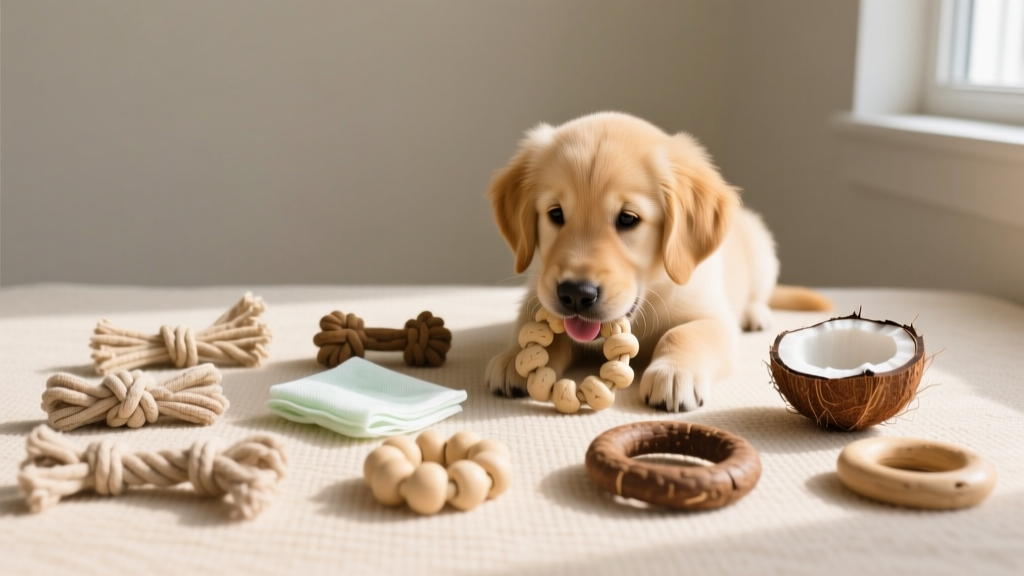
- 3-4 months: Deciduous (baby) incisors begin falling out. You may find tiny teeth in bedding or notice mild blood on chew toys. Offer frozen damp washcloths (twist, wet, freeze), rubber KONG toys filled with plain yogurt and frozen, and Nylabone Puppy chews (softer formula).
- 4-5 months: Peak teething discomfort. Canines and premolars erupt. Chewing intensity increases sharply. Rotate 5-7 different textured toys to maintain interest. Avoid hard antlers, cooked bones, or ice cubes — puppy teeth can fracture.
- 5-6 months: Most adult teeth are in. Chewing should decrease but won't stop entirely. Transition to adult-weight chew toys. Schedule a veterinary dental check to ensure no retained baby teeth (common in smaller breeds but occasionally seen in large breeds with crowded mouths).
Safe chew recommendations by age:
- 8-16 weeks: Kong Puppy (pink/blue rubber), Benebone Puppy, frozen carrot sticks (supervised)
- 4-6 months: Kong Classic (red rubber), West Paw Zogoflex Hurley, Bullymake boxes for puppies
- 6-12 months: Kong Extreme (black rubber), Goughnuts MAXX, yak cheese chews (supervised, remove small pieces)
Common Puppy Problems and Bloat-Safe Solutions
Puppy Biting and Nipping
Large-breed puppies explore the world with their mouths, and their bites hurt even at 10 weeks. How to stop puppy biting using positive reinforcement:
- When teeth touch skin, say "ouch" in a calm, medium-pitch voice (not a high squeal, which can excite some puppies).
- Immediately withdraw attention — stand up, cross arms, look away for 10-15 seconds.
- When puppy is calm, offer an appropriate chew toy and praise enthusiastically when they bite the toy instead.
- Ensure your puppy gets adequate physical and mental exercise — overtired puppies bite more. A 10-minute training session burns as much energy as a 30-minute walk.
- Redirect to a frozen chew toy if biting intensifies — cold soothes teething gums.
Never hold a puppy's mouth shut, push fingers into their throat, or use physical punishment. These methods damage trust and can increase fear-based biting.
Whining and Crying in the Crate
Distinguish between protest whining (puppy wants out) and need-based whining (puppy needs to eliminate). Take puppy out immediately before crating. If whining starts within 10 minutes of crating, wait for a 3-second pause in noise before opening the crate — this teaches that quiet, not noise, opens the door. For overnight whining after 3 AM, take puppy out on-leash for a boring, no-play potty break, then return to crate.
Destructive Chewing
Manage the environment: puppy-proof rooms with bitter apple spray on baseboards, use exercise pens to limit access, and rotate toys every 3 days to maintain novelty. A stuffed, frozen KONG buys 20-40 minutes of quiet chewing — use these during times your puppy is most destructive (typically mid-afternoon and early evening).
First-Year Cost Breakdown for a Bloat-Prone Breed Puppy
Owning a large-breed puppy costs significantly more than a small breed due to food volume, medication dosages (preventives are weight-based), and the higher stakes of emergency care. Budget realistically:
| Category | Items | Estimated Cost Range |
|---|---|---|
| Purchase/Adoption | Responsible breeder OR rescue fee | $500 - $3,500 |
| Veterinary (Wellness) | 3-4 wellness exams, DHPP series, rabies, bordetella, fecal tests, heartworm test | $400 - $800 |
| Spay/Neuter | Gonadectomy (large breed, may include gastropexy discussion) | $400 - $1,200 |
| Preventive Medications | Heartworm (e.g., Heartgard Plus), flea/tick (e.g., NexGard, Simparica Trio), weight-based dosing | $300 - $600/year |
| Food | Large-breed puppy formula, 5-7 cups/day at peak growth | $600 - $1,200 |
| Supplies | Crate (48"+), slow-feed bowls, leash/harness, bed, grooming tools, toys, exercise pen | $300 - $700 |
| Training | Puppy class + basic obedience (6-8 week sessions) | $200 - $600 |
| Pet Insurance | Monthly premium for large-breed puppy (start at 8 weeks for best rates, covers GDV surgery) | $600 - $1,200/year |
| Emergency Fund | Recommended reserve for GDV surgery or other emergencies | $2,000 - $5,000 (savings target) |
Total first-year cost (excluding purchase): $2,800 - $6,300
Prophylactic gastropexy consideration: For breeds at highest GDV risk (Great Danes, Irish Wolfhounds, Standard Poodles), discuss a prophylactic gastropexy with your veterinarian. This surgical procedure tacks the stomach to the abdominal wall to prevent twisting. It can be performed during spay/neuter surgery and costs an additional $300-$800. According to the AKC, this procedure reduces the recurrence risk of GDV by over 80% and is strongly recommended for high-risk breeds.
Frequently Asked Questions
How often should I feed my puppy at 10 weeks old?
At 10 weeks, feed your puppy 4 meals per day at evenly spaced intervals (e.g., 7 AM, 11 AM, 3 PM, 7 PM). Each meal should be approximately ¾ to 1 cup of large-breed puppy kibble, depending on your puppy's current weight and the food's caloric density. Use a slow-feeder bowl and enforce a 60-minute rest period after each meal to reduce bloat risk.
When will my puppy be fully potty trained?
Most large-breed puppies achieve daytime reliability between 4 and 6 months of age, with full reliability (including overnight) by 6-9 months. Consistency is the single biggest factor — puppies on a strict schedule with logged outings train faster. Expect occasional setbacks during growth spurts, household changes, or illness.
Can canine bloat in puppies be prevented with diet alone?
Diet management is the cornerstone of prevention, but it's not the only factor. A comprehensive approach includes: multiple small meals per day, slow-feeder bowls, floor-level feeding, enforced rest after eating, stress reduction, and — for the highest-risk breeds — discussion of prophylactic gastropexy with your veterinarian. No single intervention guarantees prevention, but stacking these strategies dramatically reduces risk.
Should I get pet insurance for a bloat-prone breed puppy?
Strongly recommended. GDV surgery costs $3,000-$7,000+ depending on severity and aftercare. Enrolling at 8 weeks (before any pre-existing conditions develop) ensures coverage. Look for policies with annual limits of $10,000+ and reimbursement rates of 80-90%. Companies like Trupanion, Healthy Paws, and Lemonade are popular choices for large-breed owners. Always read the fine print regarding hereditary condition coverage.
How do I know if my puppy is eating too fast?
If your puppy finishes a meal in under 2 minutes, inhales food without chewing, coughs or gags while eating, or has a visibly distended abdomen immediately after meals, they are eating too fast. Solutions include slow-feeder bowls (which can extend meal time to 10-15 minutes), puzzle feeders, spreading kibble on a baking sheet, or adding a large, clean ball to the bowl that the puppy must eat around.
Is dry kibble or wet food better for preventing bloat?
Neither has been definitively proven superior for bloat prevention. However, dry kibble is more practical for slow-feeder bowls and dental health. If feeding kibble, avoid formulas where fat is listed among the first four ingredients — some research suggests high-fat diets may slow gastric emptying. Adding a small amount of water to kibble 5 minutes before feeding can reduce air gulping. Always consult your veterinarian for diet recommendations specific to your puppy's breed and growth rate.
- Abdomen appears swollen, tight, or drum-like
- Puppy is retching or trying to vomit with nothing coming up
- Excessive drooling beyond normal puppy levels
- Pale or blue-tinged gums (normal gums are bubblegum pink)
- Rapid breathing or labored panting at rest
- Restlessness — unable to get comfortable, pacing, repeatedly lying down and standing up
- Weakness, stumbling, or collapse
ASPCA Animal Poison Control: (888) 426-4435 (24/7, consultation fee applies) — if bloat is suspected alongside ingestion of a foreign object or toxic substance.
Pet Poison Helpline: (855) 764-7661
This article provides educational guidance and is not a substitute for professional veterinary care. Always consult your veterinarian for feeding plans, vaccination schedules, and health decisions specific to your puppy. Individual dogs may vary based on breed, genetics, and health status.
Aaron Whyte
All our authors care for dogs every day — read more of their work on the authors page.