Blue Heeler Puppy Care Guide: Milestones, Training & First-Year Costs
Complete blue heeler puppy guide covering age milestones, feeding schedules, potty training timelines, vaccination dates, and first-year cost breakdown.

If you're bringing home a blue heeler puppy (Australian Cattle Dog), you're signing up for one of the most intelligent, energetic, and driven companions in the canine world. These dogs were bred to herd cattle across rough Australian terrain, and that working-dog DNA shows up early — often by 8 weeks old, your puppy will already be nipping heels, testing boundaries, and trying to outsmart you.
This guide walks you through every critical stage of your blue heeler puppy's first year with breed-specific timelines, exact feeding portions, training strategies tailored to their herding instincts, and a realistic cost breakdown so you can budget properly.
When Should I Bring My Blue Heeler Puppy Home?
The optimal age to bring a blue heeler puppy home is 8 to 10 weeks. While some breeders release puppies at 8 weeks, many reputable Australian Cattle Dog breeders prefer holding puppies until 10 weeks. Here's why that extra two weeks matters for this specific breed:
Blue heelers are a high-drive herding breed with strong bite inhibition learning needs. Between weeks 8 and 10, littermates teach each other crucial bite pressure control through play. Puppies removed too early from their litter often develop harder bites and more persistent nipping habits — a problem that's magnified in a breed already prone to heel-nipping behavior.
According to the AKC Australian Cattle Dog breed standard, these dogs mature slowly, often not reaching full emotional maturity until 2 to 3 years old. Starting with a well-socialized 10-week-old puppy gives you a significant training advantage over an 8-week-old who missed critical littermate socialization.
What to expect on day one: Your puppy will likely cry the first 2-3 nights in the crate, may refuse food for the first 12-24 hours due to stress, and will sleep 18-20 hours per day. This is normal. Keep the environment quiet and avoid overwhelming them with visitors during the first 48 hours.
Blue Heeler Puppy Milestones: Week by Week
Understanding what's developmentally appropriate at each stage prevents you from expecting too much too soon — or missing critical windows.
Weeks 4–8 (Still with Breeder)
- Physical: Baby teeth fully erupted, coordination improving rapidly, weight reaching 5–8 lb (2.3–3.6 kg)
- Behavioral: Learning bite inhibition from littermates, beginning to explore beyond whelping box, startle reflexes developing
- Socialization: Critical fear imprint period begins around week 8 — negative experiences now can create lifelong phobias
- What the breeder should be doing: Introducing varied surfaces (grass, gravel, tile), novel sounds, gentle handling of paws/ears/mouth, and first deworming treatments
Weeks 8–12 (Adjustment & Bonding)
- Physical: Weighing 8–15 lb (3.6–6.8 kg), gaining 1-2 lb per week, sleeping 18-20 hours daily
- Behavioral: Following you room to room, beginning to mouth/nip everything, short attention spans (3-5 minutes per training session)
- Training readiness: Can learn name recognition, sit, and basic crate entry. Keep sessions under 5 minutes.
- Breed-specific note: Heeler puppies this age already show herding instincts — watch for circling behavior, staring at moving objects, and nipping at ankles
Weeks 12–16 (Confidence Building)
- Physical: Weighing 15–22 lb (6.8–10 kg), adult teeth beginning to push in, noticeable growth spurts
- Behavioral: Testing boundaries more boldly, second fear period may occur around 12-14 weeks, increased independence
- Training readiness: Can learn down, stay (5-10 seconds), recall with low distractions, loose leash walking basics
- Energy shift: Play sessions become more intense; you'll need structured outlets or they'll create their own (usually destructive ones)
Weeks 16–24 (Adolescent Drive Emerges)
- Physical: Weighing 22–35 lb (10–15.9 kg), approaching adult height, coat transitioning from puppy softness to harsher adult texture
- Behavioral: Herding drive intensifies — chasing bikes, cars, children, other pets becomes common. Prey drive solidifies.
- Training readiness: Can handle 10-15 minute sessions, learning complex cues, ready for beginner agility foundations (flatwork only, no jumps)
- Key challenge: Selective hearing emerges. Your puppy "forgets" previously learned cues when distractions are present.
6–12 Months (Teenage Heeler)
- Physical: Reaching 30–45 lb (13.6–20.4 kg), approaching adult weight (adult blue heelers typically weigh 35–50 lb / 15.9–22.7 kg per AKC standard)
- Behavioral: Sexual maturity (spay/neuter timing discussion with your vet), peak energy and impulsivity, may challenge household rules
- Training readiness: Ready for advanced obedience, intro to herding instinct tests, dog sports foundations, longer hiking (build distance gradually)
- Reality check: This is when many heeler owners feel overwhelmed. The puppy you trained seems to have vanished. Consistency now pays off at 18-24 months.
Blue Heeler Puppy Feeding Schedule & Portions
Blue heelers are medium-sized, high-energy dogs that need nutrient-dense food to support rapid growth without promoting excessive weight gain. Overfeeding large-breed puppy food isn't necessary (they're not giant breeds), but you do want a food with appropriate calcium-to-phosphorus ratios for proper bone development.
Choose a food that meets AAFCO nutritional standards for growth (labeled "for puppies" or "all life stages"). Look for a named protein source (chicken, lamb, beef) as the first ingredient and minimum 22% protein for growing puppies.
| Age | Meals Per Day | Daily Amount (Dry Kibble) | Expected Weight Range |
|---|---|---|---|
| 8–12 weeks | 4 meals | ¾ to 1 cup/day (split into 4) | 8–15 lb (3.6–6.8 kg) |
| 12–16 weeks | 3 meals | 1 to 1½ cups/day (split into 3) | 15–22 lb (6.8–10 kg) |
| 4–6 months | 3 meals | 1½ to 2 cups/day (split into 3) | 22–30 lb (10–13.6 kg) |
| 6–9 months | 2 meals | 2 to 2½ cups/day (split into 2) | 30–40 lb (13.6–18.1 kg) |
| 9–12 months | 2 meals | 2 to 2½ cups/day (split into 2) | 35–45 lb (15.9–20.4 kg) |
Important feeding notes for blue heelers:
- These are approximate ranges. Individual puppies vary based on genetics, activity level, and metabolism. Use body condition scoring — you should feel ribs easily without pressing hard, and see a visible waist when viewed from above.
- Blue heelers are prone to resource guarding around food. From day one, practice hand-feeding portions and adding treats to their bowl while they eat to build positive associations with human hands near their food.
- Avoid free-feeding (leaving food out all day). Scheduled meals help with potty training predictability and allow you to monitor appetite changes, which can signal illness.
- Transition to adult food between 12–14 months, as blue heelers are medium-sized dogs that reach physical maturity faster than giant breeds.
Potty Training Your Blue Heeler Puppy: Realistic Timeline
Blue heelers are highly intelligent and typically learn potty routines faster than many breeds — but "faster" still means 4 to 6 months for reliable house training with occasional accidents up to 8-10 months. Any source promising full potty training in days is misleading you.
Here's the realistic timeline and the protocol that works with this breed's quick-learning, pattern-seeking mind:
Blue Heeler Potty Training Protocol
Weeks 8–12: Take puppy outside every 45–60 minutes during the day, plus immediately after waking, eating, drinking, and playing. Use a consistent phrase like "go potty." Reward with a treat within 2 seconds of elimination outdoors. Expect 3–5 accidents per week.
Weeks 12–16: Extend intervals to 60–90 minutes. Puppy should begin going to the door or whining to signal need. Accidents drop to 1–3 per week if schedule is consistent.
Months 4–6: Intervals extend to 2–3 hours. Puppy can hold overnight for 5–6 hours. Accidents become rare (1–2 per month) unless routine is disrupted.
Months 6–10: Reliable with 3–4 hour daytime intervals and 7–8 hour overnight holds. Occasional accidents may occur during excitement, illness, or schedule changes.
Troubleshooting common blue heeler potty problems:
- Submissive/excitement urination: Common in heeler puppies when greeting. Don't punish — ignore the puppy for the first 30 seconds when you arrive home, then greet calmly once they've settled.
- Marking behavior (appears 6–10 months): Intact males especially may begin lifting legs indoors. Spay/neuter discussion with your vet, plus interrupt-and-redirect when caught in the act.
- Regression during adolescence: Around 7–9 months, previously reliable puppies may have accidents. This is normal developmental regression. Return to shorter intervals for 2 weeks, then rebuild.
- Crate accidents: If your puppy is soiling the crate, the crate is too large (they're eliminating in one corner and sleeping in another) or you're exceeding their bladder capacity for their age. General rule: puppies can hold for their age in months plus one hour (a 3-month-old holds about 4 hours maximum).
Vaccination Schedule for Your Blue Heeler Puppy
Your puppy's vaccination schedule should be determined by your veterinarian based on local disease prevalence and your puppy's individual risk factors. The following represents the standard core vaccination protocol recommended by the American Veterinary Medical Association (AVMA) for puppies in most US regions.
| Age | Vaccine(s) | Type | Notes |
|---|---|---|---|
| 6–8 weeks | DHPP (Distemper, Hepatitis/Adenovirus, Parainfluenza, Parvovirus) — 1st dose | Core | Often given by breeder before you bring puppy home |
| 10–12 weeks | DHPP — 2nd dose; Bordetella (optional based on lifestyle) | Core + Non-core | Bordetella recommended if attending puppy classes or boarding |
| 14–16 weeks | DHPP — 3rd (final puppy) dose; Rabies (required by law) | Core | Rabies timing varies by state; some require it at 12 weeks |
| 12–16 months | DHPP booster; Rabies booster (1-year or 3-year depending on vaccine) | Core | First annual boosters; subsequent boosters per vet recommendation |
Optional/non-core vaccines to discuss with your vet:
- Leptospirosis: Recommended if your heeler will hike, swim in natural water, or live in areas with wildlife exposure. Given as a 2-dose series starting at 12+ weeks.
- Lyme disease: Consider if you live in or travel to tick-endemic areas (Northeast, Upper Midwest, Pacific Coast).
- Canine influenza (H3N2/H3N8): Recommended for dogs in boarding, daycare, or high-density dog environments.
When can my puppy go outside and meet other dogs? This is one of the most important questions for blue heeler puppy owners, because the socialization window is narrow. According to the Merck Veterinary Manual, puppies develop meaningful immunity approximately 5–7 days after each DHPP dose. However, full protection isn't achieved until after the final puppy dose at 14–16 weeks.
The practical approach recommended by most veterinary behaviorists: avoid high-risk areas (dog parks, pet store floors, unknown dogs' yards) until 1 week after the final DHPP at 16 weeks. But DO carry your puppy into safe, controlled environments — friends' homes with known-vaccinated dogs, outdoor café patios, car rides — starting immediately. The socialization cost of staying home entirely is often greater than the disease risk of controlled exposure.
Socialization Window: The Critical 3–14 Week Period
For blue heelers specifically, the socialization window is arguably the most important developmental period in their lives. This breed has a genetic predisposition toward wariness of strangers and environmental sensitivity. Without deliberate, positive exposure during weeks 3–14, a blue heeler can develop fear-based reactivity, suspicion of visitors, and difficulty adapting to new situations — traits that are manageable in a 10-pound puppy but dangerous in a 45-pound adult.
Your goal isn't to overwhelm your puppy with experiences. It's to create positive associations with the variety of stimuli they'll encounter throughout life. Every new thing should be paired with treats, praise, or play at a distance/intensity your puppy finds comfortable.
Breed-specific socialization priority: Blue heelers need early, positive exposure to moving objects — bicycles, skateboards, joggers, children running — because their herding instinct compels them to chase and nip. If a heeler puppy learns that moving things predict treats and calm behavior rather than chasing, you prevent a deeply ingrained behavior pattern that's extremely difficult to modify later.
Teething Timeline & Relief Strategies
Blue heeler puppies are prolific chewers, and the teething period (roughly 3–6 months) tests many owners' patience — and their furniture. Here's what to expect and how to manage it.
3–4 months: Baby teeth begin loosening. You may find tiny teeth on the floor or in bedding (many puppies swallow them — this is harmless). Chewing intensity increases noticeably.
4–5 months: Peak teething discomfort. Adult incisors and canines erupting. Gums may appear red or slightly swollen. Some puppies eat less during this period.
5–6 months: Premolars and molars erupting. Most baby teeth should be gone by 6 months. If baby canines persist alongside adult canines (creating "double teeth"), consult your vet — retained deciduous teeth are somewhat common in the breed and may need extraction.
Safe chew recommendations for blue heeler puppies:
- Kong Classic (puppy rubber, pink/blue): Fill with a mix of kibble and plain pumpkin puree, freeze for 2+ hours. The cold soothes gums and the challenge engages their problem-solving drive. Size Small for puppies under 20 lb, Medium for 20–35 lb.
- Benebone Puppy (wishbone shape): Made from softer puppy-formula nylon. The angled shape lets them grip it with their paws. Replace when wear grooves exceed 1/16 inch deep.
- Frozen washcloth: Wet a clean washcloth, twist into a rope, freeze. Supervise use — remove once they begin tearing fabric pieces off.
- Yak cheese chews (Himalayan): Hard, long-lasting, and digestible. Supervise to prevent choking on large broken pieces. Microwave the small end piece to puff it into a safer crunch.
Avoid: Rawhide (choking and intestinal blockage risk), cooked bones (splinter easily), antlers (too hard for puppy teeth — risk of tooth fracture), and any chew toy small enough to swallow whole.
Crate Training Progression & Time Limits
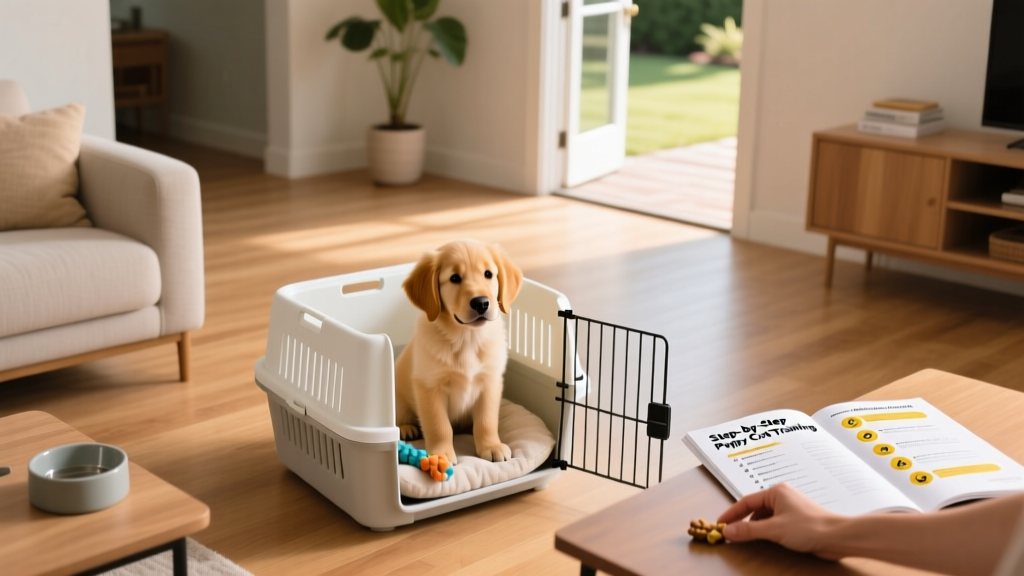
Crate training is essential for blue heelers. This breed thrives on structure, and a crate provides a safe den that prevents destructive behavior when unsupervised — and heelers left unsupervised as puppies will dismantle your home with impressive efficiency.
Start with a crate sized for the adult dog (36-inch length is standard for most blue heelers) but use the included divider panel to reduce the space to puppy-appropriate size. The puppy should be able to stand, turn around, and lie down comfortably — but not have enough room to eliminate in one corner and sleep in another.
| Puppy Age | Maximum Daytime Crate Time | Maximum Overnight Crate Time | Notes |
|---|---|---|---|
| 8–10 weeks | 30–60 minutes | 3–4 hours (then potty break) | Expect crying; place crate near your bed at night |
| 10–12 weeks | 1–1.5 hours | 4–5 hours | Begin feeding meals in crate with door open |
| 3–4 months | 2–3 hours | 5–6 hours | Introduce stuffed Kong for crate-time enrichment |
| 4–6 months | 3–4 hours | 7–8 hours | Can begin moving crate to a less central location |
| 6+ months | 4–5 hours maximum | 8 hours | No dog should regularly be crated more than 5 hours during the day |
Key crate training principles for blue heelers:
- Never use the crate as punishment. Blue heelers are sensitive dogs and will develop crate aversion quickly if it's associated with negative experiences.
- Exercise your puppy for 15–20 minutes before crating. A tired heeler puppy settles in the crate; a pent-up one will bark, whine, and attempt escape.
- If your puppy whines after being settled for 30+ minutes, take them out to potty (on leash, boring, no play), then return to crate. This teaches that whining gets a bathroom break, not playtime.
- Plan to transition out of the crate between 18–24 months, once your heeler has demonstrated reliable behavior when left alone. Many heelers do well with free-roaming once past adolescence, but some need crate access (with door open) as a permanent "safe space."
Common Blue Heeler Puppy Problems & Solutions
Blue heeler puppies come with a specific set of behavioral challenges that differ significantly from, say, a Labrador or Cavalier King Charles Spaniel puppy. Understanding the why behind these behaviors helps you address them effectively.
Nipping and Heel Biting
This is the number one complaint from blue heeler puppy owners, and it's entirely breed-typical. Heelers were bred to nip cattle heels to move them — your ankles, children's legs, and other pets' legs are simply cattle substitutes to their genetic programming.
Solution using positive reinforcement:
- When the puppy nips, say "ouch" in a calm, firm voice and immediately stop all movement and interaction (freeze like a statue for 10–15 seconds).
- Redirect to an appropriate chew toy. When they bite the toy, praise and engage in play.
- Provide an alternative herding outlet: a flirt pole (supervised, with ground-level chasing only to protect developing joints), herding balls (Jolly Ball brand), or structured "find it" scent games.
- Teach "leave it" and "drop it" starting at 10 weeks — these cues are essential for managing mouth-driven behavior.
- Manage the environment: if the puppy consistently nips children during running play, separate them during high-energy times and only allow calm, supervised interaction.
What NOT to do: Never hold the puppy's mouth shut, alpha-roll them, or use physical punishment. These methods damage trust and often escalate biting in a breed with a strong defensive bite response. Blue heelers respond to fairness and consistency — not force.
Excessive Barking and Vocalization
Heelers are vocal dogs. Puppies may bark at doorbells, passing cars, other dogs, wind in the trees, or simply because they're bored. This breed was developed to communicate with handlers across long distances, so vocalization is deeply embedded.
Solution: Teach a "quiet" cue by waiting for a natural pause in barking, saying "quiet," and immediately treating the silence. Gradually extend the silent duration before treating. Pair this with addressing the root cause — if they're barking from boredom, increase mental and physical exercise.
Destructive Chewing
A bored blue heeler puppy will chew baseboards, door frames, furniture legs, and shoes with remarkable determination. This is not spite — it's under-stimulation.
Solution: Provide minimum 30 minutes of structured physical exercise and 20 minutes of mental enrichment daily (puzzle feeders, training sessions, nosework games). Puppy-proof the home by removing accessible items and using bitter apple spray on furniture legs. Rotate chew toys every 2–3 days to maintain novelty.
Separation Anxiety Tendencies
Blue heelers bond intensely with their handlers and are predisposed to separation distress. Signs include following you from room to room, vocalizing when you leave, and destructive behavior concentrated near exit points.
Solution: Practice departures from day one. Leave the room for 30 seconds, return calmly. Gradually build to 5 minutes, 15 minutes, 30 minutes. Never make departures or arrivals emotional events. Provide a long-lasting enrichment item (frozen Kong) when you leave. If anxiety is severe (self-injury, non-stop vocalization for hours), consult a veterinary behaviorist — early intervention prevents lifelong anxiety disorders.
First-Year Cost Breakdown for a Blue Heeler Puppy
Budgeting accurately prevents surprises. Here's a realistic first-year cost range for a blue heeler puppy in the US, based on 2025–2026 pricing data from veterinary cost surveys and product averages.
| Category | Low Estimate | Medium Estimate | High Estimate |
|---|---|---|---|
| Puppy purchase (from responsible breeder) | $800 | $1,500 | $2,500 |
| Veterinary care (vaccines, wellness exams, spay/neuter, fecal tests, heartworm prevention) | $600 | $1,000 | $1,800 |
| Food (high-quality puppy kibble, 12 months) | $300 | $500 | $800 |
| Supplies (crate, bed, leash, harness, bowls, gates, chew toys, puzzle feeders) | $250 | $450 | $700 |
| Training (puppy class, basic obedience, possible private sessions for herding behaviors) | $150 | $400 | $1,200 |
| Emergency fund / unexpected illness (ear infections, GI upset, swallowed object) | $0 | $500 | $3,000 |
| Pet insurance (optional, annual premium) | $350 | $600 | $900 |
| TOTAL FIRST YEAR | $2,450 | $4,950 | $10,900 |
Cost notes: Pet insurance premiums are significantly lower when enrolled at 8–10 weeks (before any pre-existing conditions develop). For a medium-sized breed like the blue heeler, expect $30–75/month depending on deductible and coverage level. This can offset a single emergency surgery costing $2,000–$5,000.
If adopting from a rescue, the puppy purchase cost drops to $200–$500 (which often includes initial vaccines, spay/neuter, and microchip), bringing the realistic first-year total to approximately $1,500–$3,500 for a typical scenario.
Frequently Asked Questions
How often should I feed my blue heeler puppy at 10 weeks old?
At 10 weeks, feed 4 meals per day, approximately ¼ cup of high-quality puppy kibble per meal (¾ to 1 cup total daily). Space meals roughly 4 hours apart during waking hours — for example, 7 AM, 11 AM, 3 PM, and 7 PM. Consistent feeding times also create predictable potty schedules, since puppies typically need to eliminate 15–30 minutes after eating.
When will my blue heeler puppy be fully potty trained?
Most blue heeler puppies achieve reliable house training between 5 and 7 months of age with consistent scheduling. "Reliable" means fewer than one accident per month under normal conditions. Some individuals — particularly males — may have occasional marking-related accidents through 10–12 months. If your puppy is having frequent accidents past 6 months despite consistent scheduling, consult your veterinarian to rule out urinary tract infections or anatomical issues.
How do I stop my blue heeler puppy from nipping my children?
Management first: never leave a heeler puppy unsupervised with children under 12, and separate them during high-energy play (running, screaming triggers herding instinct). Teach children to freeze (not run or scream) when the puppy nips. Redirect the puppy to a tug toy or herding ball. Enroll in a positive-reinforcement puppy class where you can practice "leave it" and impulse control exercises around movement triggers. Consistency from all family members is critical — if one person allows nipping during play, the puppy will continue the behavior with everyone.
When can my blue heeler puppy attend group training classes?
Most puppy socialization classes accept puppies starting at 10–12 weeks, provided they've received their first DHPP vaccine at least 7 days prior. The AVMA and the American Veterinary Society of Animal Behavior both support early socialization classes in clean, controlled environments because the behavioral benefits outweigh the minimal disease risk. Look for classes that require proof of vaccination, use positive reinforcement methods only, and limit class size to 6–8 puppies.
My blue heeler puppy won't stop barking in the crate at night. What do I do?
First, ensure the puppy has been exercised, has had a potty break immediately before crating, and has a comfort item (a safe chew toy or a blanket that smells like you). If the puppy cries after settling, wait 5–10 minutes before responding — brief vocalization during the adjustment period is normal. If crying persists beyond 15–20 minutes, take them out on leash for a boring potty break (no play, no talking), then return to crate. If the puppy is newly home (first 3–5 nights), placing the crate next to your bed where they can smell and hear you significantly reduces distress. Gradually move the crate to its permanent location over 1–2 weeks.
Should I get pet insurance for my blue heeler puppy?
Yes, enrolling at 8–10 weeks is strongly recommended. Blue heelers are generally healthy, but they're predisposed to hip dysplasia (estimated 10–15% prevalence), progressive retinal atrophy (PRA), and deafness (particularly in puppies with excessive white markings). These conditions often don't appear until 1–3 years of age but can cost $1,500–$6,000 to diagnose and treat. Insurance enrolled before any symptoms develop ensures coverage. Compare plans from at least 3 providers and look for policies with no breed-specific exclusions and annual limits of at least $10,000.
Raising a blue heeler puppy is demanding but deeply rewarding. These dogs form extraordinary bonds with their handlers and excel in nearly every dog sport and working role you can imagine. The effort you invest in structured socialization, consistent training, and appropriate outlets for their herding drive during the first year pays dividends for the next 12–15 years of your dog's life. Stay patient, stay consistent, and don't hesitate to consult a certified positive-reinforcement trainer or your veterinarian when challenges arise.
Aaron Whyte
All our authors care for dogs every day — read more of their work on the authors page.