Blood in Puppy Faeces: What Every New Puppy Owner Needs to Know
Spotting blood in puppy faeces is alarming. Learn the causes, when to panic vs.

Finding blood in your puppy's faeces is one of those moments that stops a new dog owner cold. Your heart drops, your mind races, and you immediately wonder: Is this an emergency?
The honest answer is that it depends. Blood in puppy stool ranges from a minor digestive upset to a life-threatening infection like parvovirus. Because puppies have immature immune systems and tiny bodies that dehydrate fast, you need to know exactly what to look for — and when to call the vet immediately versus when to monitor at home.
This guide breaks down the causes of bloody stool in puppies, what the colour and consistency tell you, and pairs that critical health knowledge with a complete puppy care timeline so you know what's normal at every stage of development.
Understanding Blood in Puppy Faeces: Colours, Causes, and Urgency
Not all blood in stool looks the same, and the appearance tells you where the bleeding originates — which directly affects urgency.
| Blood Appearance | Medical Term | Origin | Common Causes in Puppies | Urgency Level |
|---|---|---|---|---|
| Bright red, fresh blood on surface | Haematochezia | Lower GI (colon, rectum) | Stress colitis, parasites (hookworms, whipworms), food intolerance, anal gland irritation | Monitor → Vet within 24-48 hours if it persists |
| Dark, tarry, black stool | Melena | Upper GI (stomach, small intestine) | Parvovirus, swallowed blood (nosebleed, oral injury), NSAID toxicity, severe parasite burden | EMERGENCY — Call vet now |
| Streaks of blood in soft/mucoid stool | Haematochezia with mucus | Colon inflammation | Dietary change stress, giardia, coccidia, bacterial overgrowth | Vet within 24 hours (bring stool sample) |
| Bloody diarrhoea with vomiting | Haemorrhagic gastroenteritis (HGE) | Entire GI tract | Parvovirus, HGE syndrome, toxin ingestion, severe parasitism | EMERGENCY — Immediate vet visit |
The Big Threat: Parvovirus
Canine parvovirus (CPV) is the reason every puppy owner should take bloody stool seriously. According to the American Kennel Club, parvo has a mortality rate of up to 91% in untreated puppies. The classic presentation includes:
- Profuse, bloody diarrhoea with a distinctive foul odour
- Vomiting (often before diarrhoea begins)
- Severe lethargy — puppy won't play or respond normally
- Loss of appetite within 24-48 hours of exposure
- Fever (above 104°F / 40°C) or hypothermia in late stages
Parvo incubates for 3-7 days after exposure. Puppies between 6 weeks and 6 months are most vulnerable, especially those who haven't completed their DHPP vaccination series. If your puppy has bloody stool and any combination of vomiting, lethargy, or appetite loss, treat it as an emergency.
Less Alarming (But Still Important) Causes
If your puppy is otherwise acting normal — eating, playing, and energetic — a small amount of bright red blood may be caused by:
- Stress colitis: Moving to a new home, diet changes, or travel can inflame the colon. This is extremely common in the first week after bringing a puppy home.
- Intestinal parasites: Hookworms and whipworms attach to the intestinal lining and cause bleeding. The Merck Veterinary Manual notes that hookworms can cause significant blood loss in puppies, leading to anaemia.
- Dietary indiscretion: Puppies eat everything. A swallowed stick fragment, grass, or foreign material can irritate the lower GI tract.
- Food transition too fast: Switching kibble brands without a 7-10 day gradual transition commonly causes loose, blood-streaked stool.
Bringing Your Puppy Home: Age, Timing, and the First 48 Hours
When should I bring my puppy home? The ideal age is 8-10 weeks for most breeds. Puppies separated from their mother and littermates before 8 weeks miss critical socialisation and bite-inhibition learning. Some toy breeds (Chihuahuas, Yorkshire Terriers) benefit from staying with the breeder until 10-12 weeks due to vulnerability to hypoglycaemia.
The First 48 Hours: Minimising Stress Colitis
Since stress colitis is a leading cause of blood in puppy faeces during the first week home, here's how to reduce GI upset:
- Feed the exact same food the breeder or shelter was using for at least 7 days. Ask for a bag of the current food or buy the same brand/formula.
- Limit visitors to immediate household members for the first 3-4 days.
- Set up a confined space (exercise pen or single room) rather than full-house access immediately.
- Add a probiotic: A veterinary-formulated probiotic like Purina FortiFlora or Proviable-DC ($15-$30 for a 30-day supply) can stabilise gut flora during transitions.
- Keep a stool log for the first week: note time, consistency (1-7 scale, where 1 is hard pellets and 7 is liquid), colour, and any blood or mucus.
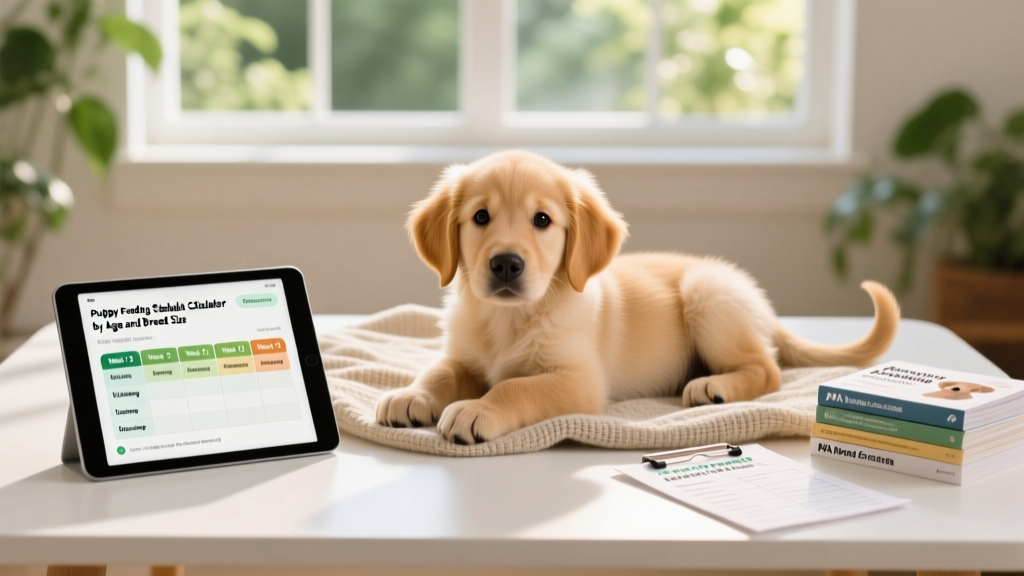
Puppy Feeding Schedule: Portions by Age and Weight
How often should I feed my puppy at each age? Puppies need frequent, measured meals — free-feeding leads to obesity and makes potty training nearly impossible. Here's a framework based on AAFCO growth-stage requirements:
| Puppy Age | Meals Per Day | Portion Guide (Small Breed 10-25 lb adult) | Portion Guide (Medium Breed 25-55 lb adult) | Portion Guide (Large Breed 55-100+ lb adult) |
|---|---|---|---|---|
| 6-12 weeks | 4 meals/day | ¼ - ½ cup per meal | ½ - ¾ cup per meal | ¾ - 1¼ cups per meal |
| 3-6 months | 3 meals/day | ⅓ - ⅔ cup per meal | ¾ - 1 cup per meal | 1 - 2 cups per meal |
| 6-12 months | 2 meals/day | ½ - ¾ cup per meal | 1 - 1½ cups per meal | 2 - 3 cups per meal |
Critical note for large breeds: Feed a food specifically labelled for "large breed growth" or "large breed puppy." These formulas restrict calcium and phosphorus ratios to reduce the risk of developmental orthopaedic diseases like hip dysplasia. The AVMA recommends checking the AAFCO statement on the bag to confirm the food is appropriate for growth.
Food Transition Protocol (To Avoid Bloody Stool)
When switching foods — whether upgrading brands or moving from puppy to adult formula at 10-12 months — follow this 10-day schedule:
- Days 1-3: 75% old food + 25% new food
- Days 4-6: 50% old food + 50% new food
- Days 7-9: 25% old food + 75% new food
- Day 10: 100% new food
If you see soft stool or streaks of blood during the transition, slow down. Extend each phase to 4-5 days instead of 3.
Vaccination Schedule: What Your Puppy Needs and When
What vaccines does my puppy need and when? Core vaccines follow a strict timeline because maternal antibodies (passed from the mother) gradually wane, leaving windows of vulnerability. Here's the standard schedule recommended by the American Animal Hospital Association (AAHA):
| Age | Vaccine | What It Protects Against | Estimated Cost |
|---|---|---|---|
| 6-8 weeks | DHPP (1st dose) | Distemper, Hepatitis (Adenovirus), Parainfluenza, Parvovirus | $20-$40 |
| 10-12 weeks | DHPP (2nd dose) + Bordetella | Booster + Kennel Cough | $30-$55 |
| 14-16 weeks | DHPP (3rd dose) + Rabies | Final puppy booster + Rabies (legally required) | $35-$65 |
| 12-16 weeks (optional) | Leptospirosis, Lyme, Canine Influenza | Lifestyle-dependent; discuss with vet based on your area | $25-$45 each |
The Critical Socialisation Window: Weeks 3-14
The American Veterinary Society of Animal Behaviour (AVSAB) states that the primary socialisation period for puppies closes around 12-14 weeks. Missing this window doesn't mean your dog is doomed — but it does mean you'll work much harder to build confidence later.
When can my puppy go outside and meet other dogs? You can begin controlled socialisation before vaccines are complete. The key is controlled environments with known, vaccinated dogs — not public dog parks.
Socialisation Exposure Checklist
- ☐ Walk on 5 different surfaces (grass, gravel, tile, carpet, metal grate)
- ☐ Hear 10+ household sounds (vacuum, doorbell, hair dryer, thunder recording at low volume)
- ☐ Meet 10+ people of varying ages, sizes, and appearances (children, elderly, people wearing hats/glasses)
- ☐ Play with 3-5 known, fully vaccinated, friendly adult dogs
- ☐ Experience gentle handling of paws, ears, mouth, and tail (prep for grooming and vet exams)
- ☐ Ride in a car for short trips (2-5 minutes, building to 15+ minutes)
- ☐ Visit the vet clinic for a "happy visit" — just treats and praise, no shots
- ☐ Encounter a person in a uniform, a person using a mobility aid, a person carrying a large object
- ☐ See an umbrella open, a plastic bag blowing in wind, a bicycle passing
- ☐ Spend 5-10 minutes alone in a safe space (builds independence, reduces separation anxiety)
Each positive exposure should be paired with high-value treats (small pieces of boiled chicken, cheese, or commercial training treats like Zuke's Mini Naturals). If your puppy shows fear, increase distance from the stimulus and let them observe — never force interaction.
Potty Training Timeline: Realistic Expectations
When will my puppy be fully potty trained? Most puppies achieve reliable house training between 4-6 months of age, with some smaller breeds taking until 8-9 months due to smaller bladder capacity. Anyone promising "potty trained in 3 days" is selling something.
Bladder Capacity by Age
A general guideline: puppies can hold their bladder for approximately 1 hour per month of age, plus one. So a 3-month-old puppy can hold it roughly 4 hours — but that's a maximum, not a target. For successful training, take them out far more frequently:
| Age | Max Hold Time | Recommended Outing Frequency | Nighttime Expectation |
|---|---|---|---|
| 8-10 weeks | 1-2 hours | Every 30-60 minutes when awake | 2-3 overnight wake-ups expected |
| 10-14 weeks | 2-3 hours | Every 1-2 hours when awake | 1-2 overnight wake-ups |
| 3-4 months | 3-4 hours | Every 2-3 hours | 0-1 overnight wake-ups |
| 4-6 months | 4-6 hours | Every 3-4 hours | Sleeping through the night (8 hours) |
Potty Training Troubleshooting
If accidents are increasing: Rule out a urinary tract infection (common in puppies; vet visit + urinalysis, ~$40-$80) or parasites causing diarrhoea that the puppy can't control.
If your puppy only goes in the crate: The crate may be too large. Puppies instinctively avoid soiling their sleeping area — but only if the space is den-sized. Use a divider to limit the crate to just enough room to stand, turn around, and lie down.
If regression happens at 4-6 months: This coincides with the adolescent fear period and increased independence. Return to basics: more frequent outings, higher-value treats for outdoor elimination, and zero punishment for indoor accidents (punishment teaches puppies to hide when they need to go).
Age-Specific Milestones: What to Expect Month by Month
Weeks 4-8 (Still with Breeder/Mother)
During this period, puppies learn bite inhibition from littermates, begin eating solid food (gruel → soft kibble), receive their first deworming (typically pyrantel pamoate at 2, 4, and 6 weeks), and start exploring beyond the whelping box. If you're evaluating a breeder, confirm they've begun early neurological stimulation (ENS) and introduced varied textures and sounds.
Weeks 8-12 (Home Transition)
This is the bonding and bonding period. Expect clingy behaviour, nighttime crying, and the stress-related digestive issues mentioned above. Key milestones:
- Learn their name (responds within 3-5 days with consistent use + treats)
- Begin crate training (see progression below)
- First vet visit within 48-72 hours of homecoming
- Start handling exercises: touch paws, look in ears, open mouth gently
Weeks 12-16 (Confidence Building)
Puppies become bolder and more exploratory. The fear impact period (typically 8-11 weeks) is ending, and your puppy is more resilient to novel experiences. Key milestones:
- Can begin short leash walks (5 minutes per month of age, twice daily — so 15 minutes at 3 months)
- Start basic cue training: sit, down, come, name recognition (5-minute sessions, 2-3x daily)
- Begin supervised interactions with vaccinated dogs in controlled settings
- Teething discomfort begins — see teething section below
Weeks 16-24 (Adolescent Energy)
Your puppy has most or all vaccinations complete, meaning the world opens up. But adolescent energy and testing boundaries also emerge:
- Can attend group puppy classes (after final DHPP booster + 1 week)
- Exercise increases to 20-30 minute walks, plus mental enrichment (snuffle mats, frozen Kongs)
- May "forget" previously learned cues — this is normal; continue consistent training
- Second fear period may occur around 6-14 months
Months 6-12 (Approaching Adulthood)
Physical growth slows (small breeds may be near full size; large breeds continue growing until 18-24 months). Spay/neuter is typically performed between 6-12 months depending on breed size — discuss timing with your vet, as large breeds may benefit from waiting until 12-18 months for orthopaedic health. Transition to adult food at 10-12 months for small/medium breeds, 12-18 months for large breeds.
Crate Training Progression: Time Limits by Age
Crate training is one of the most effective tools for potty training and preventing destructive behaviour — but over-crating causes distress and can worsen the very problems you're trying to solve.
| Age | Max Daytime Crate Duration | Max Nighttime Duration | Training Notes |
|---|---|---|---|
| 8-10 weeks | 30-60 minutes | 2-3 hours (then potty break) | Feed meals in crate; toss treats inside; never use crate as punishment |
| 11-14 weeks | 1-2 hours | 3-4 hours | Begin closing door for short periods while you're visible |
| 15-16 weeks | 2-3 hours | 5-6 hours | Practice leaving the room; return before puppy panics |
| 4-6 months | 3-4 hours | 7-8 hours | Provide a frozen Kong or safe chew for longer stretches |
Important: No puppy or adult dog should be crated for more than 8 hours total during a workday without a midday break. If you work long hours, arrange a dog walker or use an exercise pen with a potty area for absences exceeding your puppy's crate limit.
Teething Timeline: Months 3-6
Puppies have 28 deciduous (baby) teeth that begin erupting at 3-4 weeks and are fully in by 6-8 weeks. Starting around 12-16 weeks, these are replaced by 42 permanent teeth. The teething process causes:
- Increased chewing and mouthing
- Bleeding gums (you may find small blood spots on chew toys — this is normal)
- Temporary appetite reduction if gums are sore
- Finding baby teeth on the floor (though many puppies swallow them — also normal and harmless)
Safe Teething Relief Strategies
- Frozen wet washcloth: Wet a clean washcloth, twist into a rope, freeze for 2 hours. Supervise use and discard if threads come loose.
- Kong Classic (puppy rubber, pink/blue): Fill with plain pumpkin purée or soaked kibble and freeze. The puppy-sized Kong ($8-$12) is appropriate for 8-16 week puppies.
- Benebone Puppy or Nylabone Puppy Chew: Designed for softer baby teeth; replace once teeth are fully adult (around 6-7 months) to avoid dental fractures from overly hard chews.
- Carrots (whole, raw): A large whole carrot is a low-calorie, edible chew that most puppies enjoy. Supervise to prevent choking on broken pieces.
Avoid: Ice cubes (can fracture teeth), rawhide (choking and blockage risk), antlers or weight-bearing bones (too hard for puppy teeth), and any chew smaller than your puppy's mouth.
Common Puppy Problems and Solutions
Puppy Biting and Nipping
How do I stop puppy biting/nipping? Puppies explore the world with their mouths, and littermates teach them bite inhibition through yelping and disengaging. You can replicate this:
- When teeth touch skin, say "ouch" in a calm, slightly high-pitched tone.
- Immediately withdraw attention: stand up, turn away, or step behind a baby gate for 10-15 seconds.
- Return and redirect to an appropriate chew toy.
- Repeat consistently. Most puppies significantly reduce mouthing by 5-6 months as adult teeth come in and they learn boundaries.
Never hold a puppy's mouth shut, push fingers into their throat, or use physical punishment. These methods increase fear and can escalate biting behaviour. If biting is intense, persistent past 6 months, or accompanied by growling and stiffening, consult a certified professional dog trainer (CPDT-KA) or veterinary behaviourist.
Nighttime Whining
Crate whining in the first 1-2 weeks is normal. To differentiate distress from learned behaviour:
- If it's been less than 2 hours since last potty break: Wait 5-10 minutes to see if puppy self-settles. Reward silence with calm praise or a treat dropped through the crate.
- If it's been more than 2-3 hours: Take puppy out on leash, no play, boring potty trip, then back in crate.
- Cover the crate with a breathable blanket to reduce visual stimulation.
- Place a Snuggle Puppy ($25-$40) with a heartbeat simulator and heat pack in the crate — these mimic littermate warmth and significantly reduce first-week crying for many puppies.
Destructive Chewing
Puppies chew most intensely between 3-6 months (teething) and again during adolescence (6-12 months). Management is more effective than correction:
- Provide 5-8 appropriate chew options of varying textures
- Rotate toys weekly to maintain novelty
- Use bitter apple spray ($8-$12) on furniture legs and baseboards as a deterrent
- Supervise or confine — unsupervised puppies will find something expensive to destroy
First-Year Cost Breakdown: Budgeting for Your Puppy
New puppy owners consistently underestimate first-year costs. Here's a realistic breakdown based on 2026 pricing:
| Category | Low Estimate | Medium Estimate | High Estimate | Notes |
|---|---|---|---|---|
| Puppy purchase/adoption | $200 (rescue) | $1,500 (responsible breeder) | $3,500+ (specialty breed) | Adoption fees typically include initial vaccines + spay/neuter |
| Veterinary (vaccines, wellness, spay/neuter) | $400 | $700 | $1,200 | Spay/neuter: $200-$600 depending on size and clinic |
| Food (puppy formula, 10-12 months) | $250 | $500 | $900 | Large breeds eat significantly more; premium brands cost $60-$90/bag |
| Supplies (crate, bed, bowls, leash, collar, toys) | $150 | $300 | $500 | Wire crate: $40-$80; quality bed: $30-$80 |
| Training (group classes, private sessions) | $100 | $300 | $800 | Group puppy class: $100-$200 for 6 weeks |
| Preventive medications (flea/tick, heartworm) | $150 | $300 | $450 | NexGard, Simparica Trio, Heartgard: $15-$30/month |
| Pet insurance (optional but recommended) | $300/year | $500/year | $800/year | Enrol before any conditions develop; puppies get best rates |
| TOTAL FIRST YEAR | $1,550 | $4,100 | $8,150+ | Does not include emergency vet visits ($500-$5,000+) |
When to Call the Vet About Blood in Puppy Faeces
🚨 Call Your Vet Immediately If:
- Bloody diarrhoea accompanied by vomiting
- Puppy is lethargic, won't play, or seems "off"
- Refusal to eat or drink for more than 12 hours
- Dark, tarry black stool (melena)
- Large volume of blood (more than a few streaks)
- Fever above 103.5°F (39.7°C) — use a rectal thermometer
- Pale gums (lift the lip — gums should be bubblegum pink, not white or grey)
- Puppy is under 12 weeks and has not completed vaccinations
ASPCA Animal Poison Control: (888) 426-4435 (24/7, consultation fee applies) — call if you suspect your puppy ingested a toxic substance (rat poison, human medications, toxic plants) that could cause GI bleeding.
If your puppy has a small streak of bright red blood in an otherwise normal stool, is acting completely normal, eating well, and playing — monitor for 24-48 hours. Collect a stool sample and schedule a non-urgent vet visit to check for parasites. Most cases of mild haematochezia in an otherwise healthy puppy resolve with deworming, a probiotic, or a dietary adjustment.
Frequently Asked Questions
Can stress alone cause blood in my puppy's stool?
Yes. Stress colitis is one of the most common causes of blood-streaked stool in puppies, particularly in the first week after coming home. The inflammation is usually mild and self-limiting. Adding a veterinary probiotic and maintaining a calm, predictable routine typically resolves it within 3-5 days. If blood persists beyond a week or is accompanied by other symptoms, see your vet.
My puppy just had vaccines — is bloody stool a side effect?
Mild GI upset (soft stool, slight appetite reduction) can occur for 24-48 hours after vaccination. Visible blood is not a typical vaccine reaction and warrants a call to your vet. In rare cases, a vaccine reaction can cause more serious symptoms — if you see facial swelling, hives, vomiting, or difficulty breathing, seek emergency care immediately.
Should I change my puppy's food if I see blood in their stool?
Not immediately. First, rule out parasites (faecal test at the vet) and infections. If those are clear, your vet may recommend a bland diet (boiled chicken and white rice, 1:2 ratio) for 3-5 days to let the gut rest. If the issue recurs with the current food, a transition to a limited-ingredient or novel protein diet may help — but do this gradually over 10 days, not overnight.
How do I know if my puppy has worms?
Visible worms in stool (look like white rice grains or spaghetti strands) are a clear sign, but many parasites are microscopic. Hookworms and whipworms cause bloody stool but are invisible to the naked eye. A faecal flotation test at your vet ($25-$50) is the only reliable way to diagnose. Puppies should be dewormed every 2 weeks from 2-8 weeks of age, then monthly until 6 months.
Is it safe to give my puppy Pepto-Bismol for bloody stool?
No. Pepto-Bismol contains bismuth subsalicylate, which is related to aspirin and can be toxic to dogs, especially puppies. It also turns stool black, which masks melena and makes it harder for your vet to assess the situation. Never give OTC human medications to a puppy without explicit veterinary direction.
Priya Sutaria
All our authors care for dogs every day — read more of their work on the authors page.