How to Stop Puppy From Barking: A Breed-Specific Guide by Age & Stage
Learn how to stop puppy from barking with age-specific training milestones, socialization checklists, feeding schedules, and potty training timelines for every stage.

Every puppy barks — it's their primary way of communicating needs, excitement, fear, and frustration. But when that barking escalates into constant yapping, demand-barking at 5 a.m., or frantic vocalization the moment you leave the room, it becomes a serious quality-of-life issue for you and your neighbors. The good news? Barking is almost always manageable when you understand why your puppy is vocalizing and match your response to their developmental stage.
This guide breaks down how to stop puppy barking at every age milestone — from the moment you bring them home through adolescence — while also covering the foundational care (feeding, vaccines, potty training, socialization) that prevents barking from becoming a chronic behavior in the first place.
When Should I Bring My Puppy Home? (And Why It Affects Barking)
The single biggest mistake new owners make — and one that directly fuels excessive barking — is bringing a puppy home too early. Puppies should remain with their litter until 8 to 10 weeks of age. Here's why this matters for barking specifically:
- Weeks 3-5: Puppies learn bite inhibition and vocal feedback from littermates. A puppy that yelps too loudly or too often gets corrected by siblings and mother.
- Weeks 5-8: Critical period for learning "off-switch" behavior — the ability to settle after stimulation. Puppies removed before this window closes tend to have higher arousal baselines, meaning they bark more readily at lower thresholds.
- Weeks 8-10: Puppies develop early emotional regulation. Those separated at 6-7 weeks show significantly higher rates of separation-related vocalization, according to research published in the Journal of Veterinary Behavior.
If you've already brought home a puppy under 8 weeks (rescue situations sometimes require this), expect to invest extra effort in teaching quiet-settling behaviors and be patient with nighttime crying.
Age-Specific Milestones: What to Expect From Week 4 Through Month 12
Understanding your puppy's developmental stage is essential for knowing which barking triggers are normal and how to address them. Here's a detailed timeline:
| Age Range | Developmental Stage | Barking Behavior to Expect | Your Response Strategy |
|---|---|---|---|
| 4-8 weeks | Socialization period begins; littermate play peaks | Play barks, distress cries when separated from litter | Not applicable if with breeder — this is where they learn vocal modulation |
| 8-12 weeks | Fear imprint period (8-11 weeks); strong attachment forming | Separation distress barking (especially nights/crate), alert barking at new sounds | Graduated alone-time protocol; white noise; never reward demand-barking with attention |
| 12-16 weeks | Fear period often ends; confidence building; teething begins | Excitement barking during play, frustrated barking when denied access to things | Teach "quiet" cue using capture method; redirect to chew toys; reinforce calm behavior |
| 16-24 weeks | Social maturity developing; testing boundaries; teething peaks | Demand barking for food/toys/attention; barking at visitors/delivery drivers | Consistent ignoring of demand barking; "sit to say please" protocol; desensitize to door triggers |
| 6-12 months | Adolescence; secondary fear period (6-14 months); hormonal changes if intact | Territorial/alarm barking; leash reactivity barking; possible regression in trained behaviors | Counter-conditioning for triggers; increase mental enrichment; consider group training class |
How Often Should I Feed My Puppy at Each Age?
Hunger-driven barking and whining is one of the most common — and most easily fixed — vocalization triggers. Puppies with inconsistent feeding schedules or insufficient caloric intake will bark persistently, especially in the early morning and late evening. Here's a precise feeding framework:
| Puppy Age | Meals Per Day | Small Breed (under 20 lb adult) Cups/Day | Medium Breed (20-50 lb adult) Cups/Day | Large Breed (50+ lb adult) Cups/Day |
|---|---|---|---|---|
| 8-12 weeks | 4 meals | ½ – ¾ cup | 1 – 1½ cups | 1½ – 2½ cups |
| 3-6 months | 3 meals | ¾ – 1 cup | 1½ – 2¼ cups | 2½ – 4 cups |
| 6-12 months | 2 meals | ¾ – 1¼ cups | 2 – 3 cups | 3½ – 5 cups |
Key tip: Use an AAFCO-certified puppy food (look for the statement "formulated for growth" on the label). For large and giant breeds, choose a food specifically labeled for "large breed growth" to support proper skeletal development. Measure portions with a standard 8 oz measuring cup — "a handful" or "a bowl" leads to over- or underfeeding, both of which can drive food-related barking.
If your puppy barks intensely 30-60 minutes before meals, they may benefit from a slow-feeder bowl or a frozen Kong stuffed with their measured kibble and a small amount of plain pumpkin (no spices or added sugar). This extends feeding time and provides a calming outlet.
Potty Training Timeline: Realistic Expectations and Barking Connections
A puppy that needs to eliminate will bark, whine, pace, or scratch at doors. Many owners mistake this for "random" barking and scold the puppy — which teaches them to suppress the signal rather than communicate their need, leading to indoor accidents and increased anxiety-driven vocalization.
Here's a realistic potty training progression:
- 8-12 weeks: Bladder capacity is approximately 1 hour per month of age plus 1. A 2-month-old puppy can hold for roughly 2-3 hours maximum. Expect 15-20 potty trips per day. Accidents are guaranteed — your job is management, not perfection.
- 12-16 weeks: Bladder control improves. Puppy may begin signaling (barking at the door, circling). This is the window to actively teach a door-bell or door-scratch signal using positive reinforcement.
- 16-24 weeks: Most puppies can hold 4-5 hours during the day. Nighttime holding extends to 6-7 hours for many breeds. Accidents drop significantly if you've maintained a consistent schedule.
- 6-12 months: Full bladder control typically achieved by 6-8 months for medium and large breeds, 8-10 months for small and toy breeds (their bladders are proportionally smaller).
- If your puppy barks in the crate at night: Take them out immediately on leash, stand in one spot for 3-5 minutes with zero interaction. If they eliminate, praise calmly and return to crate. If they don't, return to crate and try again in 30 minutes. This teaches "bark = boring potty trip," not "bark = playtime."
- If your puppy barks at the door constantly: They may be confused about the signal. Teach one clear signal (bell, scratch, or sitting at the door) and only respond to that signal. Ignore other door-barking.
- If accidents persist past 6 months: Consult your veterinarian. Urinary tract infections, anatomical issues, and diabetes can all cause house-soiling that no amount of training will fix.
The Critical Socialization Window (Weeks 3-14): Your Anti-Barking Insurance Policy
The American Veterinary Society of Animal Behavior states that the primary socialization period for puppies closes between 12 and 14 weeks of age. Puppies that don't receive adequate positive exposure during this window are significantly more likely to develop fear-based barking, territorial barking, and leash reactivity later in life.
This is not optional enrichment. This is a developmental requirement. Here's your exposure checklist:
- ☐ At least 10 different people of varying ages, ethnicities, and appearances (hats, sunglasses, beards, wheelchairs, walkers)
- ☐ 5+ children of different ages (supervised, calm interactions only — no grabbing or chasing)
- ☐ 5+ friendly, vaccinated adult dogs of different sizes and breeds
- ☐ Exposure to: vacuum cleaners, doorbells, knock sounds, sirens, thunder recordings, clapping, pots banging
- ☐ Surfaces: grass, gravel, metal grates, wet pavement, sand, carpet, tile
- ☐ Handling: ear touching, paw handling, mouth opening, nail clipping practice, collar/harness on/off
- ☐ Environments: car rides, parking lots, outdoor café patios, friend's houses, pet-friendly stores
- ☐ Objects: umbrellas opening, plastic bags rustling, brooms, bicycles, skateboards, strollers
- ☐ Grooming tools: brush, comb, nail clippers, toothbrush — paired with treats
- ☐ Alone time: 5-30 minutes alone in a safe space, building gradually (prevents separation-related barking)
How this prevents barking: A puppy who has heard a doorbell 50 times paired with treats before week 14 will not lose their mind barking when the doorbell rings at 8 months old. A puppy who has met bearded men in hats while receiving chicken will not bark fearfully at delivery drivers. You are literally building a neurological buffer against future reactivity.
Important safety note: Before your puppy has completed their DHPP vaccine series (typically around 16 weeks), avoid high-risk areas like dog parks and pet store floors. Instead, carry your puppy in a sling or stroller for environmental exposure, and arrange playdates with known-vaccinated dogs in private yards. The AVMA supports this balanced approach to early socialization.
Vaccination Schedule: What Your Puppy Needs and When
A sick puppy is a stressed puppy, and stressed puppies bark more. Staying on schedule with vaccinations also ensures your puppy can safely access the socialization experiences that prevent fear-based barking. Here's the standard puppy vaccine protocol:
| Age | Vaccines Administered | Notes | Estimated Cost |
|---|---|---|---|
| 6-8 weeks | DHPP (Distemper, Hepatitis/Adenovirus, Parainfluenza, Parvovirus) | First dose; often given by breeder or rescue | $25-$50 |
| 10-12 weeks | DHPP booster; Bordetella (kennel cough); Leptospirosis (risk-dependent) | Bordetella recommended if attending puppy classes or boarding | $40-$75 |
| 14-16 weeks | DHPP final booster; Rabies (required by law); Leptospirosis booster if started | Rabies vaccine timing varies by state — some require 12 weeks, others 16 | $45-$85 |
| 12-16 months | DHPP booster; Rabies booster (1-year or 3-year depending on vaccine type) | Some vets recommend titer testing instead of automatic DHPP boosters | $50-$100 |
Always consult your veterinarian to determine the right vaccination protocol for your puppy based on your geographic area, lifestyle, and local disease prevalence. Core vaccines (DHPP and Rabies) are recommended for all puppies. Non-core vaccines (Bordetella, Leptospirosis, Lyme, Canine Influenza) depend on risk factors your vet will assess.
Teething Timeline (3-6 Months): Relief Strategies That Also Reduce Barking
Teething puppies bark and whine more because their mouths literally hurt. The discomfort of adult teeth pushing through inflamed gums creates irritability, increased chewing (including on you), and general fussiness. Understanding the timeline helps you prepare:
- 3-4 months: Deciduous (baby) incisors begin loosening. You may find tiny teeth on the floor. Puppy starts chewing more intensely.
- 4-5 months: Canines and premolars erupt. This is peak discomfort. Expect the most mouthing, nipping, and irritable barking during this window.
- 5-6 months: Adult teeth mostly in. Molars erupting in the back. Chewing remains high but gum sensitivity decreases.
- 6-7 months: Full adult dentition (42 teeth). If any baby teeth remain ("retained deciduous teeth"), your vet may need to extract them — common in small breeds.
Safe teething relief options:
- Frozen Kong toys stuffed with plain yogurt or mashed banana (supervised only — remove if pieces break off)
- Wet washcloth twisted into a rope shape and frozen (supervise to prevent swallowing fabric)
- Benebone Puppy or Nylabone Puppy Chew — specifically the puppy-formula versions, which are softer than adult chews
- Chilled (not frozen) carrot sticks for puppies over 12 weeks — a natural, low-calorie option
- Ice cubes made from low-sodium bone broth (no onion, no garlic)
Crate Training Progression: Time Limits and Barking Management
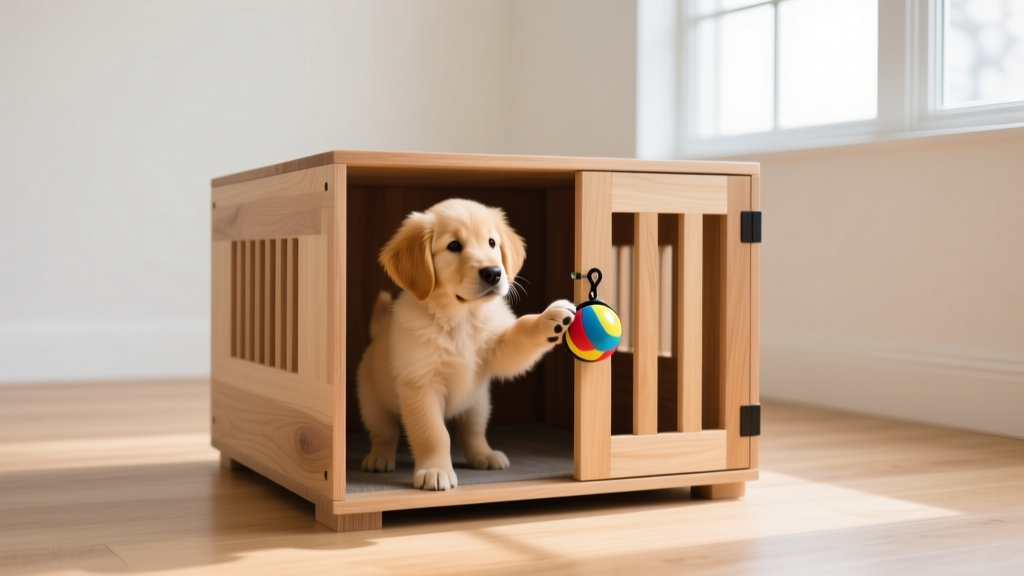
The crate is one of your most powerful tools for reducing barking — but only if introduced correctly. A puppy that views the crate as a safe den will settle quietly. A puppy that views it as punishment or isolation will bark, howl, and escalate. Here's the progression:
| Puppy Age | Maximum Daytime Crate Duration | Maximum Nighttime Duration | Barking Protocol |
|---|---|---|---|
| 8-10 weeks | 30-60 minutes | 2-3 hours (then potty break) | Cover crate; place near your bed; white noise machine; treat for quiet |
| 10-14 weeks | 1-2 hours | 3-4 hours | Move crate gradually to permanent location; practice short departures |
| 14-16 weeks | 2-3 hours | 5-6 hours | Only release when quiet for 10+ seconds; never open crate during barking |
| 4-6 months | 3-4 hours | 7-8 hours | Introduce "place" command as alternative to crate for daytime settling |
The golden rule of crate barking: Never, ever let your puppy out while they are actively barking. This is the single most common mistake that teaches puppies "barking opens the door." Instead, wait for even a brief pause — 3 seconds of silence — then open the door. Gradually extend the required silence to 10 seconds, then 30 seconds, then a full minute.
How Do I Stop Puppy Biting and Nipping? (The Barking-Biting Connection)
Puppy biting and barking often occur together because both are expressions of high arousal. A puppy that's overstimulated will bark, bite, jump, and spin — a cluster of behaviors that owners often try to address separately when they actually share the same root cause: the puppy hasn't learned to self-regulate.
Here's the protocol:
- Redirect, don't punish. When puppy teeth touch skin, say "oops" in a neutral tone and immediately offer an appropriate chew toy. This teaches "teeth on human = toy appears," not "teeth on human = scary reaction."
- Time-outs for escalation. If redirecting doesn't work within 3 attempts, calmly pick up the puppy and place them in a small playpen or behind a baby gate for 30-60 seconds. This is not punishment — it's a neurological reset. Puppies in high arousal literally cannot process new information. The brief break allows their nervous system to down-regulate.
- Enforced naps. Much puppy biting and barking between 4-8 pm is overtiredness, not misbehavior. Puppies need 18-20 hours of sleep per day. If your puppy has been awake for more than 2 hours, they need a nap — crate them or put them in their pen with a chew toy. Most will fall asleep within 5 minutes.
- Bite inhibition training. Allow gentle mouthing (no pressure) during calm play. When you feel pressure, yelp softly ("ow!") and withdraw your hand for 3 seconds. Resume play. This mimics littermate feedback and teaches the puppy to control jaw pressure — a critical safety skill.
When Can My Puppy Go Outside and Meet Other Dogs?
This question comes up constantly, and the answer balances disease risk against the closing socialization window. Here's the practical framework:
- Immediately (8+ weeks): Carry your puppy in a sling or stroller to expose them to outdoor sights, sounds, and surfaces. Private yards of known-vaccinated dogs are safe for supervised exploration.
- After 10-12 week vaccines: Leash walks in low-traffic residential areas are generally safe. One-on-one playdates with known, healthy, vaccinated dogs in private settings are appropriate.
- After 14-16 week final DHPP + 1 week: Your puppy can now safely walk in public areas, attend puppy socialization classes, and visit dog-friendly outdoor spaces. This is when structured puppy classes become invaluable for teaching calm behavior around other dogs — directly reducing leash-reactive barking later.
- Dog parks: Wait until at least 6 months and only after your puppy has solid recall and social skills. Dog parks are unpredictable environments that can trigger fear-based barking and create negative associations if introduced too early.
First-Year Cost Breakdown: Budgeting for a Quiet, Well-Adjusted Puppy
Understanding the financial commitment helps you plan for the training and enrichment that prevent behavioral issues like excessive barking. Here's a realistic first-year cost range for 2026:
| Category | Budget Range | Mid Range | Premium Range |
|---|---|---|---|
| Puppy purchase/adoption | $200-$500 (rescue) | $1,500-$2,500 (responsible breeder) | $3,000-$5,000+ (show/preservation breeder) |
| Veterinary (vaccines, spay/neuter, wellness) | $400-$600 | $600-$1,000 | $1,000-$1,800 |
| Food (AAFCO puppy formula, 12 months) | $300-$500 | $500-$800 | $800-$1,500 |
| Supplies (crate, bed, leash, collar, toys, gates) | $150-$250 | $250-$500 | $500-$1,000 |
| Training (group classes, private sessions) | $100-$200 (group only) | $300-$600 (group + 2-3 private) | $800-$2,000 (board-and-train or intensive) |
| Preventive medications (flea/tick, heartworm) | $150-$250 | $250-$400 | $400-$600 |
| First-Year Total | $1,300-$2,300 | $3,400-$5,800 | $6,500-$11,900 |
Hidden cost alert: Budget $500-$2,000 as an emergency fund. Puppies eat things they shouldn't, and a single foreign body surgery (socks, rocks, toys) can cost $2,000-$7,000. Pet insurance purchased at 8 weeks typically costs $30-$60/month and can be the difference between affording emergency care and facing an impossible decision.
Frequently Asked Questions About Puppy Barking
When will my puppy be fully potty trained?
Most puppies achieve reliable house training between 5-7 months of age, though small breeds may take until 8-10 months due to smaller bladder capacity. "Fully trained" means fewer than one accident per month with consistent schedule adherence. If your puppy is still having frequent accidents past 8 months, consult your veterinarian to rule out medical causes before assuming it's a training issue.
My puppy barks every time I leave the room — is this separation anxiety?
At 8-16 weeks, brief protest barking when you leave is normal developmental behavior, not clinical separation anxiety. True separation anxiety typically emerges later (6-18 months) and involves destructive behavior, inappropriate elimination, drooling, and self-injury in addition to vocalization. For now, practice graduated departures: leave for 5 seconds, return. Leave for 30 seconds, return. Build up over days and weeks. If barking persists beyond 2-3 minutes consistently, consult a certified professional dog trainer (CPDT-KA or IAABC-certified).
Should I ignore my puppy when they bark for attention?
Yes — but with nuance. Planned ignoring (no eye contact, no talking, no touching) works well for demand barking ("give me that," "play with me"). However, ignoring is inappropriate for barking driven by fear, pain, or genuine need (potty, hunger, illness). Before ignoring, run a quick checklist: Has the puppy been out recently? Have they eaten? Are they showing signs of discomfort? If all needs are met, ignore the barking and reward the first moment of silence with calm attention or a treat.
Are bark collars ever appropriate for puppies?
No. The American Veterinary Society of Animal Behavior and the American Kennel Club both advise against aversive devices for puppies. Bark collars suppress the symptom without addressing the cause, and puppies are particularly vulnerable to developing fear associations that can lead to lifelong behavioral problems. Positive reinforcement training is more effective long-term and doesn't carry the risk of fallout.
My puppy barks at everything outside — people, dogs, cars. What do I do?
This is leash reactivity, and it's most effectively addressed through counter-conditioning and desensitization. Start at a distance where your puppy notices the trigger but doesn't bark (this is called the "threshold distance"). Feed high-value treats (boiled chicken, cheese, freeze-dried liver) every time they look at the trigger. Gradually decrease the distance over multiple sessions. If your puppy barks, you're too close — increase distance and start again. A certified trainer can help you implement this protocol correctly. Group "reactive rover" classes typically cost $200-$400 for a 6-week course and are highly effective.
- Sudden onset of excessive barking in a previously quiet puppy (could indicate pain, illness, or neurological issue)
- Barking accompanied by pacing, panting, drooling, or other signs of distress
- Barking that doesn't respond to any training intervention after 2-3 weeks of consistent effort
- Night-time vocalization in a puppy that previously slept quietly (possible medical cause)
- Barking combined with aggression (growling, snapping, biting) — this requires professional behavioral assessment
Always consult your veterinarian before starting any behavioral medication or supplement. In some cases, a veterinary behaviorist (DACVB) may recommend short-term anti-anxiety medication to support training in severely anxious puppies.
Dr. Hannah Wickes
All our authors care for dogs every day — read more of their work on the authors page.