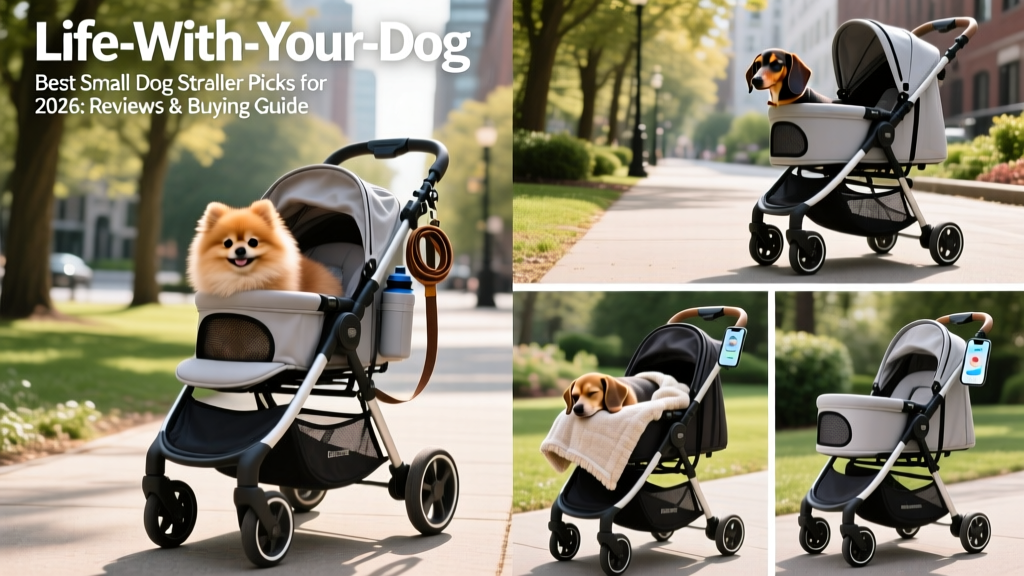
Best Small Dog Stroller Picks for 2026: Reviews & Buying Guide
Compare the best small dog strollers for 2026. Expert reviews, safety tips, sizing guidance, and real pricing to find the perfect ride for your little pup.
Why Every Small Dog Owner Should Consider a Stroller
A small dog stroller isn't a luxury item — for many dogs and their owners, it's a practical mobility solution. Senior dogs with osteoarthritis, brachycephalic breeds like Pugs and French Bulldogs who overheat quickly, and dogs recovering from IVDD surgery all benefit from a stroller that lets them enjoy outdoor stimulation without physical strain. Owners with their own mobility challenges, or those navigating crowded urban environments, farmer's markets, and airports, find that a well-chosen stroller extends their dog's quality of life and their shared adventures.
The pet stroller market has exploded, with options ranging from $40 budget models to $400+ premium systems. The gap between a flimsy stroller that tips on gravel and a well-engineered one that handles trails is enormous. This guide breaks down exactly what to look for, tests the top contenders, and helps you avoid the costly mistake of buying a stroller your dog refuses to ride in.
How Dog Strollers Work and Why Vets Recommend Them
A dog stroller functions like a human baby stroller but with a cabin designed for canine anatomy — lower entry points, mesh ventilation at nose level, and padded flooring that provides grip. Most models feature a detachable cabin that doubles as a carrier, a collapsible frame, and a storage basket underneath.
Veterinarians increasingly recommend strollers for specific clinical scenarios. Post-operative orthopedic patients need controlled, low-impact environmental enrichment during crate-rest recovery periods. Dogs with intervertebral disc disease (IVDD) can experience painful flare-ups from prolonged walking, but mental stimulation from outdoor sensory exposure remains critical for their wellbeing. Brachycephalic breeds with brachycephalic obstructive airway syndrome (BOAS) can overheat dangerously on warm days — a stroller lets them enjoy walks in climate-controlled comfort with a cooling pad underneath.
A 2024 survey published in the Journal of Veterinary Behavior found that dogs provided with regular sensory outings (even passive ones via stroller) showed lower cortisol levels and fewer stress-related behaviors compared to dogs confined at home during recovery periods.
Top Small Dog Strollers: Detailed Reviews
1. Pet Gear No-Zip NV Stroller
Price: $220–$260 | Weight Capacity: 45 lb | Cabin Dimensions: 26" L × 12" W × 19.5" H | Stroller Weight: 17 lb
The No-Zip NV earns its spot at the top because the "no-zip" entry uses a locking latch system instead of zippers — which are the number-one failure point on budget strollers. Air-filled tires with rear suspension handle mulch, cobblestone, and uneven sidewalks without jolting the cabin. The dual-entry design (front and rear) lets nervous dogs enter from whichever direction feels safest.
- One-hand quick fold, stands upright when folded
- Removable plush liner is machine washable
- Interior tether with dual clip points
- Parent tray with cup holder and phone slot
- At 17 lb, heavier than some competitors
- 45-lb capacity is overkill for very small dogs — cabin may feel too spacious for a 5-lb Chihuahua without added blanket
- Premium price point
2. Gen7Pets Monaco Stroller
Price: $280–$330 | Weight Capacity: 60 lb | Cabin Dimensions: 26" L × 14" W × 22" H | Stroller Weight: 18.5 lb
The Monaco is the closest thing to a luxury SUV in dog strollers. The Smart-Canopy folds back completely for open-air riding, and the Smart-Zip allows the canopy to unzip and tuck away neatly. EVA foam tires never go flat and handle moderate terrain well. The elevated cabin height gives dogs a clear view, which reduces anxiety for visually-oriented breeds like Italian Greyhounds.
- Highest cabin in this roundup — great for dogs who like to sit upright
- Smart-Canopy system is genuinely innovative
- Includes rain cover and travel bag
- Shock-absorbing frame design
- Heaviest stroller on this list
- Higher price point
- Wider wheelbase may not fit narrow store aisles
3. Pet Gear Special Edition Stroller
Price: $120–$150 | Weight Capacity: 45 lb | Cabin Dimensions: 24" L × 12" W × 19" H | Stroller Weight: 12 lb
This is the best value pick. At roughly half the price of premium models, the Special Edition covers the essentials: mesh ventilation on three sides, a rear parking brake, a removable fleece pad, and a one-hand fold. Hard plastic wheels limit it to paved surfaces, but for urban dog owners who primarily walk on sidewalks and through stores, it performs reliably.
- Lightest stroller in this roundup at 12 lb
- Budget-friendly without feeling cheap
- Compact folded size fits overhead compartments on most airlines (check carrier dimensions)
- Water-resistant fabric
- Hard wheels struggle on gravel and grass
- No suspension — bumpy on cracked sidewalks
- Zipper entry only (potential failure point long-term)
4. Ibiyaya 5-in-1 Pet Stroller
Price: $190–$240 | Weight Capacity: 33 lb (carrier mode) | Cabin Dimensions: 22" L × 12" W × 18" H | Stroller Weight: 15.4 lb
The Ibiyaya's standout feature is its modularity: the cabin detaches to function as a car seat (with seatbelt routing), a backpack carrier, a shoulder bag, or a standalone bed. For multi-use households that need one system for car trips, hiking, vet visits, and strolling, this versatility justifies the mid-range price. The cabin is slightly smaller than competitors, making it ideal for dogs under 20 lb.
- 5 configurations in one product — genuine space saver
- Car seat mode meets most vehicle safety standards
- Backpack straps are padded and adjustable
- Good ventilation with front and side mesh
- Smaller cabin limits use to dogs under ~20 lb comfortably
- Conversion between modes takes 2-3 minutes each
- Wheels are mid-quality — adequate but not premium
5. HPZ Pet Rover Premium Stroller
Price: $130–$170 | Weight Capacity: 50 lb | Cabin Dimensions: 26" L × 13" W × 20" H | Stroller Weight: 14 lb
The HPZ Pet Rover punches above its weight class. Rubber tires with front-wheel swivel and lock handle mixed terrain surprisingly well at this price point. The expandable cabin (a zip-open rear panel adds 6" of length) accommodates dogs who prefer to stretch out. A reflective strip along the canopy improves visibility during evening walks.
- Expandable cabin is unique at this price
- Rubber tires outperform hard plastic on varied surfaces
- Large under-seat storage basket (holds a 12-pack of water bottles)
- Quick-fold with auto-lock latch
- Build quality not as refined as Pet Gear or Gen7Pets
- Interior tether is a single clip (not dual)
- Canopy mesh is slightly less breathable than competitors
6. Foldaway Compact Pet Stroller by DoggyRide
Price: $200–$250 | Weight Capacity: 35 lb | Cabin Dimensions: 22" L × 12" W × 18" H | Stroller Weight: 11.5 lb
Engineered for travel, the DoggyRide Foldaway collapses to roughly the size of a laptop bag (28" × 14" × 5" folded). It's the lightest and most compact option here, making it ideal for apartment dwellers with limited storage and travelers who need a stroller that fits in a carry-on or small car trunk. Dutch engineering shows in the clean fold mechanism and lightweight aluminum frame.
- Ultralight at 11.5 lb — easiest to carry and store
- Ultra-compact fold is unmatched in this category
- Aluminum frame resists rust
- Shoulder strap included for carrying folded unit
- 35-lb capacity limits larger small breeds (e.g., stocky Corgis)
- Smaller wheels mean less terrain capability
- No parent tray or cup holder
Side-by-Side Comparison Table
| Feature | Pet Gear No-Zip NV | Gen7Pets Monaco | Pet Gear Special Ed. | Ibiyaya 5-in-1 | HPZ Pet Rover | DoggyRide Foldaway |
|---|---|---|---|---|---|---|
| Price Range | $220–$260 | $280–$330 | $120–$150 | $190–$240 | $130–$170 | $200–$250 |
| Weight Capacity | 45 lb | 60 lb | 45 lb | 33 lb | 50 lb | 35 lb |
| Stroller Weight | 17 lb | 18.5 lb | 12 lb | 15.4 lb | 14 lb | 11.5 lb |
| Wheel Type | Air-filled + suspension | EVA foam | Hard plastic | Rubber composite | Rubber | Small rubber |
| Best Terrain | All-terrain | Mixed surfaces | Paved only | Paved / light gravel | Mixed surfaces | Paved / indoor |
| Entry Type | No-zip latch | Smart-zip | Zipper | Zipper | Zipper | Zipper |
Safety Considerations and Warnings
Critical Safety Rules for Dog Stroller Use
- Never leave your dog unattended in a stroller. Even in shade, cabin temperatures rise rapidly. On an 80°F day, a mesh-ventilated stroller cabin in partial shade can reach 95°F within 15 minutes.
- Always use the interior safety tether. A startled dog can bolt from an open stroller in under a second. Clip the tether to a harness (never a collar) to prevent tracheal injury if they lunge.
- Engage the parking brake on any incline. Strollers with only rear brakes can roll forward on slopes of 5° or more. Test the brake on a hill before your first real outing.
- Check weight limits honestly. Exceeding the rated capacity stresses the frame and increases tip-over risk, especially on uneven ground. If your dog is near the upper limit, size up.
- Inspect wheels and latches before every outing. A loose wheel axle or worn latch can cause sudden collapse. This takes 10 seconds and prevents serious injury.
- Avoid busy roads without a wrist strap. Many strollers include a wrist safety strap — use it. If the stroller is bumped or you lose grip, the strap prevents it from rolling into traffic.
One often-overlooked risk: stroller anxiety. Some dogs, particularly those with noise sensitivity or a history of confinement stress, may panic inside a stroller. Signs include excessive panting, drooling, trembling, or attempts to claw through mesh. If your dog shows these signs, stop immediately — forcing the issue can create lasting negative associations. See the acclimation steps below.
How to Introduce Your Dog to a Stroller: A Step-by-Step Protocol
Rushing this process is the most common mistake owners make. Budget 2–4 weeks for a dog who has never been in a stroller. Use positive reinforcement throughout — high-value treats (boiled chicken, cheese) and calm praise. Never force your dog into the cabin.
Phase 1: Stationary Introduction (Days 1–3)
- Set up the stroller indoors with the canopy fully open and all entries accessible.
- Place a familiar blanket and a few treats inside the cabin.
- Let your dog investigate freely. Reward any interaction — sniffing, putting a paw in, looking inside.
- Once your dog enters voluntarily, feed a high-value treat inside. Repeat 5–10 times per session, 2–3 sessions per day.
Phase 2: Closed Cabin, No Movement (Days 4–7)
- Close the entry with your dog inside, but keep the stroller stationary.
- Feed treats through the mesh. Start with 5 seconds closed, gradually increase to 2 minutes.
- Watch body language: relaxed ears, soft eyes, and willingness to take treats = ready to progress. Whale eye, lip licking, or refusal to eat = go back a step.
Phase 3: Gentle Movement Indoors (Days 8–12)
- With your dog secured in the cabin (harness tethered), slowly push the stroller across a smooth indoor floor.
- Start with 3–4 steps, then stop and treat. Gradually increase distance.
- Keep sessions short (3–5 minutes) and end on a positive note.
Phase 4: Short Outdoor Trips (Days 13–21)
- Take a 5-minute stroll on flat, quiet pavement.
- Bring treats and offer them frequently to build positive associations with the outdoor stroller experience.
- Gradually increase duration to 15–20 minutes, then introduce mild terrain variations.
Phase 5: Regular Use (Day 21+)
- Your dog should now enter the stroller willingly and remain relaxed during rides.
- Vary your routes to maintain novelty and interest.
- Continue occasional treat rewards to maintain the positive association.
Trainer's Tip: For dogs who resist the stroller entirely after 3 weeks of patient work, try placing the detached cabin (if your model allows) on the floor as a bed for a week before reattaching it to the frame. Familiarity with the cabin as a safe space can unlock progress.
Where to Buy and What You'll Spend
Dog strollers are available through several channels, each with trade-offs:
| Retailer | Price Range | Return Policy | Notes |
|---|---|---|---|
| Chewy | $80–$330 | 365-day returns | Best selection; frequent sales; auto-ship discount on accessories |
| Amazon | $40–$350 | 30-day returns (varies by seller) | Widest range including budget imports; verify seller is brand-authorized |
| Petco / PetSmart | $100–$250 | 60-day returns | Limited in-store selection; try before you buy at some locations |
| Brand Direct (Pet Gear, Gen7Pets) | MSRP (rarely discounted) | 30–90 days | Best warranty support; replacement parts available |
Budget planning: Expect to spend $130–$260 for a quality small dog stroller that lasts 3–5 years. Models under $80 typically use hard plastic wheels, thin fabric, and cheap zippers that fail within a year. Add $15–$30 for accessories like a cooling pad, rain cover, or replacement liner if not included.
Alternatives to a Dog Stroller
A stroller isn't the only mobility solution for small dogs. Depending on your primary use case, one of these alternatives may serve you better — or complement a stroller:
- Dog carrier backpack: Ideal for hiking trails where wheels can't go. Look for ventilated models with a weight-rated frame (K9 Sport Sack, Kurgo G-Train). Best for dogs under 25 lb. Price: $60–$180.
- Pet wagon: Better for multiple dogs or larger breeds. Wider base, higher capacity (often 100+ lb). Bulkier and heavier. Price: $150–$400.
- Canine mobility cart (wheelchair): For dogs with hind-leg paralysis or severe weakness, a cart like the Walkin' Wheels allows active movement rather than passive transport. Requires veterinary fitting. Price: $250–$500.
- DIY stroller conversion: A retired baby stroller can be converted with a secured pet bed insert, mesh enclosure (sewn or zip-tied), and an interior leash clip. Cost: $20–$40 in materials. Ensure the frame can handle the weight and the enclosure prevents escape.
- Sling carrier: For very small dogs (under 10 lb) and short trips, a front-carry sling like the TomKins pet carrier offers hands-free transport without the bulk. Price: $25–$60.
When to Skip the Stroller and See Your Vet Instead
A stroller is a management tool, not a treatment. If your dog's reluctance to walk stems from an undiagnosed medical issue, masking the problem with a stroller delays care. Consult your veterinarian if you notice any of the following:
- Sudden reluctance to walk in a previously active dog — could indicate pain from arthritis, IVDD, a torn cruciate ligament, or neurological decline.
- Hind-end weakness or dragging — potential signs of degenerative myelopathy or spinal cord compression requiring immediate evaluation.
- Excessive panting or collapse during minimal exertion — may signal cardiac disease, respiratory distress, or heatstroke.
- Limping that doesn't resolve within 48 hours of rest — warrants radiographs and professional diagnosis.
- Behavioral changes like anxiety or aggression when touched or moved — can indicate pain that needs medical management.
Your veterinarian can determine whether your dog needs pain management, physical rehabilitation, or diagnostic imaging before you commit to a stroller as a long-term solution. According to the AVMA's senior dog care guidelines, twice-yearly veterinary checkups are recommended for dogs over 7 years old to catch mobility issues early.
Frequently Asked Questions
What is the best small dog stroller overall?
For most small dog owners, the Pet Gear No-Zip NV offers the best balance of durability, terrain capability, and ease of use. Its no-zip entry system eliminates the most common failure point, and the air-filled tires with suspension handle everything from city sidewalks to park trails. If budget is a primary concern, the Pet Gear Special Edition at $120–$150 delivers solid performance on paved surfaces.
How do I choose the right stroller for my dog's size?
Measure your dog in two positions: standing (floor to top of head, and floor to shoulder) and lying down (nose to tail base). The cabin interior must exceed all three measurements by at least 2–4 inches. Then verify the weight capacity — your dog's weight should fall within the middle 60% of the rated range for optimal stability. A 12-lb dog in a 45-lb-rated stroller is fine; a 40-lb dog in a 45-lb-rated stroller leaves minimal safety margin.
How much does a good small dog stroller cost?
Quality small dog strollers range from $120 to $330. Budget models under $80 exist but typically sacrifice wheel quality, frame durability, and ventilation. The sweet spot for most buyers is $130–$260, where you get reliable construction, all-terrain wheels, and proper safety features without luxury-tier pricing.
Can I take a dog stroller on an airplane?
Most airlines do not permit strollers in the cabin. However, some compact models (like the DoggyRide Foldaway) fold small enough to fit in overhead compartments and can be gate-checked. Always check your specific airline's pet policy and stroller dimensions before travel. The detached carrier cabin from modular strollers like the Ibiyaya 5-in-1 may qualify as an under-seat carrier if it meets airline size requirements.
Are there natural alternatives to using a stroller?
If your goal is to reduce your dog's physical exertion without a stroller, consider shorter, more frequent walks (3 × 10 minutes instead of 1 × 30 minutes), indoor enrichment activities (snuffle mats, puzzle feeders, scent work), and controlled play in a fenced yard. For senior dogs, canine physical therapy and joint supplements (glucosamine, omega-3 fatty acids) may improve mobility enough to reduce stroller dependency over time — always under veterinary guidance.
When should I skip OTC products and see a vet about my dog's mobility?
If your dog shows any sudden change in mobility — limping, reluctance to jump, dragging a limb, vocalizing when picked up — schedule a veterinary exam before purchasing a stroller. These symptoms may indicate conditions that require medical treatment (pain medication, surgery, physical therapy) rather than just assisted transport. Early diagnosis of conditions like IVDD or cruciate ligament tears significantly improves outcomes.
Priya Sutaria
All our authors care for dogs every day — read more of their work on the authors page.