Dog With a Big Nose: The Science Behind Canine Scent Power
Why does your dog have such a big nose? Explore the canine science behind scent receptors, olfactory anatomy, and what a large nose means for your dog's abilities.

Quick Answer: Why Does My Dog Have a Big Nose?
A dog with a big nose typically has a larger nasal cavity housing up to 300 million olfactory receptors (compared to humans' 6 million), along with an expanded olfactory epithelium surface area of up to 150 cm². Larger-nosed breeds — particularly dolichocephalic (long-snouted) dogs like Bloodhounds, Greyhounds, and German Shepherds — evolved this anatomy to maximize scent detection, thermoregulation, and air filtration. Nose size directly correlates with olfactory capability: bigger nasal passages allow more air turbulence, which separates scent molecules from respiratory air and directs them to the olfactory region for processing.
The Canine Nose: An Olfactory Supercomputer
If you've ever watched your dog stop mid-walk to investigate a seemingly uninteresting patch of grass for 45 seconds, you've witnessed one of the most sophisticated chemical detection systems in the animal kingdom. The canine nose isn't just a nose — it's a multi-chambered analytical instrument that processes environmental data at a level we can barely comprehend.
How Dogs Process Scent: The Physiological Mechanism
When your dog inhales, air doesn't simply travel straight to the lungs. The canine nasal cavity features a complex system of turbinates — bony, scroll-like structures covered in mucous membranes. These turbinates create air turbulence, effectively sorting incoming air into two streams:
- Respiratory stream (approximately 88% of inhaled air): Directed toward the lungs for oxygen exchange
- Olfactory stream (approximately 12% of inhaled air): Diverted upward into the dorsal meatus, where the olfactory epithelium resides
The olfactory epithelium contains specialized receptor neurons, each expressing specific protein receptors that bind to odorant molecules. According to research published in the Journal of Comparative Neurology, dogs possess approximately 1,000 different types of olfactory receptor genes (humans have roughly 350 functional types). When an odorant molecule binds to a receptor, it triggers a signal transduction cascade — a G-protein coupled receptor pathway that converts the chemical binding event into an electrical signal transmitted via the olfactory nerve (Cranial Nerve I) directly to the olfactory bulb.
The canine olfactory bulb is proportionally 40 times larger than the human olfactory bulb relative to total brain size. From there, signals are routed to the piriform cortex, amygdala, and entorhinal cortex — regions involved in memory, emotion, and spatial mapping. This is why scent triggers such powerful behavioral and emotional responses in dogs.
What makes the system even more remarkable is the lateral slit on each side of a dog's nostrils. While humans exhale through the same pathway they inhale, dogs have separate exhalation slits that allow them to continuously sample new air without disrupting incoming scent streams. A study from the Royal Society's Interface journal demonstrated that this aerodynamic design creates a continuous sampling loop — dogs effectively "breathe in" scent while simultaneously "breathing out" spent air through the side slits, maintaining an uninterrupted flow of chemical information.
Evolutionary Origins: Why Big Noses Developed
From Wolf Ancestors to Modern Breeds
The large canine nose traces back to Canis lupus — the gray wolf — whose survival depended on detecting prey at distances of up to 1.5 miles (2.4 km) under ideal wind conditions. Wolves that could detect the faintest chemical signatures of injured or distant prey had a significant survival advantage. Over approximately 15,000-30,000 years of domestication, humans selectively amplified this trait in specific working lines.
Scent hounds like the Bloodhound were bred specifically for olfactory performance. The Bloodhound's nose contains an estimated 300 million scent receptors — the highest count of any breed — and their long, drooping ears serve a functional purpose: they sweep ground-level scent particles upward toward the nostrils during tracking. The breed's skin folds around the face also help trap scent molecules near the nasal openings.
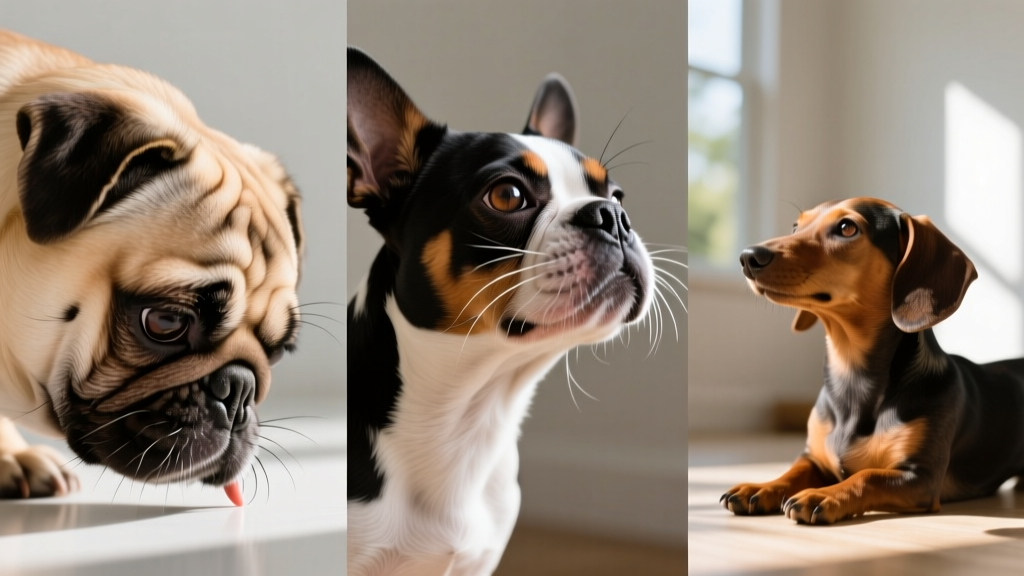
Conversely, brachycephalic breeds (Pugs, Bulldogs, Shih Tzus) were selectively bred for flattened faces, which compressed the nasal cavity and reduced olfactory surface area. This trade-off — aesthetic preference for flat faces at the cost of scent ability and respiratory function — is one reason these breeds struggle with both brachycephalic obstructive airway syndrome (BOAS) and reduced scent detection performance.
Nose Size, Breed Variations, and Scent Capability
Not all big-nosed dogs are created equal. Nose size and shape fall along a spectrum influenced by skull morphology, which veterinary science categorizes into three types:
| Skull Type | Nose Characteristics | Example Breeds | Olfactory Performance |
|---|---|---|---|
| Dolichocephalic (long-skulled) | Elongated nasal passage, maximum turbinate surface area | Bloodhound, Greyhound, Borzoi, Collie | Highest — up to 300M receptors |
| Mesocephalic (medium-skulled) | Moderate nasal passage, balanced turbinate area | Labrador Retriever, German Shepherd, Beagle | High — approximately 225M receptors |
| Brachycephalic (short-skulled) | Compressed nasal passage, reduced turbinate area | Pug, French Bulldog, Shih Tzu, Boxer | Reduced — fewer functional receptors |
Interestingly, some mesocephalic breeds outperform dolichocephalic breeds in specific scent tasks. The Beagle, despite having a shorter snout than a Greyhound, is widely used in airport detection work (the USDA's Beagle Brigade) because their scent drive and persistence compensate for slightly lower receptor counts. Scent ability involves motivation and training, not just anatomy.
How Dogs Use Their Big Noses: Scent Processing in Action
Understanding how your dog processes scent explains many everyday behaviors:
Stereo olfaction: Research from the Italian team at the University of Naples confirmed that dogs use each nostril independently to determine scent direction. When a novel or emotionally significant odor is first detected, dogs preferentially sniff with their right nostril (connected to the left brain hemisphere, which processes novel stimuli). For familiar, non-threatening scents, they shift to the left nostril. This lateralized sniffing pattern is measurable and has been replicated across multiple studies.
Vomeronasal organ (Jacobson's organ): Located on the roof of the mouth behind the incisors, this secondary scent-detection system specifically processes pheromones. When your dog curls their upper lip after sniffing another dog's rear end (the flehmen response), they're directing air to this organ to analyze social and reproductive chemical signals.
Scent aging: Dogs can determine how old a scent trail is. A study in Applied Animal Behaviour Science demonstrated that trained tracking dogs could distinguish between scent trails that were 1 hour old versus 3 hours old with accuracy rates above 80%. They detect the degradation rate of volatile organic compounds in the trail.
Common Misconceptions About Dogs With Big Noses
| Myth | Fact (Supported by Research) |
|---|---|
| "A wet nose means a healthy dog; a dry nose means sickness" | Nose moisture fluctuates throughout the day based on humidity, hydration, and activity. A healthy dog can have a dry nose after sleeping. A sick dog can have a wet nose. Body temperature and behavior are far more reliable health indicators. |
| "Big-nosed dogs are always better at tracking" | While receptor count matters, scent drive, training methodology, and environmental conditions (humidity above 60% improves scent detection; wind speed above 15 mph disperses molecules) all play critical roles. A motivated Beagle can outperform an untrained Bloodhound in short-distance detection tasks. |
| "Dogs see the world in black and white" | Dogs have dichromatic vision (blue and yellow cones) and see in muted color. However, their primary "picture" of the world is built through scent, not sight. A dog's mental map of your neighborhood is essentially a chemical landscape they read like we read a newspaper. |
| "My dog's nose print is unique, like a human fingerprint" | This is actually true. Canine nose prints have unique ridge patterns that can be used for identification. Some registries and apps now accept nose print scans as pet ID, though microchipping remains the gold standard per AVMA guidelines. |
Practical Implications: Living With a Big-Nosed Dog
What a Large Nose Means for Your Daily Life
1. Sniff walks are non-negotiable mental exercise. A 20-minute walk where your dog is allowed to sniff freely provides more mental stimulation than a 60-minute brisk walk without sniff breaks. Research from the Journal of Veterinary Behavior (2019) found that dogs allowed to engage in free-choice sniffing during walks showed lower cortisol levels (a stress hormone) compared to dogs walked on structured heel patterns for the same duration. Budget at least 15-20 minutes of dedicated sniff time per walk for big-nosed breeds.
2. Scent-based enrichment prevents behavioral problems. Dogs with high olfactory capacity that aren't given opportunities to use their noses often develop displacement behaviors: excessive licking, destructive chewing, or obsessive sniffing indoors. Invest in enrichment tools:
- Snuffle mats ($15-$35 on average): Fleece-strip mats that hide kibble, forcing your dog to forage using scent. Brands like Wooly Snuffle Mat and AWOOF offer durable options.
- Nose work classes ($150-$300 for a 6-week course): Formal canine scent detection training, modeled after professional detection dog protocols. Organizations like the National Association of Canine Scent Work (NACSW) offer titling trials.
- Scent discrimination games at home: Hide treats in cardboard boxes, under towels, or in different rooms. Start easy (visible treats) and increase difficulty over 2-3 weeks.
3. Recall training is harder for scent-driven dogs. When a Bloodhound or Beagle locks onto a compelling scent, their brain's reward center (nucleus accumbens) activates intensely, making them less responsive to verbal cues. Use positive reinforcement with high-value rewards (real chicken, cheese, freeze-dried liver — not standard training treats) and practice recall in low-distraction environments before progressing to outdoor settings. A 30-foot long line ($15-$25, Biothane material recommended for durability) provides safety during off-leash training transitions.
4. Never punish sniffing behavior. Pulling your dog away from scent sources or using aversive methods (shock collars, prong collars) to suppress sniffing creates frustration and can lead to leash reactivity. Sniffing is a biologically driven need, equivalent to a human's need for social interaction. Redirect with engagement games rather than suppress.
When a Big Nose Signals a Problem
While a large nose is typically a healthy anatomical trait, certain changes warrant veterinary attention:
Red Flags: When to Consult Your Veterinarian
- Sudden nasal discharge (especially unilateral — from one nostril only): May indicate a nasal tumor, foreign body (foxtail awn), or fungal infection (aspergillosis). Diagnostic costs: rhinoscopy ($800-$1,500), CT scan ($1,200-$2,500).
- Nose color changes (depigmentation, crusting, ulceration): Could signal discoid lupus erythematosus (DLE), pemphigus, or squamous cell carcinoma — particularly in lightly pigmented noses exposed to UV radiation.
- Frequent sneezing episodes (more than 5-6 sneezes in a cluster, repeated daily): May indicate nasal mites (Pneumonyssoides caninum), dental abscesses eroding into the nasal cavity, or reverse sneezing episodes (usually benign but worth documenting).
- Loss of scent interest (a previously food-motivated dog suddenly ignoring treats): Could signal cognitive dysfunction syndrome in senior dogs, upper respiratory infection, or neurological issues affecting the olfactory nerve.
- Nostril asymmetry or swelling: Any visible change in nose shape warrants prompt evaluation for neoplasia or inflammatory conditions.
Always consult your veterinarian if you notice sudden changes in your dog's nasal health or scent-seeking behavior. These symptoms may require diagnostic imaging or specialist referral to a veterinary dermatologist or internal medicine specialist.
How Is Canine Scent Processing Different From Humans?
The differences between canine and human olfaction aren't just matters of degree — they represent fundamentally different sensory priorities:
| Feature | Dogs | Humans |
|---|---|---|
| Olfactory receptors | Up to 300 million | Approximately 6 million |
| Olfactory receptor gene types | ~1,000 functional types | ~350 functional types |
| Olfactory epithelium surface area | Up to 150 cm² | Approximately 5 cm² |
| Olfactory bulb proportion (relative to brain) | ~40x larger proportionally | Baseline |
| Sensitivity (parts per trillion) | 1-2 parts per trillion (trained dogs) | Parts per million range |
| Primary sensory mode | Olfactory (scent-first world model) | Visual (sight-first world model) |
To put canine sensitivity in perspective: a trained detection dog can identify a single teaspoon of sugar dissolved in a million gallons of water — roughly the volume of two Olympic swimming pools. This is why dogs are deployed for medical detection (identifying certain cancers, diabetic hypoglycemia episodes, and seizure-onset chemical changes), search and rescue, and conservation work (detecting invasive species or endangered wildlife scat).
Frequently Asked Questions
Why does my dog spend so long sniffing one spot?
Your dog is reading what researchers call a "chemical bulletin board." Urine marks, feces, and glandular secretions from other animals contain information about species, sex, reproductive status, health, diet, and individual identity. Each sniff involves multiple inhalation cycles — dogs take 5-10 rapid sniffs per second (at 300 milliseconds each) to build a complete chemical profile of the source.
Can dogs really smell emotions?
Yes, within limits. A 2018 study published in Animal Cognition demonstrated that dogs could distinguish between human sweat samples collected during fearful, happy, and neutral emotional states. Dogs exposed to "fear sweat" showed increased stress behaviors and elevated heart rates compared to those exposed to "happy sweat." The mechanism involves detecting volatile organic compounds (VOCs) like cortisol metabolites and catecholamine byproducts released during emotional arousal.
Is it normal for my dog's nose to change color?
Seasonal depigmentation ("snow nose" or "winter nose") is common in Siberian Huskies, Golden Retrievers, and Labrador Retrievers. The nose lightens in winter and darkens in summer due to temperature-dependent enzyme activity (tyrosinase) involved in melanin production. This is generally benign. However, progressive, permanent depigmentation with crusting or ulceration warrants a veterinary dermatology evaluation for autoimmune conditions.
Does a bigger nose always mean a better sense of smell?
Not necessarily. While larger nasal cavities provide more surface area for olfactory receptors, scent performance also depends on receptor gene expression, olfactory bulb development, and behavioral motivation. Some medium-nosed breeds (Labs, Beagles) consistently outperform larger-nosed breeds in detection work due to higher hunt drive and trainability. The correlation between nose size and scent ability is strong but not absolute.
Can I train my dog's nose to be more sensitive?
You can't increase your dog's receptor count — that's genetically fixed. However, you can dramatically improve their scent discrimination and detection performance through structured nose work training. Dogs trained in formal scent detection programs show measurable improvements in accuracy over 8-12 weeks of consistent practice (3-4 sessions per week, 5-10 minutes each). The brain's olfactory processing pathways strengthen with use, similar to how human musicians develop enhanced auditory processing.
Sources & Further Reading
- Craven, B.A., et al. "The fluid dynamics of canine olfaction: unique nasal airflow patterns as an explanation of macrosmosmia." Journal of the Royal Society Interface, 2010. Available at royalsocietypublishing.org
- Quignon, P., et al. "Genetics and the Evolution of Olfactory Receptor Genes in Dogs." Journal of Heredity, 2012. Referenced via academic.oup.com/jhered
- American Kennel Club. "How a Dog's Sense of Smell Works." akc.org
- AVMA. "Brachycephalic Breeds and Respiratory Health." avma.org
Jonas Cole
All our authors care for dogs every day — read more of their work on the authors page.