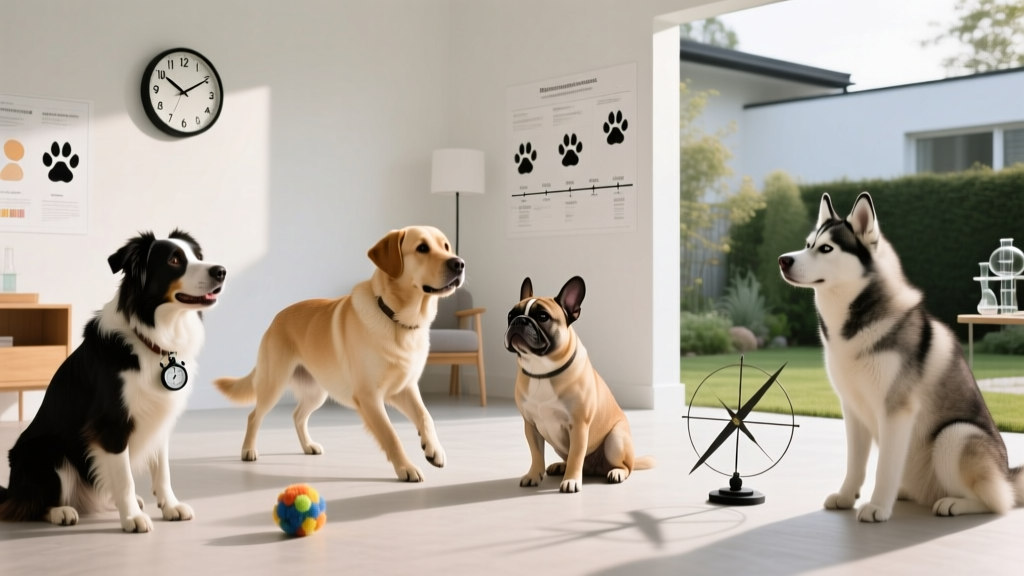
Night Vision of the Dog in the Nighttime: How Dogs See After Dark
Discover the science behind the night vision of the dog in the nighttime — tapetum lucidum, rod density, and what it means for your dog's after-dark behavior.

Quick Answer: How Well Do Dogs See at Night?
Dogs see significantly better than humans in low-light and nighttime conditions. Thanks to a reflective layer behind the retina called the tapetum lucidum, a rod-to-cone ratio heavily favoring light detection, and pupils that dilate wider than ours, dogs can function in light levels roughly five times dimmer than what humans need. However, dogs do not see in total darkness — they require at least some ambient light (moonlight, starlight, or artificial glow) to navigate. Their nighttime vision sacrifices color and fine detail for superior motion detection and light sensitivity.
If you've ever watched your dog confidently trot across a dark backyard while you fumble for a flashlight, you've witnessed canine low-light vision in action. The visual system of the dog in the nighttime is a marvel of evolutionary engineering — one that traces directly back to their wolf ancestors and the crepuscular hunting patterns that shaped the species. Understanding this biology doesn't just satisfy curiosity; it changes how you manage walks, play, safety, and even sleep arrangements after the sun goes down.
The Science of Canine Night Vision
The Tapetum Lucidum: Nature's Night-Mode Filter
The single most important structure behind a dog's nighttime vision is the tapetum lucidum — a mirror-like layer of tissue positioned directly behind the retina. When light enters the eye and passes through the photoreceptors without being absorbed, the tapetum bounces it back for a second pass. This effectively doubles the retina's chance to capture available photons.
This is the same structure responsible for the eerie green, blue, or yellow "eye shine" you see when a flashlight catches your dog's eyes in the dark. The color of the reflection varies based on the dog's age, breed, and the specific mineral composition (zinc and riboflavin crystals) of their tapetum. According to research published in the Merck Veterinary Manual, puppies are born without a fully developed tapetum — it matures between 3 and 6 months of age, which is why young puppies' eyes don't produce the same reflective shine as adults.
Notably, some dogs lack a functional tapetum entirely. Dogs with blue eyes and merle-patterned coats (common in Australian Shepherds, Great Danes, and some Collies) often have reduced or absent tapetal tissue, which measurably reduces their low-light capability compared to dogs with standard pigmentation.
Rod-Dominant Retina: Built for Dim Light
The canine retina contains two types of photoreceptor cells: rods (which detect light intensity and motion) and cones (which detect color and fine detail). Humans have roughly 200,000 rods per square millimeter in the peripheral retina. Dogs have approximately 250,000 to 300,000 rods per square millimeter in the same region — a density advantage that directly translates to superior light sensitivity.
The trade-off is cone density. Dogs have only about 10% of the cone concentration that humans do, concentrated in a small area called the visual streak rather than a centralized fovea. This means their daytime color perception is limited (roughly equivalent to a human with deuteranopia — red-green color blindness) and their visual acuity is approximately 20/75 compared to the human standard of 20/20.
| Feature | Dog | Human |
|---|---|---|
| Tapetum lucidum | Present (most dogs) | Absent |
| Rod density (peripheral) | ~250,000-300,000/mm² | ~200,000/mm² |
| Cone density | ~10% of human level | Baseline |
| Minimum light threshold | ~5x lower than humans | Baseline |
| Visual acuity | ~20/75 | 20/20 |
| Flicker fusion rate | ~75 Hz | ~60 Hz |
| Pupil maximum dilation | Larger relative to eye size | Smaller |
| Field of view | ~240° (breed-dependent) | ~180° |
The flicker fusion rate deserves special mention. Dogs process visual information at approximately 75 frames per second, compared to roughly 60 Hz for humans. This means that in low-light conditions, dogs perceive motion more fluidly and can detect subtle movements — like a rabbit darting through tall grass at dusk — that would appear as a blur to human eyes.
Evolutionary Basis: Why the Dog in the Nighttime Sees Differently
From Crepuscular Wolves to Modern Dogs
The gray wolf (Canis lupus), the direct ancestor of all domestic dogs, is primarily a crepuscular hunter — most active during dawn and dusk. This is the period when light is low but not absent, and when many prey species (deer, elk, rabbits) are also active. Natural selection strongly favored individuals whose visual systems could extract maximum information from fading light.
Over approximately 15,000 to 30,000 years of domestication, dogs retained this ancestral visual architecture almost entirely intact. While selective breeding modified skull shape, body size, coat type, and temperament, the fundamental retinal structure and tapetum lucidum remained remarkably conserved across breeds. A 2020 study published in Proceedings of the Royal Society B confirmed that domestic dogs show visual processing patterns nearly identical to wolves when tested under low-light conditions, suggesting domestication did not significantly alter this system.
The evolutionary logic is straightforward: a predator that hunts at twilight needs to detect motion at distance, distinguish shapes from background noise, and track fast-moving prey — all with minimal light. The rod-dominant retina with tapetal reflection is precisely the adaptation that solves this problem.
Dolichocephalic vs. Brachycephalic: Skull Shape Affects Night Sight
Not all dogs see equally well in the dark, and much of the variation traces to skull conformation:
- Dolichocephalic breeds (long-nosed: Greyhounds, Collies, German Shepherds) have a pronounced visual streak — a horizontal band of high-density photoreceptors across the retina. This gives them excellent panoramic motion detection, particularly useful in low light. Studies by Dr. Paul McGreevy at the University of Sydney demonstrated that long-skulled breeds have significantly wider visual fields (up to 270° in some sighthounds).
- Brachycephalic breeds (short-nosed: Pugs, Bulldogs, Shih Tzus) have a retinal anatomy closer to a human-like area centralis — a concentrated spot of photoreceptors rather than a streak. Their visual field narrows to approximately 180-200°, and their large, protruding eyes (a result of shallow orbits) are more prone to conditions that can degrade night vision, including corneal exposure keratitis and progressive retinal atrophy (PRA).
- Mesocephalic breeds (moderate skull: Labrador Retrievers, Beagles) fall between these extremes and tend to have the most balanced visual capabilities across lighting conditions.
How Dogs Process Nighttime Visual Information
The physiological pathway from photon to perception works like this in the canine eye after dark:
- Light enters through a maximally dilated pupil. In low light, the canine pupil opens wider relative to eye size than the human pupil, admitting more light. The iris muscles of dogs respond to dimming conditions within 2-4 seconds.
- Photons strike the rod-dominant retina. Rods contain the photopigment rhodopsin, which is extraordinarily sensitive to low light levels — a single photon can trigger a rod cell response. Dogs have higher rhodopsin concentration per rod than humans do.
- Unabsorbed light passes through the retina and hits the tapetum lucidum. The reflective crystals bounce approximately 40-50% of this light back through the photoreceptor layer, giving rod cells a second opportunity to capture photons they missed on the first pass.
- Signals travel via the optic nerve to the visual cortex. The canine brain dedicates proportionally more processing power to motion detection and spatial mapping than to color or detail analysis, meaning nighttime visual data is interpreted primarily as "where is it and is it moving?"
- Rhodopsin regeneration occurs rapidly. After exposure to a bright light (like car headlights), canine rhodopsin regenerates in approximately 6-10 minutes, compared to 20-30 minutes in humans. This is why your dog recovers from being "blinded" by a flashlight much faster than you do.
Practical Implications for Dog Owners
What Canine Night Vision Means for Your Daily Routine
- Late-evening walks: Your dog can see the path, obstacles, and other animals far better than you can. However, they cannot see in total darkness. On moonless nights in unlit areas, use a collar-mounted LED light (such as the Nite Ize SpotLit, approximately $12-$15) so your dog remains visible to you and to others — their vision is fine, but your ability to track them is not.
- Backyard safety: Dogs navigating a familiar yard at night rely on spatial memory as much as vision. Avoid rearranging outdoor furniture or leaving new obstacles in their usual path — they may not detect stationary objects in very low light despite excellent motion detection.
- Play and enrichment: High-contrast toys (white or light-colored against dark grass) are easier for dogs to track at dusk. Avoid dark-colored balls or frisbees for evening fetch sessions — a white rubber ball (like the Chuckit! Ultra, ~$10-$14 for a 2-pack) reflects ambient light and is far more visible.
- Sleep environment: Dogs do not need a nightlight. Their visual system functions well enough in minimal ambient light (even starlight through a window) to navigate to a water bowl or door. A completely pitch-black room is fine, but if you use a nightlight for your own convenience, it won't disturb them.
- Nighttime anxiety: If your dog paces, whines, or seems disoriented at night, this is rarely a vision issue (see "When Night Behavior Signals a Problem" below). More commonly, it relates to insufficient daytime exercise, separation distress, or environmental stimuli (noises, wildlife) that their superior senses detect before you do.
Cost Considerations for Nighttime Safety Gear
| Item | Price Range | Purpose |
|---|---|---|
| LED collar light (Nite Ize SpotLit) | $12-$15 | Visibility to owners and traffic |
| Reflective harness (Ruffwear Front Range) | $40-$50 | Full-body reflectivity for road walks |
| Glow-in-dark fetch ball | $8-$14 | Dusk/evening play visibility |
| Motion-sensor pathway lights (4-pack) | $25-$40 | Backyard navigation aid for you |
| GPS tracker with LED (Fi Series 3) | $129 + $8-$12/mo subscription | Location tracking if dog bolts at night |
Common Misconceptions About Dogs and Night Vision
| Myth | Fact |
|---|---|
| "Dogs can see in complete darkness." | No. Dogs require some ambient light — moonlight, starlight, or artificial glow. In a truly light-sealed environment (a cave, a windowless basement), dogs are as blind as humans. Their advantage is functioning in very low light, not zero light. |
| "Eye shine color tells you how well a dog sees at night." | Tapetal reflection color (green, blue, yellow, or red) is determined by the dog's age, pigmentation, and crystal composition — not by visual acuity. A dog with yellow eye shine does not see better or worse than one with green. |
| "Dogs are nocturnal." | Domestic dogs are socially adapted to human schedules and are generally diurnal. Their visual system is optimized for crepuscular (dawn/dusk) conditions, but their behavior follows their household's routine. Nighttime activity is typically driven by insufficient daytime stimulation, not biology. |
| "If my dog bumps into things at night, their vision is normal — dogs just aren't careful." | Frequent collisions with furniture or walls in low light can signal progressive retinal atrophy (PRA), cataracts, or other degenerative eye conditions. This warrants a veterinary ophthalmology exam. |
| "All dogs see equally well in the dark." | Breed, skull shape, age, and individual genetics create significant variation. Brachycephalic breeds, merle-coated dogs, and senior dogs over 8-10 years often have measurably reduced low-light performance. |
When Nighttime Behavior Signals a Problem
Red Flags: Consult Your Veterinarian If Your Dog Shows These Signs
- Sudden reluctance to go outside after dark — especially if the dog previously had no hesitation. This can indicate declining night vision from cataracts, PRA, or nuclear sclerosis (lenticular sclerosis, common in dogs over 8).
- Bumping into furniture or walls in dim light — this is not normal clumsiness. It suggests the dog cannot see well enough to navigate.
- Dilated pupils that don't constrict in bright light — possible retinal detachment, optic nerve damage, or neurological issue.
- Visible cloudiness or opacity in the lens — cataracts can develop at any age (hereditary in many breeds including Cocker Spaniels, Poodles, and Boston Terriers) and progressively degrade vision in all lighting conditions.
- Nighttime pacing, restlessness, or vocalization in senior dogs — while sometimes related to vision loss, this more commonly indicates Canine Cognitive Dysfunction (CCD), the canine equivalent of Alzheimer's disease. According to the ASPCA, approximately 14% of dogs over age 11 show signs of CCD, but fewer than 2% receive a diagnosis.
- One eye reflecting light differently than the other — asymmetrical eye shine can indicate a tumor, retinal detachment, or glaucoma in the affected eye. This is an emergency; seek veterinary care within 24 hours.
Always consult your veterinarian if you notice changes in your dog's nighttime behavior or visual capability. Early diagnosis of conditions like PRA and cataracts can preserve remaining vision and improve quality of life.
Breed-Specific Eye Conditions That Affect Night Vision
| Condition | Predisposed Breeds | Onset | Night Vision Impact |
|---|---|---|---|
| Progressive Retinal Atrophy (PRA) | Miniature Poodles, Cocker Spaniels, Australian Shepherds, Irish Setters | 1-5 years (varies by type) | Night blindness is often the first symptom; progresses to total blindness |
| Cataracts (hereditary) | Boston Terriers, Staffordshire Bull Terriers, Miniature Schnauzers | 1-3 years (hereditary) or 8+ (age-related) | Progressive clouding reduces light transmission; night vision degrades first |
| SARDS (Sudden Acquired Retinal Degeneration Syndrome) | Dachshunds, Miniature Schnauzers, middle-aged females | Sudden onset, typically 4-10 years | Complete blindness within days; night vision lost first |
| Glaucoma | Cocker Spaniels, Basset Hounds, Shih Tzus, Arctic breeds | Variable; often 4-8 years | Increased intraocular pressure damages optic nerve; peripheral and night vision affected early |
Related Canine Senses: Beyond Vision in the Dark
A dog's nighttime superiority doesn't rest on vision alone. The visual system works in concert with other heightened senses to create a remarkably complete picture of the after-dark environment:
- Hearing: Dogs detect frequencies up to 45-65 kHz (humans max out around 20 kHz). At night, when ambient noise drops, their effective hearing range increases. A dog can detect a mouse rustling in grass at approximately 25 feet — roughly four times the human range. Sound travels differently at night due to temperature inversions, and dogs exploit this naturally.
- Olfaction: The canine olfactory epithelium contains 150-300 million scent receptors (compared to 5-6 million in humans). Cooler nighttime air holds scent molecules closer to the ground, making evening and early-morning hours optimal for scent-based activities. This is why tracking and search-and-rescue operations often schedule dog teams for nighttime deployment.
- Vibrissae (whiskers): The tactile hairs on a dog's muzzle, above the eyes, and on the lower jaw detect air current changes caused by nearby objects. In near-total darkness, these function as a short-range proximity sensor — helping the dog avoid obstacles at distances of approximately 6-12 inches from the face. Never trim a dog's whiskers; they serve a critical navigational function.
The integration of these systems means that even a dog with partial vision loss can navigate a nighttime environment far more competently than a human with equivalent visual impairment. This multi-sensory redundancy is another inheritance from their wolf ancestors, for whom a single sensory failure in the dark could mean starvation.
Frequently Asked Questions
Why do dogs seem more alert at night?
Their crepuscular evolutionary heritage means their sensory systems — vision, hearing, and smell — are optimized for dawn and dusk conditions. Combined with reduced environmental noise at night, dogs detect stimuli (distant wildlife, neighbors, wind-carried scents) that humans simply cannot perceive. Their alertness isn't anxiety; it's their sensory systems operating at peak efficiency.
Can dogs see in total darkness?
No. Dogs require at least minimal ambient light. The tapetum lucidum amplifies available light but cannot create it. In a sealed, windowless room with zero light sources, a dog's vision is effectively non-functional — identical to a human in the same conditions. Moonlight, starlight, or distant artificial light is sufficient for canine navigation, but absolute darkness defeats their visual system.
How do dogs see colors at night compared to during the day?
Under very low light conditions, cone cells (responsible for color vision) become less effective, and rod cells (which detect only light intensity) dominate. This means that at night, dogs essentially see in monochrome — shades of gray — even more than their already limited daytime color perception (blues and yellows). The transition from color to monochrome happens gradually as light levels drop, typically becoming complete at approximately 0.01 lux (roughly the brightness of a full moon).
What does it mean when my dog stares into the dark?
When your dog fixates on something in the darkness that you cannot see, they are almost certainly detecting real stimuli — not "seeing ghosts." Their superior motion detection, combined with hearing and olfactory input, allows them to identify animals, people, or environmental changes at distances and in conditions beyond human perception. A study from the American Kennel Club notes that dogs can detect motion at distances of up to 900 meters in optimal low-light conditions, compared to roughly 500 meters for humans.
Is it normal for older dogs to seem confused at night?
Nighttime disorientation in senior dogs (typically 10+ years) is common but not "normal" in the sense of being harmless. It can indicate Canine Cognitive Dysfunction (CCD), vision loss from cataracts or PRA, or pain from arthritis that worsens when the dog lies still for extended periods. A veterinary exam including an ophthalmologic assessment and cognitive screening is recommended for any senior dog showing new nighttime behavioral changes. Treatments including selegiline (Anipryl), prescription cognitive diets, and environmental modifications can significantly improve quality of life.
How is dog night vision different from cat night vision?
Cats have an even more developed tapetum lucidum and higher rod density than dogs, giving them superior low-light performance. Cats need approximately one-sixth the light humans require (compared to one-fifth for dogs). However, cats sacrifice more daytime visual acuity for this advantage. Dogs retain better daytime function while still maintaining strong nighttime capability — a balance that reflects their ancestors' need to function across a wider range of lighting conditions throughout a full hunting cycle.
Sources and Further Reading
- Merck Veterinary Manual — Structure and Function of the Eye in Dogs
- American Kennel Club — Can Dogs See in the Dark?
- ASPCA — Common Dog Diseases (including eye conditions)
- Miller, P.E. & Murphy, C.J. (1995). "Vision in Dogs." Journal of the American Veterinary Medical Association, 207(12), 1623-1634.
- McGreevy, P.D. et al. (2004). "A strong correlation exists between the distribution of retinal ganglion cells and retinal streak type in dogs." Brain, Behavior and Evolution, 63(2), 82-90.
Dr. Hannah Wickes
All our authors care for dogs every day — read more of their work on the authors page.