Do Dogs Have a Sense of Time? What Science Says (2026 Guide)
Do dogs have a sense of time? Explore the science behind canine time perception, circadian rhythms, and how your dog tracks your daily schedule.
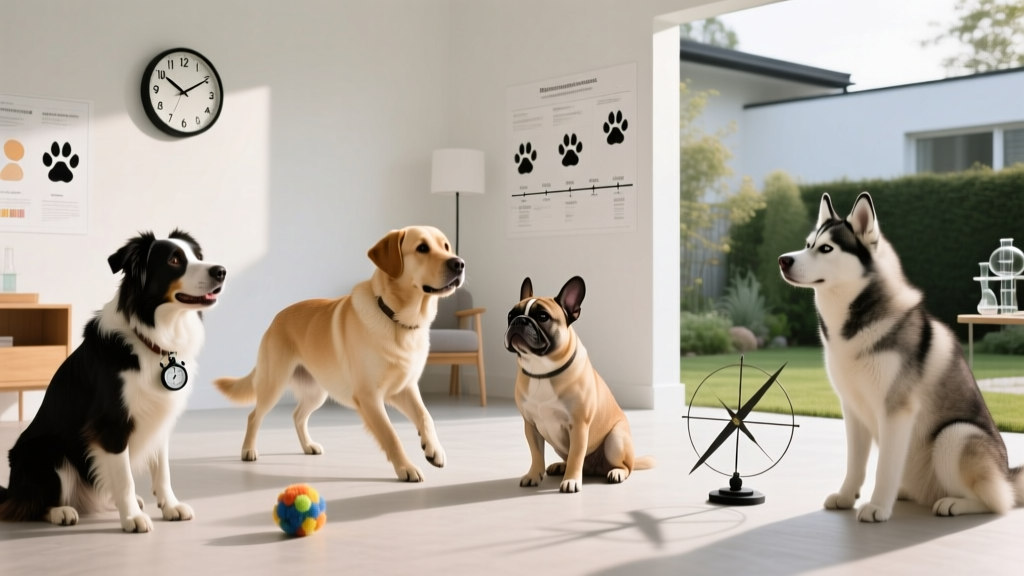
If you've ever watched your dog perk up at 5:15 PM — the exact minute you usually pull into the driveway — you've probably wondered: do dogs have a sense of time? The short answer is yes, but their perception of time works very differently from ours. Dogs don't read clocks or count minutes, yet research shows they can anticipate routine events, distinguish between longer and shorter intervals, and even recognize how long you've been gone based on scent decay.
This isn't a food safety article, but understanding your dog's relationship with time has real practical implications — from managing separation anxiety to structuring feeding schedules and training sessions. Let's break down what the science actually tells us.
Dogs perceive time through circadian rhythms, scent gradients, environmental cues, and associative memory. They cannot conceptualize hours or minutes the way humans do, but they reliably distinguish short from long durations and anticipate recurring events. Studies from Stockholm University and Eötvös Loránd University confirm dogs react differently after 2 hours vs. 30 minutes of owner absence.
How Dogs Perceive Time: The Science
Human time perception is linguistic and abstract — we think in minutes, hours, and calendar dates. Canine time perception is embodied and environmental. Your dog's brain doesn't count seconds, but it tracks patterns through multiple overlapping systems:
Circadian Rhythms and Internal Clocks
Like all mammals, dogs have a suprachiasmatic nucleus (SCN) in the hypothalamus that regulates circadian rhythms — roughly 24-hour cycles governing sleep-wake patterns, hormone release, and body temperature. A study published in the journal Applied Animal Behaviour Science demonstrated that dogs show anticipatory activity before regular feeding times, indicating their internal clocks can track intervals of approximately 24 hours with reasonable accuracy.
This means your dog's stomach literally prepares for breakfast before the bowl appears. Gastric acid secretion, digestive enzyme production, and even activity levels shift in the 30–60 minutes before a habitual meal.
Scent Decay as a Time Marker
One of the most fascinating hypotheses in canine cognition comes from researcher Alexandra Horowitz, who proposed that dogs may use olfactory gradients to gauge elapsed time. When you leave home, your scent concentration peaks and then gradually dissipates. Your dog may learn to associate a specific scent "thickness" with your typical return time.
This explains why dogs can distinguish a 30-minute absence from a 4-hour absence: the scent environment is measurably different. In a 2011 study at Stockholm University published in Applied Animal Behaviour Science, dogs showed significantly more greeting behavior — tail wagging, body shaking, lip licking — when owners returned after 2 hours versus 30 minutes, suggesting they perceived the longer duration as more significant.
Associative and Episodic-Like Memory
Dogs possess what researchers call episodic-like memory — the ability to recall specific events in context, though likely without the conscious "I remember when" narrative humans experience. A landmark 2016 study from Eötvös Loránd University in Budapest, published in Current Biology, found that dogs could recall observed actions after delays of up to 24 hours, demonstrating a memory system that encodes "what happened" and roughly "when" — even without formal training to do so.
Practically, this means your dog remembers that the mail carrier arrives in early afternoon, that your evening walk follows the sound of your laptop closing, and that weekends have a different rhythm than weekdays.
Practical Signs Your Dog Tracks Time
You don't need a laboratory to observe your dog's time perception. Here are the everyday behaviors that reveal how dogs track temporal patterns:
| Behavior | What It Reveals | Time Mechanism |
|---|---|---|
| Waiting by the door before you arrive home | Anticipates routine return time | Circadian rhythm + scent decay |
| Pacing or whining near mealtime | Tracks feeding intervals (~12–24 hours) | Internal clock + gastric signals |
| More excited greeting after long absences | Distinguishes duration of separation | Olfactory gradient + episodic-like memory |
| Settling into a nap after morning walk | Learns sequence of daily events | Associative memory + event sequencing |
| Reacting differently to weekday vs. weekend mornings | Detects schedule variations | Environmental cues (alarm, light, activity) |
Do Dogs Know How Long You've Been Gone?
This is where the research gets genuinely useful for dog owners. The Stockholm University study (Rehn & Keeling, 2011) tested dogs left alone for 30 minutes, 2 hours, and 4 hours. The key findings:
- 30-minute absence: Dogs showed baseline greeting behavior upon return.
- 2-hour absence: Dogs displayed significantly more tail wagging, higher body activity, and more lip licking and body shaking — behaviors associated with social reunion and mild stress release.
- 4-hour absence: Greeting intensity plateaued, but dogs showed increased resting behavior afterward, suggesting longer absences impose greater physiological fatigue or stress.
This has direct implications for separation anxiety management. Dogs are not simply "dramatic" when you return from a long day — they genuinely experience longer absences as different events. For dogs with separation distress, graduated departure training (starting with 5-minute absences and building incrementally) works precisely because dogs can perceive the difference between durations and learn that each separation ends predictably.
If your dog struggles with alone time, keep departures and arrivals low-key. Dramatic goodbyes and overexcited greetings reinforce the "event significance" of your leaving, making the absence feel more salient. Practice leaving for 2 minutes, 5 minutes, 15 minutes — varying the duration unpredictably — so your dog learns that absence length is variable and your return is always certain. Use positive reinforcement only: reward calm settling with a stuffed Kong or snuffle mat, never punish anxiety behaviors.
How Routine Consistency Affects Your Dog's Stress Levels
Because dogs rely on environmental and circadian cues to predict events, inconsistent schedules create measurable stress. A 2020 review in the journal Animals found that dogs in environments with predictable feeding, walking, and social interaction schedules showed lower cortisol baselines and fewer stress-related behaviors (excessive licking, pacing, destructive chewing) compared to dogs with erratic schedules.
This doesn't mean you need military precision. Dogs are adaptable — but they benefit from anchoring events that occur at roughly the same time each day:
- Morning feeding: Within a 30-minute window of the same time daily
- Primary walk: Same general time block (e.g., always before 8 AM or always after 5 PM)
- Evening settling routine: A consistent pre-bedtime sequence (last potty break → chew toy → lights dim)
For working owners with variable schedules, automatic feeders (like the PetSafe Smart Feed 2.0, approximately $150–$180) can provide feeding consistency even when your arrival time fluctuates. This anchors at least one daily event, reducing the cumulative stress of unpredictability.
Can Dogs Tell the Difference Between Short and Long Durations?
Yes — and the threshold appears to be roughly 10 to 15 minutes for meaningful discrimination in trained laboratory settings, though in real-world contexts, dogs clearly distinguish intervals as short as 5 minutes apart when those intervals predict significant events (like your return home).
Research on interval timing in dogs, summarized in the Merck Veterinary Manual, suggests dogs use a combination of internal pacemaker mechanisms and external event markers to estimate duration. They don't count seconds, but they can learn that "after the dishwasher finishes its cycle, my human usually takes me outside."
This ability has a ceiling. Dogs likely cannot distinguish between 6 hours and 8 hours with any precision — both probably register as "a very long time." This is relevant for owners considering crating durations: while a dog may tolerate 8 hours in a crate physically, their perception of the duration as "very long" without meaningful stimulation contributes to the behavioral deterioration seen in over-crated dogs.
Age, Breed, and Individual Variation in Time Perception
Not all dogs experience time identically. Several factors influence temporal perception:
Age-Related Changes
Senior dogs with canine cognitive dysfunction (CCD) — the canine equivalent of dementia — often lose their ability to track routines. A dog who reliably anticipated mealtime may begin pacing or vocalizing at random hours. CCD affects an estimated 28% of dogs aged 11–12 years and 68% of dogs aged 15–16 years, according to the Merck Veterinary Manual. If your senior dog suddenly seems "confused" about daily schedules, this warrants a veterinary evaluation — there are management options including dietary supplements (SAMe, phosphatidylserine) and prescription medications (selegiline).
Breed Tendencies
Working breeds (Border Collies, German Shepherds, Belgian Malinois) and highly trainable breeds often demonstrate sharper anticipatory behavior, likely because their selection history favored dogs that could predict handler actions. Brachycephalic companion breeds (Pugs, Bulldogs) may show less obvious anticipatory behavior, though this likely reflects expression differences rather than perception deficits.
Individual Temperament
Anxious dogs may hyper-fixate on temporal cues, becoming stressed if a routine event is even 10 minutes late. Confident, easygoing dogs typically show greater flexibility. This is a temperament trait, not a training failure — and it's worth consulting a certified behavior professional (IAABC or CCPDT-certified) if schedule sensitivity is causing your dog distress.
When to Consult Your Veterinarian About Time-Related Behaviors
- Sudden disorientation about time of day or routine events (possible CCD or neurological issue)
- Excessive vocalization or destructive behavior specifically tied to your departure (separation anxiety — treatable with behavior modification and, if needed, medication like fluoxetine or clomipramine prescribed by your vet)
- Pacing, restlessness, or inability to settle at night (could indicate pain, cognitive decline, or endocrine disorders like Cushing's disease)
- Loss of previously reliable house-training timing (may signal urinary tract infection, diabetes, or kidney disease — not simply a "time perception" problem)
- Staring at walls, getting stuck in corners, or appearing lost in familiar spaces (neurological red flag requiring prompt evaluation)
Always consult your veterinarian if your dog's time-related behaviors change suddenly. What looks like "confusion about the schedule" can be an early symptom of pain, metabolic disease, or cognitive decline — and early intervention significantly improves outcomes.
Frequently Asked Questions
Do dogs know what time it is?
No — dogs cannot read clocks or understand the concept of "3:00 PM." However, they track time through circadian rhythms, environmental light changes, scent decay, and learned associations with routine events. Your dog knows it's "walk time" not because of the clock, but because the afternoon light angle, your energy level, and the sequence of prior events all align with past walks.
Can dogs tell how long you've been gone?
Yes. Research shows dogs behave differently after 2-hour absences compared to 30-minute absences, displaying more intense greeting behavior after longer separations. They likely use scent dissipation and internal state changes to gauge duration, though they probably cannot distinguish between very long intervals (e.g., 6 vs. 8 hours).
Why does my dog always know when I'm coming home?
Your dog likely combines multiple cues: the fading of your scent to a specific level, the position of sunlight in the house, the time since your last feeding interaction, and possibly auditory cues (your car's specific engine sound from blocks away). Dogs who appear to "predict" arrivals beyond routine times may be responding to phone-based cues — they hear you end a call or notice a change in another household member's behavior that signals your approach.
Do dogs get bored waiting for you?
Yes, particularly dogs left without environmental enrichment for extended periods. Dogs sleep 12–14 hours per day on average, but unstimulated dogs in barren environments develop boredom-related behaviors: excessive chewing, barking, or licking. Providing food puzzles, snuffle mats, or safe chew items can reduce boredom during absences. If boredom escalates to destructive behavior or self-harm (acral lick dermatitis), consult your veterinarian and a certified behavior professional.
Should I keep a strict schedule for my dog?
Moderate consistency is ideal. Anchor 2–3 daily events (morning feeding, primary walk, evening settling) within a 30-minute window, but allow natural variation in other activities. Dogs raised with rigid, unvarying schedules can become more stressed by unavoidable disruptions (vet visits, travel, schedule changes) than dogs accustomed to moderate flexibility.
Can I train my dog to understand time intervals?
You can train duration-based behaviors ("stay" for 30 seconds vs. 2 minutes) using positive reinforcement and gradual increments, but you're training behavioral responses to cues, not teaching abstract time concepts. Dogs learn "I wait, then I get rewarded" — not "I waited 47 seconds." This distinction matters: it means your dog's "understanding" of time is always context-dependent and tied to specific situations.
Marcus Aldridge
All our authors care for dogs every day — read more of their work on the authors page.


