Dog Language Translator: The Science Behind How Dogs Communicate
Can a dog language translator really decode your pup's barks and body language?
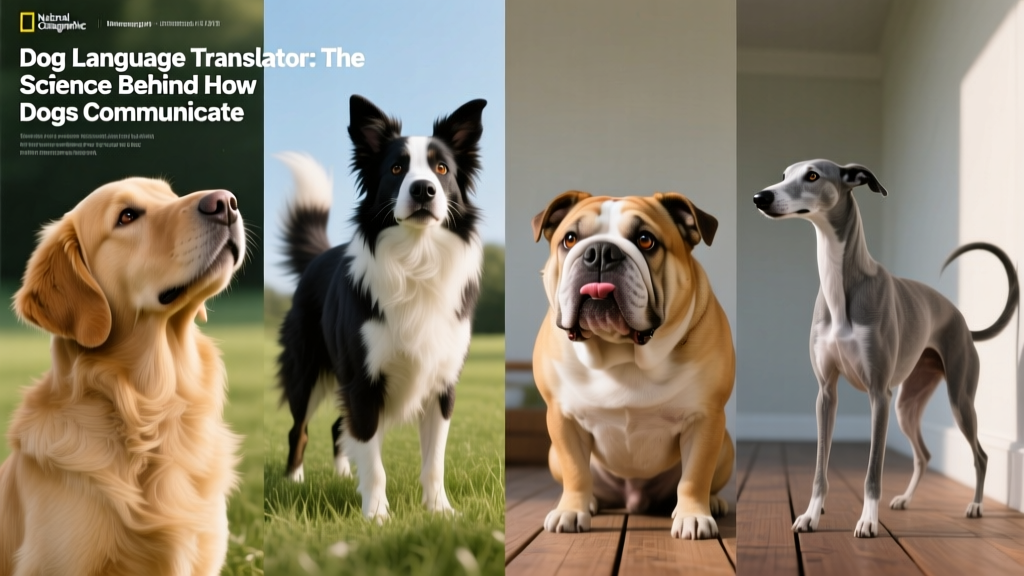
Can a dog language translator really work? Not in the way apps claim. No software can reliably "translate" a bark into a specific English sentence. However, decades of peer-reviewed research confirm that dogs communicate through a sophisticated multimodal system combining vocalizations, body postures, facial expressions, and scent signals. You are your dog's best translator — and canine science gives you the framework to read them accurately. The key is understanding what the research actually shows rather than relying on gimmick apps.
Why Dogs Communicate: The Evolutionary Roots
Dog communication didn't emerge from nowhere. It's a modified version of wolf social signaling, refined over at least 15,000–30,000 years of domestication. Wolves rely on complex pack coordination for hunting and territory defense, which demanded a rich communication repertoire: tail position, ear orientation, piloerection (raised hackles), vocalizations from whines to howls, and elaborate scent marking.
What changed during domestication? Research published in Science (2017) by evolutionary biologist Bridgett vonHoldt and colleagues identified genetic variants near the GTF2I and GTF2IRD1 genes in dogs — the same genes linked to Williams-Beuren syndrome in humans, characterized by hypersociability. This genetic shift made dogs hyper-motivated to communicate with humans specifically, not just with other dogs.
Ancestral wolves communicate primarily with conspecifics (other wolves). Dogs retained most of that wolf-based signaling system but added something remarkable: the ability to direct communicative signals cross-species toward humans. Dogs spontaneously use referential gestures — like pointing with their muzzle or pawing at a door then looking back at you — in ways that even our closest primate relatives, chimpanzees, do not naturally do with humans.
How Dogs Process Human Language and Signals
The Neurological Evidence
In a landmark 2014 study published in Current Biology, neuroscientist Attila Andics and colleagues at Eötvös Loránd University in Budapest used fMRI scans on awake, unrestrained dogs. The findings were striking:
- Left hemisphere activation: Dogs processed meaningful words (like "sit" or "good") in the left auditory region, similar to how humans process language semantics.
- Right hemisphere activation: Intonation (the emotional tone of voice) was processed in the right auditory region.
- Reward center activation: The caudate nucleus (a reward-processing area) lit up most strongly when both the word was meaningful AND the intonation was praising. Praising words spoken in a neutral tone, or neutral words spoken in a praising tone, produced significantly weaker reward responses.
This means dogs don't just hear sounds — they separately decode what you say and how you say it, then integrate both channels. This is a form of parallel processing previously thought to be uniquely human.
But here's where "dog language translator" apps overreach: dogs are not processing human grammar or syntax. They're mapping specific sound patterns to outcomes ("walk" predicts leash and door), reading prosody (your excited vs. angry tone), and combining that with your body language and environmental context. A dog who responds to "Do you want to go for a walk?" is responding to the words "walk" and the rising, excited intonation — not parsing the sentence structure.
The Multimodal Communication System: What the Research Shows
Scientific consensus recognizes at least five distinct communication channels dogs use simultaneously:
| Channel | Examples | Information Conveyed | Human Detectability |
|---|---|---|---|
| Vocal | Barks, whines, growls, howls, sighs, huffs | Arousal level, alert, distress, play invitation | High — we hear it easily |
| Visual/Postural | Tail position, ear set, body lean, piloerection, eye contact | Emotional state, intent, confidence level | Moderate — requires training to read accurately |
| Facial Expression | Eyebrow raises (AU101), mouth shape, tongue flicks, whale eye | Stress, appeasement, attention-seeking | Low — subtle and often missed |
| Olfactory | Urine marking, anal gland secretions, pheromones | Identity, reproductive status, territorial claims | Very low — humans lack comparable olfactory sensitivity |
| Tactile | Leaning, pawing, nudging, mounting, play bow contact | Affiliation, request, redirect, social bonding | High — but interpretation varies |
According to the Merck Veterinary Manual, effective canine communication reading requires attending to all of these channels simultaneously. A dog barking at the door with a high tail and forward lean is communicating something very different from a dog barking with a tucked tail and lowered body, even though the vocalization sounds identical to an untrained ear.
Can Dog Language Translator Apps Really Work?
As of 2026, several apps on the market claim to translate dog barks into human language. Here's what the science says about their accuracy:
| Claim (Myth) | What Science Shows (Fact) |
|---|---|
| "Each bark means a specific word." | Barks vary along arousal and context dimensions, not semantic ones. A 2000 study by Sophia Yin in the Journal of Comparative Psychology found that barks differ by context (stranger vs. isolation vs. play), but they encode emotional state and urgency, not specific messages like "I'm hungry" or "I love you." |
| "AI can analyze bark patterns to decode meaning." | Machine learning models can classify barks into broad categories (alert, play, distress) with roughly 60-70% accuracy in controlled lab settings. However, these models fail in real-world noisy environments and cannot produce word-level translations. No peer-reviewed study has validated a consumer app's accuracy claims. |
| "Growling always means aggression." | Growls occur in at least four distinct contexts: aggressive defense, play, resource guarding, and fear. Research by Faragó et al. (2010, published in Animal Behaviour) showed that humans can differentiate aggressive growls from play growls by acoustic properties alone — but apps often misclassify growl context because they ignore the accompanying body language. |
| "Dogs understand full sentences." | Dogs extract keyword associations and prosodic cues. The average trained dog reliably responds to 15-25 distinct verbal cues. Border Collies like the famous "Chaser" studied by Pilley and Reid (2011) demonstrated comprehension of over 1,000 words — but this required years of intensive daily training and represents an extreme outlier. |
| "Tail wagging always means happy." | Tail wag direction matters. A 2013 study in Current Biology by Vallortigara et al. found that dogs wag more to the right when experiencing positive emotions (seeing their owner) and more to the left when experiencing negative emotions (seeing an unfamiliar dominant dog). Other dogs can perceive this asymmetry. |
What Your Dog Is Actually Saying: A Practical Decoding Guide
Rather than relying on an unvalidated app, here's a research-backed framework for reading your dog's most common signals. This combines findings from veterinary behaviorists and the American Kennel Club's body language resources:
Vocalization Decoder
- Single sharp bark (medium pitch): Alert — "Something is different in our environment." Check what triggered it. This is normal watchdog behavior.
- Rapid bark string (3-4 barks, pause, repeat): Alarm/territorial call. Higher urgency than a single bark. Your dog wants you to investigate.
- Low-pitched growl-bark combination: Defensive warning. Your dog feels threatened and is prepared to escalate. Do not punish — remove the trigger and give space.
- High-pitched whine or whimper: Distress, anticipation, or pain. Context matters: whining at the door means "I need out"; whining while trembling may signal pain or fear.
- "Roo-roo" howl-like vocalization: Social bonding call. Common in hound breeds and Huskies. Often triggered by sirens or music (frequency matching instinct).
- Content sigh (long exhale while resting): Relaxation signal. Equivalent to a human settling into a comfortable chair. This is a positive sign.
Body Language Quick Reference
The 3-Second Assessment Method
When trying to understand your dog's emotional state, scan these three zones in order:
- Ears: Forward = interest/arousal. Flat back = fear/submission. Relaxed/neutral = calm. One forward, one back = uncertain processing.
- Body weight distribution: Leaning forward = confidence/approach. Leaning back or crouching = uncertainty/retreat. Weight shifted to hindquarters = preparation to bolt. Full-body wiggle = high positive arousal.
- Tail: High and stiff = high arousal (positive OR negative — check ears and body). Neutral/spine-level with loose wag = friendly. Tucked = fear/anxiety. Low slow wag = uncertainty, possible appeasement.
This 3-second scan, done before you react to a bark, will give you far more accurate information than any app.
Breed Variations in Communication Style
Not all dogs "speak" the same dialect. Selective breeding for specific working roles has amplified or suppressed certain communication channels:
| Breed Group | Communication Tendencies | Common Misread by Owners |
|---|---|---|
| Hounds (Beagles, Coonhounds, Bloodhounds) | Highly vocal; baying/howling is bred-in hunting communication. Scent-driven with less eye contact. | Vocalization mistaken for anxiety when it's breed-typical expression. |
| Herding (Border Collies, Australian Shepherds) | Intense eye contact ("the eye"), body stalking, nipping as communication. Highly responsive to human gesture. | Staring and stalking misread as aggression rather than herding instinct. |
| Northern/Spitz (Huskies, Malamutes, Akitas) | Extremely vocal with "talking" (woo-woo vocalizations). Less barking, more howling/grumbling. Independent communicators. | Vocalizations mistaken for distress when they're conversational. |
| Guardian (Great Pyrenees, Anatolian Shepherds) | Night barking is normal territorial signaling. Deep, resonant warning barks. Less eye contact with strangers. | Nocturnal barking punished as nuisance when it's functional behavior. |
| Companion/Toy (Cavalier King Charles, Pugs) | High eye contact seeking, frequent checking behaviors, lap-seeking as affiliative communication. | Clinginess misread as separation anxiety when it's breed-typical bonding. |
| Terriers (Jack Russells, Airedales) | High-pitched, rapid barking. Quick to escalate vocally. Earth-dog body language (digging, scratching as communication). | Vocal intensity mistaken for aggression rather than high arousal. |
Brachycephalic breeds (Pugs, Bulldogs, Boston Terriers) deserve special mention: their shortened airways alter vocalization acoustics and produce snorting, snoring, and reverse sneezing sounds that owners sometimes misinterpret as distress. These are often normal breed-specific respiratory patterns, though brachycephalic obstructive airway syndrome (BOAS) should be evaluated by a veterinarian if breathing sounds worsen.
When Communication Signals Indicate a Problem
Red Flags: When to Consult a Veterinarian or Veterinary Behaviorist
While most dog communication is normal, certain changes warrant professional evaluation:
- Sudden increase in vocalization in a previously quiet dog — may indicate pain, cognitive dysfunction (in seniors over 10), or sensory loss (hearing/vision decline).
- Sudden decrease in communication — a normally vocal dog going silent can signal depression, illness, or neurological issues.
- Repetitive/compulsive vocalization — barking or howling in fixed patterns for extended periods (30+ minutes) without environmental triggers may indicate a compulsive disorder requiring behavioral intervention.
- Growling or snapping during routine handling — if your dog growls when touched in specific areas, this often signals localized pain (arthritis, dental disease, ear infection) rather than "dominance." A veterinary exam is the first step.
- Stress signals that don't resolve: persistent lip licking, yawning out of context, whale eye (showing whites of eyes), trembling, and panting without heat/exercise all indicate chronic stress or anxiety that may benefit from a veterinary behavior consultation.
- Disrupted sleep-wake cycles with nighttime vocalization in dogs over 8 years old — this is a hallmark sign of canine cognitive dysfunction syndrome (CCDS), which has treatment options your veterinarian can discuss.
Always consult your veterinarian when communication patterns change suddenly. Behavioral changes are frequently the first symptom of underlying medical conditions.
How Dog Communication Differs From Human Language
Understanding this distinction is essential to being a good "translator" for your dog:
| Feature | Human Language | Dog Communication |
|---|---|---|
| Syntax/Grammar | Recursive, infinite combinations | Fixed signal repertoire, no evidence of syntax |
| Temporal reference | Past, present, future, hypothetical | Primarily present-state emotional signaling |
| Displacement | Can discuss absent objects/events | Signals relate to immediate context or learned associations |
| Deception | Common and intentional | Limited — dogs may "fake" a play bow to lure, but this is debated |
| Cross-species design | Not applicable | Dogs evolved specific signals (eye contact, pointing response) aimed at humans |
| Scent component | Negligible | Major channel — dogs have 220-300 million olfactory receptors vs. human ~6 million |
This table illustrates why "dog language translator" is somewhat misleading terminology. Dogs don't have a language in the linguistic sense — they have a communication system that is honest, present-focused, and multimodal. Trying to translate it into English sentences imposes human linguistic structure onto a fundamentally different system.
Frequently Asked Questions
Why does my dog bark differently at the mail carrier versus at squirrels?
This is context-dependent vocalization, and it's well-documented in canine bioacoustics research. Mail carrier barks tend to be rapid, mid-pitched alarm barks (territorial defense context). Squirrel barks are often higher-pitched, more frustrated-sounding (prey drive context where the target is visible but unreachable). Your dog is genuinely communicating different internal states, not just "barking at everything."
Can dogs understand words in different languages?
Dogs learn sound patterns, not languages. A dog trained with German commands responds to the specific phonetic patterns of those German words, not to German as a language. If you switched to Japanese commands using the same training methodology, your dog would learn those equally well. The dog is mapping acoustic signatures to predicted outcomes.
Is it normal for my dog to "talk back" when I speak to them?
Yes — vocalizing in response to human speech is normal, especially in breeds selected for vocal communication (Huskies, Hounds, some Terriers). This is social facilitation: your vocalization triggers theirs. It's affiliative behavior, not defiance. As long as it's not excessive or compulsive (lasting 30+ minutes without stopping), it's healthy social interaction.
Do calming pheromone diffusers actually communicate with dogs?
Products like Adaptil (which synthesizes dog-appeasing pheromone, or DAP, produced by nursing mothers) work through the olfactory communication channel. Peer-reviewed studies show modest efficacy — approximately 30-50% of dogs show measurable anxiety reduction in clinical settings. They don't "tell" the dog anything specific; they create a background olfactory environment associated with safety and nursing comfort.
How is my dog's communication different from a wolf's?
Dogs retain many wolf signals but show key differences: dogs bark far more than wolves (adult wolves rarely bark; they howl and use subtle body signals). Dogs maintain juvenile wolf traits into adulthood (neoteny), including play solicitation and food-begging behaviors. Dogs also make intentional eye contact with humans to request help — wolves do not. A 2003 study by Miklósi et al. in Current Biology demonstrated that when faced with an unsolvable task, dogs look back at their human handler while wolves persist independently.
What does it mean when my dog sighs heavily?
Context determines meaning. A long exhale while lying down and settling = contentment and relaxation (the "I'm comfortable" sigh). A sigh while staring at you or the door = mild frustration or a request ("I've been waiting and nothing is happening"). Dogs produce both types; body position and eye direction tell you which one you're hearing.
Key Research References
- Andics, A. et al. (2014). "Social reward processing in dog brain." Current Biology, 24(18).
- Faragó, T. et al. (2010). "Dogs' inner emotional states can be decoded from their growls." Animal Behaviour, 79(2).
- Miklósi, Á. et al. (2003). "A simple reason for a big difference: Wolves do not look back at humans." Current Biology, 13(7).
- Vallortigara, G. et al. (2013). "Asymmetric tail-wagging responses by dogs to different emotive stimuli." Current Biology, 23(4).
- Yin, S. (2002). "A new perspective on barking in dogs." Journal of Comparative Psychology, 116(2).
- Pilley, J.W. & Reid, A.K. (2011). "Border collie comprehends object names as verbal referents." Behavioural Processes, 86(2).
Beth Carrasco
All our authors care for dogs every day — read more of their work on the authors page.