The Deerhound Dog's Prey Drive: Canine Science Behind...
Explore the science behind the deerhound dog's legendary chase instinct — from sighthound vision physiology to evolutionary prey drive and practical owner guidance.
Quick Answer: Why Do Deerhound Dogs Chase Everything That Moves?
The Scottish Deerhound dog possesses one of the most powerful prey drives in the canine world, rooted in a physiological trait called visual coursing instinct. Unlike scent hounds that track by smell, sighthounds like the Deerhound are neurologically wired to detect motion at distances up to half a mile (800 meters) and respond with an explosive, near-reflexive chase sequence. This behavior is not disobedience — it is a hardwired predatory motor pattern involving specialized retinal anatomy, a uniquely shaped skull, and dopamine-driven reward circuitry that has been selectively bred for over 2,000 years. Understanding this science is essential for any Deerhound owner to manage safety, exercise, and enrichment effectively.
The Sighthound Brain: How a Deerhound Dog Processes Motion
To understand why a deerhound dog will launch into a full sprint after a distant rabbit — often ignoring recall commands entirely — we need to look at how their visual system feeds information to the brain differently than in most other breeds.
The Visual Cortex Advantage
Sighthounds, including the Scottish Deerhound, possess a visual streak — a horizontal band of high-density ganglion cells across the retina — rather than the area centralis (a central focal point) found in brachycephalic breeds like Pugs or Bulldogs. This visual streak gives them panoramic acuity across a wide horizontal field, optimized for detecting small, fast-moving objects against open terrain.
Research published in the Journal of Comparative Neurology confirmed that dolichocephalic (long-skulled) breeds like the Deerhound have significantly higher ganglion cell density in the visual streak region compared to brachycephalic breeds — directly correlating with superior motion detection at distance.
When a deerhound dog spots movement, the signal travels through the superior colliculus (a midbrain structure governing orienting responses) faster than cortical processing can engage. In practical terms: the dog begins turning toward and pursuing the target before the "thinking" part of the brain has fully registered what the object is. This is why recall training with a Deerhound is fundamentally different from training a Labrador Retriever — you are competing against a subcortical reflex, not a choice.
The Deerhound's field of vision spans approximately 270-280 degrees, compared to roughly 180 degrees in humans and about 240 degrees in mesocephalic breeds. This extraordinary peripheral range means a Deerhound can detect a squirrel darting nearly behind them without turning their head.
Evolutionary Origins: From Wolf Pack Hunting to Highland Coursing
The Ancestral Chase Sequence
All domestic dogs inherit a modified version of the wolf predatory motor sequence: Orient → Eye → Stalk → Chase → Grab-bite → Kill-bite → Dissect → Consume. In most modern breeds, selective breeding has truncated or suppressed parts of this sequence. Herding dogs, for instance, have an exaggerated Eye-Stalk phase but a suppressed Chase-Kill phase.
In sighthounds like the deerhound dog, the Chase component has been hyper-developed while the Kill-bite and Dissect phases have been softened (the historical goal was to course and hold game for the human hunter, not to consume it). This means the drive to pursue is extraordinarily strong, but the dog is typically less inclined to maul or consume what they catch compared to a terrier (which retains a strong grab-bite/kill-bite sequence).
The Scottish Deerhound's ancestors — the large Celtic sighthounds documented as early as the 3rd century AD — were specifically selected for the ability to pursue red deer (Cervus elaphus) and wolves across the rugged Scottish Highlands. This required not just speed but endurance coursing: the ability to maintain a 35-40 mph (56-64 km/h) gallop over uneven terrain for distances up to several miles. According to the AKC breed standard, the Deerhound is described as "rough-coated, resembling the Irish Wolfhound but smaller," built for sustained pursuit rather than short sprints.
Wolves typically hunt using a combination of endurance tracking and opportunistic pursuit, often covering 20-30 miles per day while searching. The Deerhound's coursing instinct represents a human-directed amplification of just one phase of this ancestral pattern — the explosive pursuit of a visually identified, fleeing target.
Physiological Mechanisms: The Body Built for the Chase
The deerhound dog's physical architecture is a masterclass in biomechanical specialization for high-speed pursuit. Here is a breakdown of the key systems involved:
| System | Deerhound Adaptation | Human Comparison |
|---|---|---|
| Cardiovascular | Heart comprises ~1.1-1.3% of body weight (large for a dog); cardiac output can increase 6-7x at full gallop | Human heart is ~0.5% of body weight; max output increase ~4-5x |
| Respiratory | Deep, narrow chest allows massive lung expansion; respiratory rate synchronizes with stride (1 breath per stride at gallop) | Humans breathe independently of stride; less efficient O₂ coupling |
| Muscular | High proportion of fast-twitch (Type II) muscle fibers in hindquarters; long, arched loin provides spinal flexion for double-suspension gallop | Humans have mixed fiber types optimized for endurance walking/running, not explosive speed |
| Skeletal | Long, lightweight limbs with reduced distal mass (narrow paws); flexible spine enables stride length of ~15 feet at full speed | Human stride length maxes around 7-8 feet in elite sprinters |
| Neurological | Enlarged superior colliculus and visual streak retina; dopamine surge during pursuit reinforces chase behavior | Humans process visual stimuli through cortical pathways first; slower orienting response |
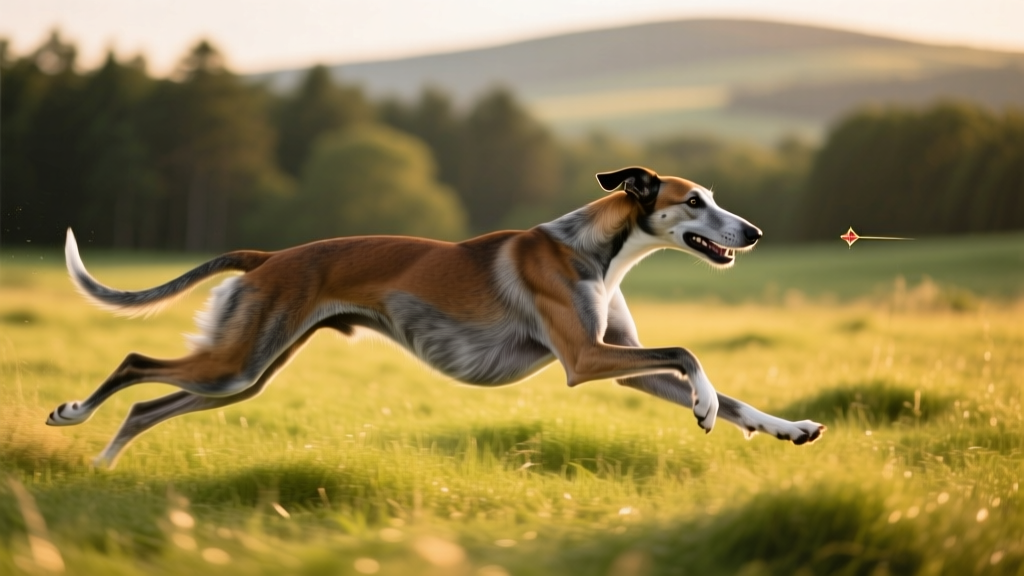
The double-suspension gallop — where all four feet leave the ground twice per stride cycle (once gathered beneath the body, once fully extended) — is the hallmark gait of sighthounds. This gait is mechanically impossible for humans and most non-sighthound breeds, and it is what allows a deerhound dog to reach speeds of 35-40 mph within just a few strides.
On the neurochemical side, the act of chasing triggers a potent dopamine release in the brain's reward pathways. This is the same neurotransmitter system involved in human addiction, and it explains why a Deerhound appears "addicted" to chasing. Each successful pursuit reinforces the neural pathway, making the behavior more likely to recur. This is not stubbornness — it is neurochemistry.
Practical Implications: Living With a Deerhound Dog's Chase Drive
What This Means for Daily Life
- Never trust off-leash recall in unsecured areas. A deerhound dog that spots a deer at 400 yards will typically reach full sprint within 3-4 seconds. At 38 mph, they can cover a quarter-mile in roughly 25 seconds — far faster than most owners can react or pursue. According to the Merck Veterinary Manual, predatory chase is one of the most difficult behaviors to modify because it is self-reinforcing.
- Minimum fencing: 6 feet, no gaps. Deerhounds can clear 5-foot fences from a standing start when motivated. A secure, fully enclosed yard is non-negotiable. Electric/invisible fences are ineffective — the dog's chase drive will override the pain of the shock collar stimulus.
- Structured exercise minimum: 60-90 minutes daily, split between leash walking and secured-area free running. A Deerhound that does not get to run will redirect that energy into destructive behaviors or become depressed and lethargic.
- Use a martingale collar or harness on walks. Sighthound necks are nearly as wide as their heads, making standard buckle collars easy to slip. A properly fitted martingale collar (priced $12-$25 from brands like Ruffwear or Country Brook Design) prevents escape without choking.
- Leash reactivity management: Many Deerhounds become leash-frustrated when they see potential prey they cannot chase. This is not aggression — it is thwarted drive. Counter-conditioning with high-value treats (freeze-dried liver, $18-$28 per 8 oz bag) at sub-threshold distances can reduce this over time using positive reinforcement methods.
Enrichment That Channels the Instinct
Rather than trying to suppress the chase drive (which is neurologically impossible), successful Deerhound owners redirect it:
- Lure coursing: A sport where dogs chase a mechanically dragged lure across a field. Entry fees for AKC lure coursing trials typically range $25-$45 per event. This is the single best outlet for a Deerhound's prey drive.
- Flirt pole sessions: A wand toy with a lure dragged along the ground. 10-15 minute sessions, 3-4 times weekly, can significantly reduce frustration. Cost: $20-$40 for a quality pole (Squishy Face Studio or Outward Hound models).
- Scent work: While sighthounds are primarily visual hunters, introducing nose work games provides complementary mental stimulation and can build a stronger recall foundation.
Common Misconceptions About Deerhound Prey Drive
| Myth | Fact |
|---|---|
| "My Deerhound will outgrow the chasing phase." | Prey drive in sighthounds does not diminish with age. A 10-year-old Deerhound may be slower, but the neurological impulse to chase remains intact throughout life. |
| "If I train hard enough, my Deerhound will reliably come back off-leash." | Even expertly trained sighthounds have a failure rate near 100% when a high-value prey stimulus appears at distance. The subcortical chase reflex overrides trained recall. This is why positive reinforcement trainers recommend never trusting off-leash freedom outside fully secured areas. |
| "Deerhounds are aggressive because they chase small animals." | Chasing is predatory behavior, not aggression. Aggression involves intent to threaten or harm a social rival. A Deerhound chasing a cat is expressing prey drive, not hostility. Many Deerhounds coexist peacefully with cats they were raised alongside, though introductions require careful management. |
| "Deerhounds are lazy — they just sleep all day." | Sighthounds are famously "45-mph couch potatoes" — they conserve energy between exercise bouts with deep rest. This is normal physiological recovery, not laziness. They still require 60-90 minutes of structured activity daily. |
| "A tired Deerhound is a well-behaved Deerhound." | Physical exhaustion alone is insufficient. Without mental enrichment and instinct outlets (lure coursing, flirt poles), a physically tired Deerhound may still exhibit frustration behaviors. Mental stimulation is equally important. |
When Chase Drive Signals a Problem
While a strong prey drive is entirely normal for a deerhound dog, certain behavioral shifts can indicate underlying medical or psychological issues:
Consult Your Veterinarian If You Notice:
- Sudden intensification of chase behavior in a previously calm adult — may indicate hyperthyroidism (rare in dogs but documented) or neurological changes
- Chasing shadows, light reflections, or tails obsessively — this is not normal prey drive but may indicate compulsive disorder (canine compulsive disorder, or CCD), which has been studied extensively in the Tufts Cummings School of Veterinary Medicine research
- Inability to disengage from chasing even when physically exhausted or injured — may suggest impaired impulse control linked to frontal cortex dysfunction
- Redirected aggression — biting or snapping at the owner when physically restrained from chasing — this requires immediate behavioral consultation with a certified applied animal behaviorist (CAAB) or veterinary behaviorist (DACVB)
- New-onset chasing in a senior Deerhound (8+ years) combined with disorientation or night waking — may signal canine cognitive dysfunction (CCD/dog dementia)
Always consult your veterinarian before attempting to modify behavior that may have a medical basis. A full physical exam and bloodwork panel ($150-$350 depending on region) can rule out physiological causes.
Breed Variations: How the Deerhound Compares to Other Sighthounds
While all sighthounds share the visual coursing instinct, the deerhound dog's expression of prey drive differs from related breeds in measurable ways:
| Breed | Top Speed | Chase Style | Prey Drive Intensity |
|---|---|---|---|
| Scottish Deerhound | 35-40 mph (56-64 km/h) | Endurance coursing; sustained pursuit over rough terrain | Very High |
| Greyhound | 40-45 mph (64-72 km/h) | Sprint specialist; explosive acceleration over flat ground | Very High |
| Whippet | 30-35 mph (48-56 km/h) | Sprint/middle-distance; highly agile | High |
| Saluki | 35-42 mph (56-68 km/h) | Desert endurance courser; heat-tolerant | Very High |
| Italian Greyhound | 25 mph (40 km/h) | Short sprint; companion-adapted | Moderate-High |
| Borzoi | 35-40 mph (56-64 km/h) | Wolf-coursing; powerful grab-and-hold | Very High |
The Deerhound's distinguishing feature among these breeds is its combination of large body mass (75-110 lb / 34-50 kg) with endurance-oriented coursing. A Greyhound will outrun a Deerhound over 400 yards, but a Deerhound was historically expected to pursue a red deer over miles of Highland terrain — a task requiring sustained effort, rough-ground agility, and the physical power to grapple with large game.
Frequently Asked Questions
Can a deerhound dog live with cats or small dogs?
Some Deerhounds coexist peacefully with cats, particularly when raised together from puppyhood. However, this is an individual assessment — not a breed guarantee. A Deerhound that tolerates the family cat may still chase a cat that runs in the yard. Introductions should be done gradually with the Deerhound on leash and muzzled for initial sessions. Small dogs can trigger prey drive if they run or squeak, so supervision is essential. Never leave a Deerhound unsupervised with small pets regardless of their prior history.
Is it normal for my Deerhound to stare intently at things I can't see?
Yes. The Deerhound's visual streak retina detects motion at distances and in low-light conditions where the human eye cannot. Your dog may be watching a bird, rodent, or leaf movement 200+ yards away. This "sighthound stare" — head raised, ears pricked, body frozen — is the Orient phase of the predatory sequence and is completely normal.
How is a Deerhound's vision different from a human's?
Humans have trichromatic color vision (three cone types) with high-acuity central focus. Deerhounds have dichromatic vision (two cone types, seeing blues and yellows) but far superior motion detection and low-light sensitivity due to a reflective layer behind the retina called the tapetum lucidum. Their visual acuity for stationary objects is lower than humans (roughly 20/75 equivalent), but their motion detection threshold is dramatically better — they can identify a moving object at distances where a human would see nothing.
What does it mean when my Deerhound's tail goes straight up and stiff during a walk?
A high, stiff tail in a sighthound signals heightened arousal — often that they have visually identified something of interest. This is the transition from the Orient phase to the Eye/Stalk phase of the predatory sequence. It is a warning to the handler that the dog is preparing to chase. Shorten the leash, redirect attention with a treat or cue, and move away from the stimulus if possible.
Is prey drive the same as aggression in deerhound dogs?
No. Prey drive is a food-acquisition behavior directed toward fleeing targets. Aggression is a social behavior directed toward perceived threats or competitors. A Deerhound chasing a rabbit is not "angry" at the rabbit — it is expressing an ancient hunting program. Aggression toward humans or other dogs is a separate behavioral issue that should be evaluated by a veterinary behaviorist. Conflating the two leads to misdiagnosis and inappropriate interventions.
Can I use an e-collar (shock collar) to stop my Deerhound from chasing?
Aversive tools like shock collars, prong collars, and alpha rolls are not recommended by the American Veterinary Society of Animal Behavior (AVSAB) and are counterproductive for sighthounds. A Deerhound's chase drive is strong enough that the pain of a shock will often be ignored during a pursuit — and the associated pain can create fear-based reactivity toward the handler or the environment. Force-free management (secure fencing, long-line training, lure coursing outlets) is the evidence-based approach.
Sources & Further Reading
- McGreevy, P. et al. (2004). "Retinal ganglion cell distribution in the dog." Journal of Comparative Neurology. PubMed
- American Kennel Club. "Scottish Deerhound Breed Standard." AKC.org
- Merck Veterinary Manual. "Undesirable Behaviors in Dogs." MerckVetManual.com
- Overall, K.L. (2013). Manual of Clinical Behavioral Medicine for Dogs and Cats. Elsevier.
- American Veterinary Society of Animal Behavior (AVSAB). Position Statement on Punishment. AVSAB.org
Anouk Beaumont
All our authors care for dogs every day — read more of their work on the authors page.