The Siberian Breed of Dog Few People Know: Yakutian Laika Guide
Discover the Yakutian Laika, a rare Siberian breed of dog built for Arctic work.

A Siberian Breed of Dog That Predates Modern Sled Racing
When most people think of a Siberian breed of dog, the Siberian Husky or Samoyed comes to mind. But the Yakutian Laika (Yakutskaya Laika) is one of the oldest working dogs from the Russian Arctic — a versatile spitz that herded reindeer, pulled sleds, and hunted bears across some of the most unforgiving terrain on Earth. Despite its centuries-long history, this breed remains genuinely rare outside Russia, and even dedicated spitz enthusiasts are often surprised by its existence.
This guide covers everything a prospective owner or curious researcher needs to know about the Yakutian Laika: its origins in the Sakha Republic, its physical and behavioral traits, breed-specific health data, realistic ownership costs, and how it compares to the more familiar Siberian Husky and Alaskan Malamute.
Origin and Historical Purpose: Born in the Coldest Place on Earth
The Yakutian Laika developed in the Sakha Republic (Yakutia), a region in northeastern Siberia where winter temperatures routinely drop below −50°F (−45°C). The indigenous Yakut (Sakha) people relied on these dogs for three core tasks:
- Sled pulling — transporting people, goods, and mail across frozen rivers and tundra
- Reindeer herding — driving and guarding semi-domesticated herds
- Hunting — tracking and holding large game including bear, moose, and Arctic fox
Estimated Timeline of the Yakutian Laika
- Pre-1600s: Aboriginal spitz-type dogs present in Yakutia; archaeological remains of sled dogs in the region date back 8,000+ years
- 1600s–1800s: Yakut people selectively breed dogs for multi-purpose Arctic work; Russian explorers document "Yakut dogs" in expedition journals
- 1843: The breed is first described in scientific literature by Russian naturalist Ivan Pavlovsky
- Mid-1900s: Mechanization (snowmobiles, aircraft) causes a sharp decline; the breed nearly goes extinct
- 1998: Revival effort begins — cynologists Vladimir Dyachkov and Lyudmila Sidorchuk establish a breeding program in Yakutsk
- 2004: Russian Kynological Federation (RKF) publishes the official breed standard
- 2019: FCI grants provisional recognition (Group 5, Section 1 — Nordic Sled Dogs)
The breed is not recognized by the AKC as of 2026, though it is listed in the AKC Foundation Stock Service (FSS), which is the preliminary step toward full recognition. The United Kennel Club (UKC) recognizes the Yakutian Laika in the Northern Breed Group. The FCI's provisional acceptance has helped standardize breeding in Europe, but the global population remains small — estimated at fewer than 5,000 registered dogs worldwide.
Physical Traits and Measurements
| Attribute | Details |
|---|---|
| Weight (male) | 55–66 lb / 25–30 kg |
| Weight (female) | 44–55 lb / 20–25 kg |
| Height (male) | 21–23 in / 53–58 cm at withers |
| Height (female) | 20–22 in / 51–55 cm at withers |
| Lifespan | 12–15 years |
| Coat | Double coat; dense undercoat; straight outer coat 3–5 in long; pronounced neck ruff |
| Colors | Black & white, gray & white, white with spots, red & white, sable — solid colors are not accepted per FCI standard |
| Eyes | Almond-shaped; blue, brown, or one of each (heterochromia is common and accepted) |
| Tail | Thick, carried in a curl over the back; may be sickle-shaped |
| Energy Level | High — 60–90 minutes of vigorous activity daily |
| Grooming | Heavy seasonal shedding; brushing 3–4×/week during blow-out periods |
| Family Fit | Good with children when socialized; high prey drive with small animals |
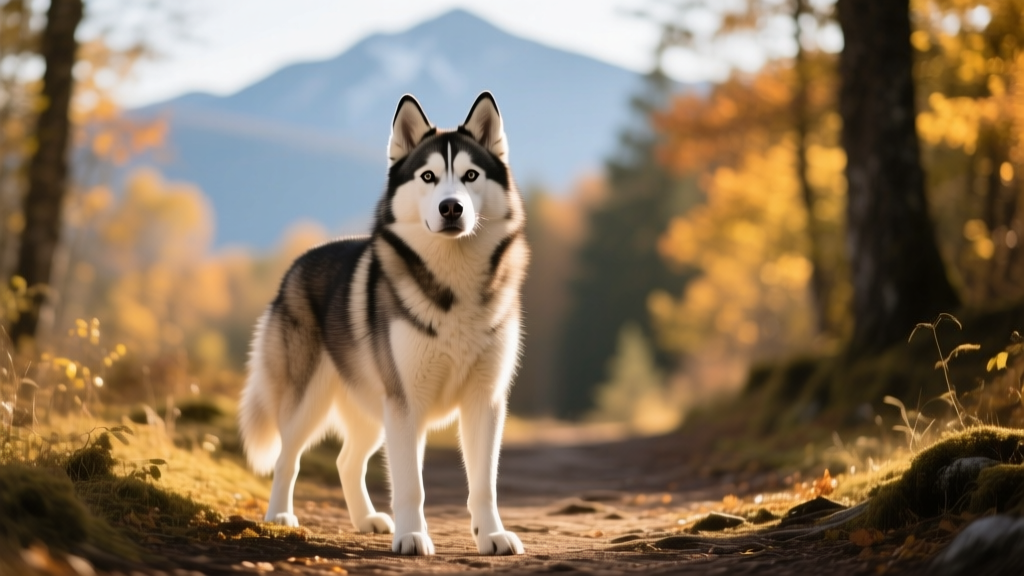
What sets the Yakutian Laika apart visually from a Siberian Husky is its stockier build, heavier bone structure, and more pronounced neck ruff. The coat is longer overall — particularly on the hindquarters, where feathering creates a distinct "trouser" effect. The ears are triangular and erect but slightly rounded at the tips, giving a softer expression than the sharper-eared Husky. Heterochromia (one blue eye, one brown) is frequent and considered a hallmark of the breed, not a fault.
Temperament: What Surprises New Owners
Most first-time Yakutian Laika owners expect a dog that behaves like a Siberian Husky — aloof, independent, and single-minded about running. The reality is more nuanced, and this is where the breed genuinely surprises people:
They are noticeably more biddable than Huskies. Bred not just to pull sleds but also to herd reindeer and work closely with handlers, the Yakutian Laika has a stronger cooperative instinct. Owners consistently report that recall, while never guaranteed with any spitz breed, is more achievable here than with a Siberian Husky. That said, this is still a primitive working breed — positive reinforcement training with high-value rewards (freeze-dried liver, real meat) works far better than compulsion-based methods. Force-free trainers who have worked with the breed describe them as "willing partners, not obedient servants."
They are vocal — but differently than Huskies. Rather than the sustained howling and "talking" that Huskies are famous for, the Yakutian Laika tends toward alert barking and a distinctive low grumble when communicating with its owner. They are not typically nuisance barkers, but apartment living is still a poor fit due to their exercise needs and vocal tendencies.
They bond intensely to their family. Unlike some spitz breeds that are friendly-but-detached, the Yakutian Laika forms deep attachments and can develop separation anxiety if left alone for more than 4–5 hours regularly. They are not a breed you can leave in a backyard and check on twice a day.
Prey drive is significant. Bred to hunt Arctic fox and assist with bear, these dogs will chase squirrels, cats, and small dogs unless carefully socialized from 8 weeks of age. Even well-socialized individuals should not be trusted off-leash in unfenced areas with wildlife present.
Breed-Specific Health Concerns
Because the Yakutian Laika has a small global gene pool, prospective owners should understand the conditions that appear at higher-than-average rates. Always consult your veterinarian about breed-specific screening, and ask any breeder for OFA or equivalent health clearances on both parents.
| Condition | Description | Estimated Prevalence | Screening |
|---|---|---|---|
| Hip Dysplasia | Malformation of the hip socket causing arthritis over time | ~8–12% (based on limited OFA data) | OFA/PennHIP evaluation at 24 months |
| Eye Conditions (cataracts, PRA) | Progressive retinal atrophy and early-onset cataracts reported in some lines | ~5–7% estimated | Annual CERF/OFA ophthalmologist exam |
| Elbow Dysplasia | Abnormal elbow joint development; can cause front-leg lameness | Reported but not well-quantified; likely <5% | OFA elbow radiographs |
| Gastric Dilatation-Volvulus (Bloat) | Life-threatening stomach torsion; deep-chested breeds at higher risk | Risk elevated vs. average; exact rate unknown | Preventive: slow-feed bowls, no exercise 1 hr around meals |
| Autoimmune Thyroiditis | Immune-mediated destruction of thyroid tissue leading to hypothyroidism | Reported in several European lines | Annual thyroid panel (T4, free T4, TSH, antibodies) |
Because bloat (GDV) is a genuine emergency — dogs can deteriorate within 30–60 minutes — owners should know the signs: unproductive retching, distended abdomen, restlessness, and pale gums. If you observe any of these, go to the nearest emergency veterinary clinic immediately. Prophylactic gastropexy (surgically tacking the stomach to the abdominal wall) is an option to discuss with your veterinarian, typically performed during spay/neuter surgery for around $300–$600.
Special Care Requirements
Yakutian Laika Care Checklist
- Exercise: 60–90 min/day minimum. Sled pulling, bikejoring, canicross, and long trail hikes are ideal. A 20-minute walk around the block will not meet this dog's needs.
- Coat care: Brush 2–3×/week with an undercoat rake (e.g., Furminator Large or Chris Christensen Big G). During spring and fall blow-outs, daily brushing for 15–20 minutes is necessary. Never shave the coat — the double coat regulates both heat and cold.
- Cold tolerance: Extremely high. Comfortable working at −40°F (−40°C). In warm climates (above 80°F / 27°C), provide air conditioning, cooling mats, and exercise during early morning or late evening only.
- Diet: High-quality kibble or raw diet formulated for active/working breeds. Adults typically eat 2.5–3.5 cups of kibble daily (split into two meals) or an equivalent caloric raw ration (~1,500–2,000 kcal/day depending on activity). Look for AAFCO complete-and-balanced statements and a named animal protein as the first ingredient.
- Nail and dental care: Trim nails every 3–4 weeks. Brush teeth 3×/week minimum using enzymatic dog toothpaste; dental disease is not breed-specific but is the #1 preventable condition across all dogs.
- Mental stimulation: Puzzle feeders, scent work, and structured training sessions prevent destructive behavior. A bored Yakutian Laika will dig, chew, and attempt to escape.
How the Yakutian Laika Compares to Similar Breeds
| Trait | Yakutian Laika | Siberian Husky | Alaskan Malamute |
|---|---|---|---|
| Weight range | 44–66 lb | 35–60 lb | 75–100 lb |
| AKC recognition | FSS only | Full (1930) | Full (1935) |
| Trainability | Moderate-High | Moderate | Moderate |
| Prey drive | High | High | Very High |
| Separation anxiety risk | Moderate-High | Moderate | Moderate |
| Vocalization | Moderate (bark + grumble) | High (howl + talk) | Moderate (howl + "woo-woo") |
| Suitability for first-time owners | Low-Moderate | Low | Low |
| Puppy price (US) | $2,500–$5,000+ | $800–$2,500 | $1,500–$3,500 |
The Yakutian Laika occupies a middle ground: larger and more powerful than a Husky, but more tractable and handler-focused than a Malamute. For someone who wants a serious working-capable spitz with slightly better trainability than a Husky and a smaller footprint than a Malamute, the Yakutian Laika can be an excellent fit — provided they can meet the exercise and companionship demands.
Availability, Cost, and Finding a Responsible Breeder
This is where owning a Yakutian Laika gets challenging. The breed is extremely rare in the United States. As of 2026, there are fewer than a dozen active breeding programs in North America, and many US-based owners import puppies from Russia, Finland, or the Czech Republic.
Typical cost breakdown:
- US-bred puppy (from a rare domestic breeder): $2,500–$4,000
- Imported puppy (Europe or Russia): $3,000–$5,000 for the puppy + $1,500–$3,000 for shipping, import health certificates, and USDA endorsement
- First-year total ownership cost: $4,000–$7,000 (including purchase price, initial veterinary exams, core vaccines, spay/neuter, gear, food, and pet insurance)
- Annual ongoing cost: $1,800–$3,000/year (food, preventive medications, insurance, grooming supplies, routine vet care)
Red flags when evaluating a Yakutian Laika breeder:
- No health testing documentation on parents (OFA hips, elbows, eyes, thyroid)
- Unwillingness to share the pedigree or discuss genetic diversity
- Puppies available year-round with no waiting list — responsible breeders of rare breeds typically have 6–18 month waitlists
- No take-back clause in the contract — every reputable breeder will require the dog be returned to them if you cannot keep it
- Price significantly below $2,000 — this often signals a backyard breeder or puppy mill exploiting the breed's rarity
Start your search through the AKC Foundation Stock Service listings or connect with the Yakutian Laika Club of America (if active) or European breed clubs affiliated with the FCI. Be prepared to wait, travel, and answer extensive questions from the breeder about your experience, living situation, and activity level.
Is This Breed Right for You?
The Yakutian Laika is not recommended for first-time dog owners. It is best suited to:
- Experienced spitz or working-breed owners who understand primitive dog behavior
- Active households with access to outdoor space (minimum a securely fenced yard with 6-foot fencing — these dogs are capable climbers and diggers)
- Cold or temperate climates; hot climates require significant management
- People who work from home or can arrange mid-day companionship — 8+ hours alone daily will produce a stressed, destructive dog
- Families with older children (8+) who can participate in the dog's exercise and training
If you are drawn to the idea of a rare Siberian breed of dog but want something more readily available and with a larger support community, the Siberian Husky or the Samoyed offer similar aesthetics and energy with far more accessible breeding programs and veterinary familiarity.
Frequently Asked Questions
How rare is the Yakutian Laika today?
Very rare. The global registered population is estimated at fewer than 5,000 dogs, with the majority in Russia and Eastern Europe. In the United States, the breed is represented by a small number of dedicated breeders and imported dogs. You will almost never encounter one at a dog park.
Can a Yakutian Laika live in a warm climate?
It is possible but requires careful management. Air conditioning is mandatory, exercise must happen during cool hours, and owners must watch for heatstroke signs (excessive panting, drooling, lethargy, vomiting). The dog's double coat should never be shaved — it provides insulation against heat as well as cold. Breeds adapted to Arctic conditions are at higher risk of heat-related illness, so warm-climate owners must be vigilant.
Do Yakutian Laikas get along with other dogs?
Generally yes, especially with dogs of similar size raised together. Same-sex aggression can occur, particularly between intact males. Early socialization (from 8–16 weeks) with diverse dogs is critical. Dog parks are not recommended due to the breed's high prey drive and potential for rough play styles that smaller dogs cannot tolerate.
Are Yakutian Laikas good with cats?
Risky. Their hunting heritage gives them strong chase instincts. Some individuals can cohabit with a cat they are raised alongside from puppyhood, but this is never guaranteed. Introducing an adult Yakutian Laika to a household cat is generally not advisable.
What is the best type of exercise for this breed?
Activities that combine physical exertion with a job: sled pulling or carting (in winter), bikejoring or canicross (in cooler months), long-distance hiking with a dog backpack, and structured scent-work or obedience training. Free running in a secure area is beneficial but should supplement, not replace, structured activity.
How do I find a Yakutian Laika rescue or adoption?
Breed-specific rescues for the Yakutian Laika essentially do not exist in the US due to the tiny population. If a dog does become available, it is typically rehomed directly by the breeder. General spitz rescues (e.g., Northern Breed Rescue organizations) occasionally have Yakutian Laika mixes. Adoption is always a worthwhile path to explore, though patience is essential with a breed this rare.
Robin Maitland
All our authors care for dogs every day — read more of their work on the authors page.