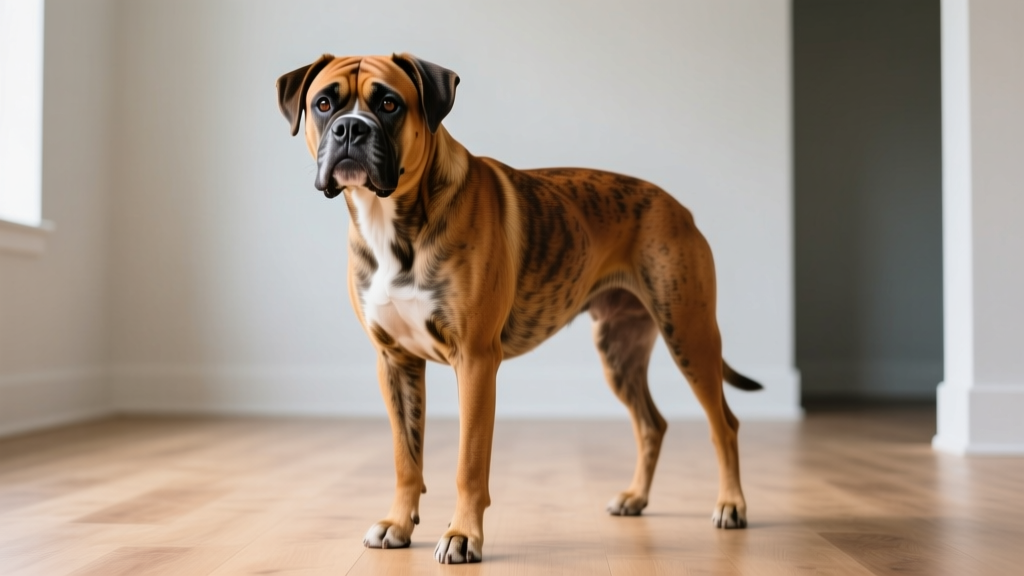
Staffordshire Bull Terrier Boxer Mix: Complete Breed Guide
Everything about the Staffordshire Bull Terrier Boxer mix — size, temperament, health risks, coat types, costs.

If you've encountered a muscular, broad-headed dog with the playful bounce of a Boxer and the tenacious loyalty of a Staffy, you may have met a Staffordshire Bull Terrier Boxer mix. Sometimes called a "Bull Boxer" or "Staffy Boxer," this cross pairs two athletic, people-oriented breeds into one energetic companion. But because mixed-breed dogs inherit traits unpredictably, knowing what to expect requires understanding both parent breeds in depth.
This guide breaks down exactly what prospective owners need to know about the Staffordshire Bull Terrier Boxer mix — from realistic size ranges and coat possibilities to health screening priorities and 2026 pricing — so you can decide whether this cross fits your household.
Parent Breed Breakdown: Staffy Meets Boxer
The Staffordshire Bull Terrier Boxer mix is a first-generation or multigenerational cross between two AKC-recognized breeds. Neither parent is a "designer" breed themselves — both have deep working-class roots. Here's how the two foundation breeds compare:
| Trait | Staffordshire Bull Terrier | Boxer |
|---|---|---|
| AKC Group | Terrier | Working |
| Weight Range | 24–38 lb (11–17 kg) | 50–80 lb (23–36 kg) |
| Height | 14–16 in (36–41 cm) | 21.5–25 in (55–64 cm) |
| Coat | Short, smooth, single-layer | Short, smooth, single-layer |
| Energy Level | High — needs 60–90 min/day | High — needs 60–120 min/day |
| Temperament | Courageous, affectionate, tenacious | Playful, alert, loyal |
| Lifespan | 12–14 years | 10–12 years |
| Shedding | Low to moderate | Moderate |
| Trainability | Moderate — responds to positive reinforcement | Moderate — can be willful |
Both breeds share a stocky, muscular build, short coats, and strong attachment to their families. Where they differ is scale — the Boxer is roughly twice the weight and significantly taller — and in certain behavioral tendencies. Staffies were originally bred for bull-and-terrier sports and later refined as companions, which gives them a high pain tolerance and a sometimes dog-selective social style. Boxers were developed as hunting and guard dogs in Germany, contributing a protective instinct and a bouncy, almost clownish demeanor.
Sources: AKC Staffordshire Bull Terrier, AKC Boxer
How Big Will a Staffordshire Bull Terrier Boxer Mix Get?
Because the parent breeds differ substantially in size, the resulting mix falls into a wide range. Most Staffordshire Bull Terrier Boxer mixes land somewhere between the two parents, but genetics don't split evenly.
F1 (First Generation): One purebred Staffy × one purebred Boxer. Most variable in appearance and size. Puppies in the same litter can look dramatically different.
F1B (Backcross): An F1 mix bred back to one of the parent breeds (usually the Boxer for larger size or the Staffy for smaller). Slightly more predictable leaning toward the backcross parent.
F2 (Second Generation): Two F1 mixes bred together. Produces the widest variation — some puppies may closely resemble one grandparent breed while others blend evenly.
Multigen: F2 or later generations bred selectively over time. Rare for this particular cross, as most breeders don't maintain dedicated Staffy-Boxer lines the way they do for Poodle mixes.
| Size Category | Weight | Height at Shoulder | Likely Scenario |
|---|---|---|---|
| Small end | 30–40 lb (14–18 kg) | 15–18 in (38–46 cm) | More Staffy-dominant inheritance; more common in F1 litters where smaller parent genes express strongly |
| Average | 40–60 lb (18–27 kg) | 17–21 in (43–53 cm) | Balanced blend; most common outcome for F1 crosses |
| Large end | 60–75 lb (27–34 kg) | 21–24 in (53–61 cm) | More Boxer-dominant inheritance; common in F1B backcrosses to Boxer |
The honest answer: you won't know exactly how big an F1 puppy will get until they're 12–18 months old. Males tend to cluster toward the larger end and females toward the smaller, but individual variation is significant. If size predictability matters for your living situation (apartment weight limits, for example), adopting an adult mix from a rescue removes this uncertainty entirely.
Temperament: What to Expect (and What Might Surprise You)
The Staffordshire Bull Terrier Boxer mix typically inherits high energy, strong human attachment, and a playful streak from both parents. But temperament in mixed breeds is a spectrum, not a guarantee.
Best-Case Scenario
Your dog is gregarious, bouncy, and deeply bonded to the family. They greet visitors with enthusiasm (perhaps too much — both breeds are notorious jumpers), play well with children they've been raised alongside, and settle nicely after adequate exercise. They're eager enough to please that positive reinforcement training clicks quickly. Think of a dog that's part athlete, part clown, part lapdog.
Challenging Scenario
Some individuals inherit the Staffy's dog-selectiveness or same-sex aggression tendencies, combined with the Boxer's protective wariness of strangers. Without early socialization, this can manifest as leash reactivity, resource guarding, or difficulty introducing new dogs to the household. Both breeds can be stubborn during training sessions that lack engagement, and adolescent dogs (8–18 months) may test boundaries persistently.
Trait Variability Breakdown
| Trait | More Staffy-Like | More Boxer-Like | Blended Outcome |
|---|---|---|---|
| Social Style with Dogs | Selective; may prefer humans | Generally sociable; playful | Moderately sociable; needs structured introductions |
| Stranger Response | Indifferent to friendly | Alert and watchful | Brief alert bark, then warms up |
| Play Style | Tug, wrestling, mouthy | Boxing with paws, bouncing | Combination — pawing and mouthing during play |
| Separation Tolerance | Low — prone to anxiety | Low — thrives on company | Low — plan for minimal alone time (under 4 hours) |
| Trainability | Food-motivated but can be stubborn | Intelligent but easily bored | Needs short, varied sessions with high-value rewards |
Both parent breeds score high on attachment to their people. This is wonderful for bonding but means this mix is a poor fit for households where the dog would be left alone for 8+ hours daily. Separation anxiety is a realistic concern, not a rare exception.
Coat, Shedding, and Grooming Reality
Neither the Staffordshire Bull Terrier nor the Boxer carries a recessive long-hair gene or a curl gene, so this mix will virtually always have a short, smooth, single-layer coat. There are no "fluffy" Staffy-Boxer mixes.
No. Neither parent breed is hypoallergenic or low-shedding. This mix sheds moderately year-round with seasonal increases in spring and fall. People with dog allergies should not expect this cross to be tolerable. If low-shedding is a priority, this is not the right mix for you.
Grooming routine:
- Brushing: 2–3 times per week with a rubber curry brush (like a Kong ZoomGroom, ~$8–12) or a bristle brush. This removes loose hair and distributes skin oils.
- Bathing: Every 4–8 weeks, or as needed. Use a gentle oatmeal-based dog shampoo. Over-bathing strips coat oils and can worsen skin allergies both breeds are prone to.
- Nail trims: Every 2–4 weeks. Both breeds are active enough that some nail wear occurs naturally, but most dogs still need regular trims.
- Ear cleaning: Monthly, or more often if the dog inherits the Boxer's dropped ears, which trap moisture and debris.
- Dental care: Daily tooth brushing is ideal. Both breeds are prone to dental disease, and starting early prevents costly extractions later.
One note on skin: both Staffies and Boxers are overrepresented for atopic dermatitis (environmental allergies). The mix may inherit sensitive skin that reacts to grass, pollen, or certain food proteins. If you notice persistent paw licking, ear redness, or belly rashes, consult your veterinarian for allergy testing rather than switching foods repeatedly on your own.
Health Considerations: Hybrid Vigor vs. Reality
There's a persistent myth that mixed-breed dogs automatically escape the health problems of their parent breeds through "hybrid vigor." The reality is more nuanced. Hybrid vigor (heterosis) refers to the reduced likelihood of inheriting recessive genetic diseases when two unrelated gene pools combine. It does not eliminate conditions that both parent breeds share, nor does it protect against structural or developmental issues.
According to data from the Merck Veterinary Manual, crossbreed dogs do show lower incidence of some inherited disorders compared to purebreds, but they remain susceptible to any condition prevalent in both parent lines.
Conditions to Screen For
| Condition | Inherited From | Prevalence | Screening Method |
|---|---|---|---|
| Hip Dysplasia | Both breeds | Boxers: ~20% affected (OFA data); Staffies: ~12% | OFA or PennHIP radiographs at 24 months |
| Elbow Dysplasia | Both breeds (more common in Boxers) | Boxers: ~15% | OFA elbow radiographs |
| Heart Conditions (Aortic Stenosis, Cardiomyopathy) | Boxer primarily | Boxers: up to 25% for ARVC (Boxer cardiomyopathy) | Cardiac exam + echocardiogram; Holter monitor for ARVC |
| L-2-HGA (L-2-Hydroxyglutaric Aciduria) | Staffordshire Bull Terrier | Staffies: carrier rate ~15% in some lines | DNA test — both parents should be tested clear |
| Hereditary Cataracts (HC) | Staffordshire Bull Terrier | Staffies: carrier rate varies by line | DNA test (HIPS/HC panel) |
| Degenerative Myelopathy (DM) | Boxer primarily | Boxers: carrier rate ~15–20% | DNA test — SOD1 mutation screening |
| Atopic Dermatitis | Both breeds | High in both — estimated 20–30% of Boxers | Clinical diagnosis; allergy panel if severe |
| Brachycephalic Issues | Boxer (moderate) | Boxers are mesocephalic-to-brachycephalic | Physical exam — watch for snoring, exercise intolerance, heat sensitivity |
What this means practically: If buying from a breeder, both parent dogs should have OFA hip and elbow scores, a cardiac clearance (Boxer parent especially), and DNA clearances for L-2-HGA, HC, and DM. Request documentation — not verbal assurances. For rescue dogs, baseline veterinary screening within the first month should include a cardiac auscultation and hip evaluation if any gait abnormalities are noted.
Expected lifespan: 10–14 years, with the mix typically falling between the parent breed averages. Smaller individuals may trend toward the longer Staffy lifespan; larger, Boxer-dominant dogs may cluster around 10–12 years.
- Sudden rear-leg weakness or dragging (possible DM or spinal issue)
- Exercise collapse, fainting, or persistent cough (cardiac concern — especially Boxer-line ARVC)
- Seizures or behavioral changes (possible L-2-HGA in Staffy-line dogs)
- Difficulty breathing in heat or after mild exertion (brachycephalic airway concern)
- Chronic skin infections or hot spots that don't resolve with basic treatment
Always consult your veterinarian if you observe these symptoms. Early intervention significantly improves outcomes for cardiac and neurological conditions.
Exercise, Training, and Mental Stimulation
This is a high-energy, high-drive cross that needs structured daily activity. "A walk around the block" will not suffice — under-exercised Staffy-Boxer mixes tend to develop destructive chewing, excessive barking, or hyperactive indoor behavior.
Daily exercise targets:
- 60–90 minutes total for most adults
- At least 20–30 minutes of vigorous activity (running, fetch, flirt pole, swimming)
- Structured leash walking with training elements (heel work, automatic sits at curbs)
- Mental enrichment: puzzle feeders, snuffle mats, frozen Kongs, or scent work games
Training approach: Both breeds respond best to positive reinforcement — food rewards, toy rewards, and praise. Force-free methods build trust and engagement. Shock collars, prong collars, and alpha rolls are counterproductive and can trigger the defensive responses these breeds are genetically primed for. If you're new to training, invest in a group class or a certified force-free trainer (look for CPDT-KA or IAABC credentials).
Socialization priority: Given the Staffy's potential dog-selectiveness, plan structured, positive socialization from puppyhood through adolescence. This doesn't mean dog parks (which are unpredictable and often overwhelming) — it means controlled parallel walks with known-stable dogs, supervised play dates, and counter-conditioning to other dogs at a distance if reactivity emerges.
Cost: Purchase Price, Adoption, and Annual Care
The Staffordshire Bull Terrier Boxer mix is not as commercially produced as Poodle-based designer breeds, which affects both availability and pricing.
| Source | Price Range | What's Typically Included |
|---|---|---|
| Responsible Breeder (health-tested parents) | $800–$2,000 | Health testing documentation, first vaccinations, deworming, microchip, early socialization, take-back clause |
| Casual/Backyard Breeder | $300–$700 | Often minimal — may lack health testing, vet checks, or support |
| Breed-Specific Rescue (Staffy or Boxer rescue) | $200–$450 | Spay/neuter, vaccinations, microchip, behavioral assessment, foster evaluation |
| General Shelter/SPCA | $50–$300 | Basic vetting; varies widely by organization |
First-year total cost estimate: $2,500–$5,000 including purchase/adoption fee, initial veterinary exams, vaccinations, spay/neuter (if not included), crate, leash gear, food, training classes, and pet insurance enrollment.
Annual ongoing costs: $1,500–$3,000 per year for food ($50–$90/month for a 40–60 lb dog on quality kibble), routine veterinary care, preventives (heartworm, flea/tick — approximately $300–$500/year), grooming supplies, toys, and insurance premiums ($40–$80/month depending on coverage and location).
A note on breed-specific legislation (BSL): Depending on your jurisdiction, a dog that visually resembles a pit bull-type breed may face housing restrictions, insurance surcharges, or municipal breed bans. The Staffordshire Bull Terrier is commonly listed in BSL ordinances. Before committing to this mix, check your city/county regulations, your homeowner's or renter's insurance policy, and your lease agreement. Local laws vary significantly, and this is a practical consideration — not a political one.
Who Is This Mix Best Suited For?
The Staffordshire Bull Terrier Boxer mix thrives in specific household setups and can struggle in others. Here's an honest assessment:
| Factor | Good Fit | Poor Fit |
|---|---|---|
| Experience Level | Intermediate to experienced owners comfortable with strong, energetic dogs | First-time owners without trainer support |
| Activity Level | Active households — runners, hikers, families with yards | Mostly sedentary lifestyles; long work-from-office absences |
| Children | Families with children aged 8+ who understand dog body language; both breeds are known for patience with kids they're raised with | Toddlers without constant supervision — these are powerful, bouncy dogs |
| Other Pets | Single-dog homes or homes with opposite-sex, well-socialized resident dogs | Multi-dog homes with same-sex dogs; homes with small pets (high prey drive possible) |
| Housing | Homes with fenced yards; apartments if owner commits to rigorous daily exercise | Housing with breed restrictions; no outdoor access |
| Time Commitment | Owners home most of the day or able to arrange midday visits | 12+ hour daily absences; frequent travel without dog-care plans |
Frequently Asked Questions
What two breeds make up the Staffordshire Bull Terrier Boxer mix?
The Staffordshire Bull Terrier (a compact, muscular terrier from England, 24–38 lb) and the Boxer (a larger working breed from Germany, 50–80 lb). These are two distinct, AKC-recognized purebreds.
How big will this mixed breed get?
Most fall between 30–75 lb (14–34 kg) and 15–24 inches at the shoulder. The average lands around 40–60 lb. Exact size depends on which parent's genes express more strongly, and this is genuinely unpredictable in F1 litters.
What will the temperament be like?
Expect a loyal, energetic, people-oriented dog with moderate to high play drive. Dog sociability varies — some individuals are friendly with all dogs, others are selective. Early socialization and positive reinforcement training are essential regardless of individual disposition.
Is this mix hypoallergenic or low-shedding?
No. Both parent breeds have short, single coats that shed moderately. This mix is not suitable for allergy sufferers.
What health issues might this mix inherit?
Key concerns include hip dysplasia, cardiac conditions (especially Boxer-related ARVC and aortic stenosis), L-2-HGA and hereditary cataracts (from the Staffy side), degenerative myelopathy, and atopic dermatitis. Reputable breeders screen parent dogs for all testable conditions.
How much does a Staffordshire Bull Terrier Boxer mix cost?
From a responsible breeder: $800–$2,000. Through breed-specific rescue: $200–$450. First-year total ownership costs typically range from $2,500–$5,000 including initial veterinary care, supplies, and training.
Are Staffy-Boxer mixes good with children?
Both parent breeds have reputations for being patient and affectionate with children they're raised alongside. However, these are strong, energetic dogs that can accidentally knock over small children during play. Supervision is non-negotiable for children under 8, and all children in the home should be taught to read canine body language and respect the dog's rest time.
Can I find this mix in a shelter?
Yes — Staffy and Boxer mixes are relatively common in shelters and breed-specific rescues. Organizations like Staffy Rescue USA and American Boxer Club Rescue often have mixed-breed dogs available. Adopting an adult removes the size and temperament guesswork inherent in puppies.
This article is for informational purposes and does not replace professional veterinary advice. Always consult your veterinarian for health decisions specific to your dog.
Jonas Cole
All our authors care for dogs every day — read more of their work on the authors page.