Top Dog Breeds for Remote Workers in 2026: WFH Guide
Discover the best dog breeds for remote workers in 2026. Learn the psychology behind WFH-friendly dogs and how their instincts match your home office routine.
The Psychology of the Work-From-Home Dog in 2026
As we navigate the deeply entrenched remote work culture of 2026, the home office has evolved from a temporary setup into a permanent, highly optimized environment. For the millions of professionals now working exclusively from home or managing flexible hybrid schedules, choosing a canine companion is no longer just about finding an adorable pet. It is about finding a co-worker whose psychological profile, energy levels, and breed instincts align with a sedentary, screen-heavy lifestyle. Not all dogs are built for the quiet hum of a laptop, the confined space of a home office, or the sudden, jarring sounds of video conferencing software. Understanding the behavioral psychology behind specific breeds is the absolute key to maintaining a harmonious and productive home office.
Dogs are highly attuned to human routines and emotional states. In a remote work environment, your dog is exposed to your stress levels, your sedentary periods, and your intense focus. Breeds that possess high 'emotional contagion'—the ability to mirror human emotions—can either become wonderful stress-relievers or develop anxiety if they misinterpret your focused silence as tension. Therefore, the best work-from-home (WFH) dogs are those with a stable nervous system, a low prey drive, and a genetic predisposition for companionship rather than active working roles.
Instincts vs. Environment: Why High-Drive Breeds Struggle in Home Offices
Before diving into the best breeds, it is crucial to understand why certain popular breeds fail in a home office setting. Herding breeds, such as Border Collies and Australian Shepherds, possess a genetic mandate to control movement. In a home office, this instinct can manifest as pacing, nudging your elbows while you type, or even attempting to herd your children or pets during your breaks. Similarly, guardian breeds like German Shepherds or Livestock Guardian Dogs have heightened territorial instincts. Every delivery drone, smart doorbell chime, or passing car can trigger a barking episode that ruins a critical Zoom presentation.
Instead, remote workers need breeds with 'off-switches' built into their DNA. Setting up boundaries is also essential. According to the Humane Society, utilizing crate training and designated 'place' commands helps dogs understand the physical boundaries of your workspace, reducing anxiety and pacing behaviors during your working hours.
Top 5 Best Dog Breeds for Remote Workers
1. The Cavalier King Charles Spaniel (The Empathetic Shadow)
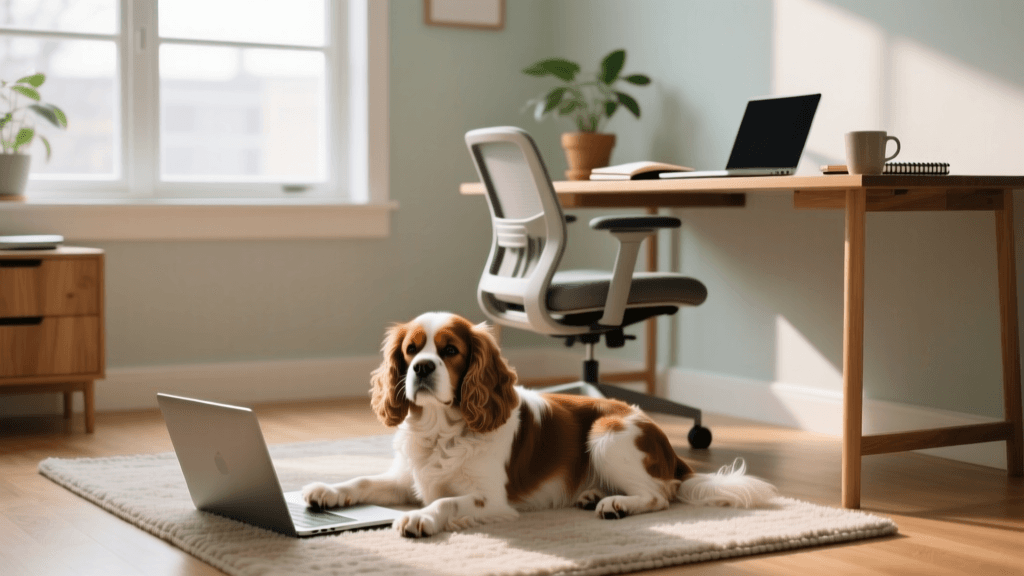
The Cavalier King Charles Spaniel is the quintessential 'velcro dog,' genetically selected over centuries for one primary purpose: to provide affectionate companionship. Psychologically, Cavaliers are highly empathetic and excel at reading human body language. If you are stressed during a tight deadline, a Cavalier is more likely to rest its head quietly on your foot rather than demand active play. Their low prey drive means they are rarely distracted by squirrels outside your window, and their moderate energy levels are easily satisfied with a morning walk and an evening stroll. They are the ultimate under-desk companions for deep-work sessions.
2. The Greyhound (The 45-MPH Couch Potato)
It is a common misconception that Greyhounds require massive amounts of exercise. In reality, they are sprinters, not marathon runners. Once their brief daily need for a short, high-speed run is met, their psychological drive shifts entirely to resting. Greyhounds are known to sleep up to 18 hours a day. For a remote worker who needs absolute silence during long stretches of coding or writing, a retired racing Greyhound is an ideal match. They are remarkably quiet, rarely bark, and are perfectly content to curl up on a dog bed in the corner of your office for the entire eight-hour workday.
3. The Basset Hound (The Low-Energy Co-Pilot)
Basset Hounds are scent hounds, meaning their brains are wired to process olfactory information rather than react to visual stimuli or auditory triggers. This makes them incredibly resilient to the typical distractions of a home environment. While a herding dog might react to a notification ping on your phone, a Basset Hound is far more likely to remain completely unfazed, likely snoring softly. Their stubborn nature actually works in your favor here; once they decide the floor beneath your standing desk is a comfortable spot, no amount of household noise will convince them to move. They are grounded, low-anxiety dogs that provide a calming physical presence.
4. The Shih Tzu (The Bred-to-Companion Lap Warmer)
Originating as royal companions in ancient China, the Shih Tzu has zero working drive. Unlike terriers that were bred to hunt vermin, or retrievers bred to fetch, the Shih Tzu's only historical job was to sit in the sleeves of royalty and provide warmth and affection. This deep-seated psychological contentment with inactivity makes them phenomenal WFH partners. They do not require a yard, they are highly adaptable to small apartment home offices, and their primary goal in life is to be in close physical proximity to their owner. They thrive on the passive attention they receive while you are seated at your desk.
5. The Bernese Mountain Dog (The Gentle Giant Anchor)
While they are a larger breed with a history as Swiss draft dogs, the Bernese Mountain Dog is renowned for its deeply bonded, gentle, and placid indoor temperament. They are 'leaners'—dogs that prefer to physically rest their weight against their owner's legs. For remote workers with spacious home offices, a Bernese provides a profound sense of grounding and emotional support. Their psychological need is simply to be near their 'pack.' As long as they have a large, orthopedic bed under or near your desk and receive adequate mental stimulation through sniff-walks on the weekends, they are remarkably quiet and unobtrusive co-workers.
Behavioral Comparison Chart: WFH Breed Traits
| Breed | Energy Level | Barking Tendency | Clinginess (Velcro Factor) | Best WFH Setup |
|---|---|---|---|---|
| Cavalier King Charles Spaniel | Low to Moderate | Low | Very High | Under-desk bed, lap access |
| Greyhound | Low (Indoors) | Very Low | Moderate | Large corner bed, quiet room |
| Basset Hound | Very Low | Moderate (Howling) | High | Floor space near entryway |
| Shih Tzu | Low | Moderate | Very High | Lap, heated desk pad |
| Bernese Mountain Dog | Moderate | Low | High | Oversized orthopedic mat |
Managing Territorial Instincts During Zoom Calls
Even the most laid-back breeds can develop reactive behaviors if their environment is constantly triggering them. In 2026, smart home ecosystems are ubiquitous, but the constant chiming of smart doorbells and delivery notifications can trigger a dog's territorial barking instinct, turning a peaceful workday into a chaotic one. The American Kennel Club emphasizes that managing the environment is the first step in stopping nuisance barking. Muting the internal chimes on your smart home hub, using visual doorbell alerts on your smartwatch instead of auditory room speakers, and utilizing white noise machines near your office door can drastically reduce your dog's alert barking during critical meetings.
Furthermore, training a solid 'place' command is non-negotiable for remote workers. By teaching your dog to go to a specific mat and remain there until released, you create a psychological boundary. The dog learns that when you sit at your desk and put on your headset, it is time to settle on their mat. This routine reduces the dog's anxiety about what they should be doing and allows you to focus entirely on your work.
Preparing Your Velcro Dog for Hybrid Off-Site Days
One of the greatest psychological risks for remote workers in 2026 is the sudden shift to hybrid schedules or mandatory off-site corporate retreats. Dogs that are accustomed to their owner's presence 24/7 can develop severe distress when left alone. This phenomenon, known as separation anxiety, is characterized by destructive behavior, excessive vocalization, and house-soiling. The ASPCA notes that separation anxiety is triggered by a sudden change in the dog's daily routine and the absence of their primary attachment figure.
To prevent this, remote workers must proactively build independence into their dog's psychological profile. Even if you work from home every day, you must practice 'micro-departures.' Leave the house for 20 minutes to get coffee without the dog. Utilize AI-powered pet cameras that allow you to monitor your dog's stress levels and dispense treats remotely, helping them associate your absence with positive outcomes. Provide long-lasting enrichment items, such as frozen puzzle toys, exclusively when you leave the house. By deliberately engineering periods of separation, you ensure that your velcro dog remains emotionally resilient, confident, and relaxed, whether you are sitting three feet away at your desk or across town at an office meeting.
Ultimately, the best dog breed for a remote worker is one whose genetic purpose aligns with the reality of your daily life. By prioritizing companionship instincts over working drives, and by proactively managing your home environment, you can cultivate a deeply rewarding partnership with a canine co-worker who makes the remote work experience infinitely better.
jonas-cole
All our authors care for dogs every day — read more of their work on the authors page.