Decoding Canine Calming Signals: Expert Behavior Guide
Learn to decode canine calming signals and displacement behaviors. Expert advice on reading dog body language to reduce anxiety and build trust.

The Hidden Language of Dogs: Beyond the Tail Wag
As humans, we are a highly vocal species. We rely on words, tone, and explicit facial expressions to convey our emotions and intentions. Dogs, however, operate in a completely different communicative paradigm. While they do use vocalizations like barking, whining, and growling, the vast majority of canine communication is visual, subtle, and deeply rooted in evolutionary survival mechanisms. To truly understand your dog, you must look beyond the obvious tail wags and learn to read the micro-expressions and postural shifts that dictate their emotional state.
From an expert behavior analysis perspective, misinterpreting these subtle cues is the leading cause of friction in the human-dog bond. When a dog exhibits stress, they rarely jump straight to aggression. Instead, they utilize a sophisticated repertoire of calming signals and displacement behaviors designed to de-escalate tension, appease perceived threats, and manage their own internal nervous system arousal. Recognizing these signals is not just an academic exercise; it is a fundamental requirement for ethical dog ownership and effective behavioral modification.
The Neurology of Canine Stress and Appeasement
Before diving into specific behaviors, it is crucial to understand the neurology driving them. When a dog perceives a stressor—whether it is an approaching stranger, a loud noise, or an overly enthusiastic toddler—their sympathetic nervous system activates. This triggers the release of cortisol and adrenaline, preparing the body for a fight, flight, freeze, or fawn response. In the domestic environment, physical flight or fighting is often restricted by leashes, fences, or training. Consequently, dogs rely heavily on the 'fawn' or appeasement response, which manifests as calming signals.
According to the American Kennel Club (AKC), understanding these stress indicators is vital for preventing behavioral fallout. When a dog's subtle appeasement signals are ignored by humans, the dog is forced to escalate their communication to more overt, and often dangerous, warning signs like snapping or biting. By intervening at the calming signal stage, we can prevent the dog from crossing their behavioral threshold.
Calming Signals vs. Displacement Behaviors
Coined by Norwegian dog trainer and behaviorist Turid Rugaas, 'calming signals' are specific behaviors dogs use to communicate peaceful intentions, de-escalate potential conflicts, and calm themselves down in stressful situations. These are deliberate communicative acts aimed at another individual (human or canine).
'Displacement behaviors,' on the other hand, are outlets for nervous energy. They occur when a dog experiences conflicting emotional drives—for example, the desire to greet a stranger coupled with the fear of that same stranger. The resulting neurological conflict causes the dog to perform a completely out-of-context behavior, such as sudden, intense scratching or sniffing the ground.
Top 5 Calming Signals and Displacement Behaviors
The following table breaks down common signals, how humans frequently misinterpret them, and the expert behavioral analysis of what is actually occurring.
| Behavior | Trigger Context | Common Human Misinterpretation | Expert Behavioral Analysis |
|---|---|---|---|
| Lip Licking | Approaching a larger dog, vet exam, or being hugged. | 'The dog is hungry, thirsty, or tasting the air.' | A rapid, repetitive flick of the tongue over the nose is a primary calming signal indicating mild to moderate stress and an attempt to self-soothe or appease the approaching entity. |
| Yawning | Arriving at the training facility or owner raising their voice. | 'The dog is tired or bored with the training session.' | When not associated with waking up, yawning is a massive stress indicator. It increases oxygen flow to the brain to prepare for a reaction and signals deep internal conflict or anxiety. |
| Looking Away / Head Turn | Direct eye contact from a human or a camera pointed at their face. | 'The dog is ignoring me or being stubborn.' | Direct eye contact is inherently confrontational in canine body language. Turning the head or showing the whites of the eyes (whale eye) is a polite request for space and de-escalation. |
| Sudden Sniffing | Another dog approaches too quickly or an unfamiliar person reaches out. | 'The dog is easily distracted or found an interesting smell.' | This is a classic displacement behavior. The dog is avoiding direct confrontation by pretending to be occupied, thereby signaling they are not a threat to the approaching individual. |
| Shaking Off | After a tense interaction, a tight hug, or a stressful vet handling. | 'The dog is wet or itchy.' | Known as a 'shake-off,' this is a physiological reset button. The dog is literally shaking off the accumulated adrenaline and cortisol from a stressful event to return to baseline. |
The 'Guilty Look' Myth: An Expert Re-evaluation
One of the most pervasive and damaging myths in dog ownership is the 'guilty look.' When a human comes home to find a shredded cushion and the dog is cowering, avoiding eye contact, with pinned ears and a tucked tail, the human assumes the dog feels guilt. Expert behavior analysis completely debunks this. Dogs do not possess the complex cognitive capacity for secondary emotions like guilt or shame, which require an understanding of moral frameworks.
Instead, the 'guilty look' is a cluster of intense appeasement behaviors. The dog is reading the human's angry body language, elevated voice, and tense posture. In response to this perceived threat, the dog deploys every calming signal in their arsenal to say, 'I see you are upset, please do not harm me.' Punishing a dog for this appeasement posture only increases their fear of the owner and damages the foundational trust required for a healthy relationship.
Actionable Protocols: How to Respond to Stress Signals
Identifying stress is only the first step. As an advocate for your dog, you must implement actionable protocols to help them manage their environment and emotional state. Here are expert-recommended strategies complete with specific gear, timing, and cost considerations.
1. Spatial Management and Threshold Distances
Every dog has a 'behavioral threshold'—the distance at which they notice a trigger but remain under their stress threshold (capable of learning and taking treats). If your dog exhibits lip licking and yawning when a stranger is 10 feet away, that distance is too close. You must manage the environment to keep the trigger at a sub-threshold distance, perhaps 25 or 30 feet. Use visual barriers like parked cars or fencing to break the dog's line of sight, which drastically reduces neurological arousal.
2. High-Value Treat Timing and Counter-Conditioning
When your dog notices a trigger at a safe distance, you must change their emotional response through counter-conditioning. The timing of your reward is critical: the treat must be delivered within 1 to 1.5 seconds of the dog noticing the trigger. Use high-value, easily consumable rewards. Zuke's Mini Naturals (typically costing $6.99 for a 6oz bag) are an industry favorite among behaviorists. They are under 3 calories per treat, feature real meat as the first ingredient, and can be consumed rapidly without breaking the dog's focus. Avoid hard biscuits that require excessive chewing, as chewing can sometimes increase frustration in highly aroused dogs.
3. Decompression Walks and Proper Gear
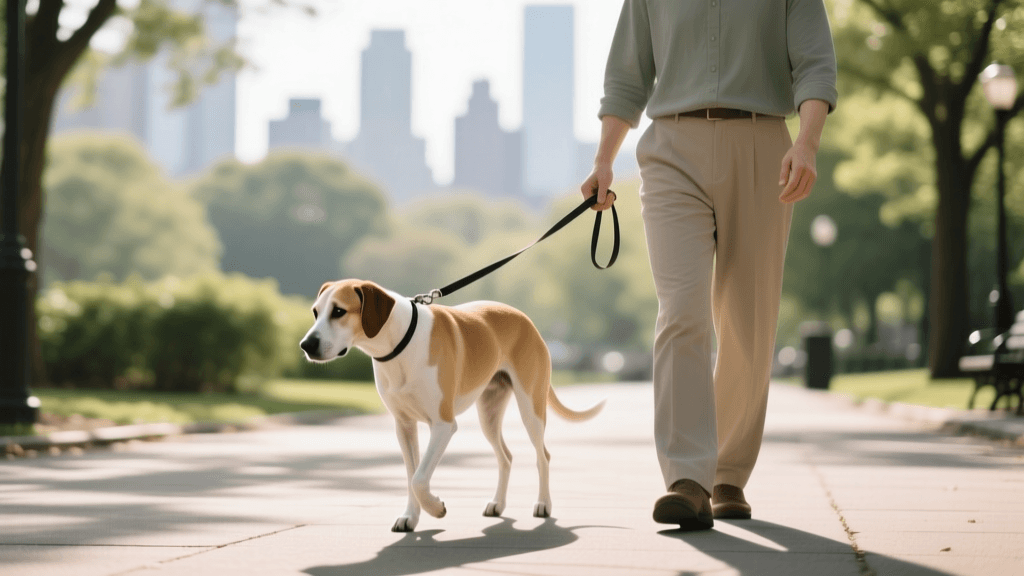
Structured, heel-focused walks do not allow a dog to process their environment or engage in natural stress-relieving behaviors like sniffing. Implement 'Sniffaris' or decompression walks 3 to 4 times a week. To do this safely, abandon retractable leashes (like the Flexi brand), which maintain constant tension and can cause tracheal damage or rope burn. Instead, invest in a 15-foot Biothane long line (costing between $25 and $40). Biothane is waterproof, durable, and doesn't tangle easily. Pair this with a well-fitted Y-front harness to ensure the dog's shoulders are unrestricted, allowing for natural, stress-free movement and sniffing, which has been proven to lower a dog's heart rate.
When to Call a Professional Behaviorist
While understanding calming signals empowers owners to manage mild to moderate stress, severe anxiety, fear-based aggression, or resource guarding requires professional intervention. If your dog is consistently crossing the threshold into freezing, lunging, or biting, it is time to seek expert help.
Look for professionals certified by reputable organizations such as the International Association of Animal Behavior Consultants (IAABC) or veterinary behaviorists certified by the American College of Veterinary Behaviorists (DACVB). Avoid trainers who rely on dominance theory, alpha rolls, or aversive tools like prong or shock collars, as these methods suppress warning signs without addressing the underlying emotional distress, often leading to a dog that 'bites without warning.' Expect to invest between $150 and $300 per hour for a certified behavior consultant, a worthwhile investment in your dog's welfare and your household's safety. Furthermore, consulting resources from Fear Free Pets can help you find veterinarians and professionals dedicated to reducing fear, anxiety, and stress in companion animals.
"Behavior is a conversation. When we take the time to learn our dog's native language, we transition from being their wardens to becoming their trusted advocates. Listen to the whispers of their calming signals so you never have to hear the shout of a bite."
Ultimately, decoding canine body language is an ongoing practice of empathy and observation. By respecting their boundaries, honoring their calming signals, and providing structured, positive support, you forge an unbreakable bond built on mutual understanding and profound trust.
hannah-wickes
All our authors care for dogs every day — read more of their work on the authors page.