Holistic Sniffaris: Understanding Canine Scent Psychology in 2026
Discover how holistic sniffaris and natural scent enrichment fulfill your dog's instinctual needs, reduce anxiety, and improve behavior in 2026.
The Shift Toward Holistic Canine Behavioral Science
As we navigate the evolving landscape of canine behavioral science in 2026, holistic and natural approaches to dog care have moved from niche alternatives to mainstream necessities. For decades, the standard advice for dog owners was to enforce strict, heel-oriented leash walks, prioritizing physical exhaustion over mental stimulation. However, modern holistic behaviorists now recognize that suppressing a dog’s natural instincts often leads to anxiety, leash reactivity, and chronic stress. At the core of this paradigm shift is a deeper understanding of canine scent psychology and the implementation of the holistic 'sniffari.' By allowing dogs to engage with their environment through their most powerful sense, we can naturally regulate their nervous systems, fulfill deep-seated breed instincts, and foster a profound psychological balance that traditional, force-based training methods simply cannot achieve.
The Neurological Power of the Canine Nose
To truly understand why natural scent enrichment is vital, we must first look at canine neurology. A dog's brain is hardwired for olfactory processing. While humans possess roughly six million olfactory receptors, dogs have up to 300 million, depending on the breed. Furthermore, the part of a dog's brain devoted to analyzing smells is proportionally 40 times greater than ours. According to the American Kennel Club, dogs also possess a secondary olfactory system known as the Jacobson's organ, or vomeronasal organ, which allows them to detect pheromones and chemical signals that dictate social and mating behaviors. When we rush a dog past a fire hydrant or a patch of grass, we are essentially blindfolding them. Holistic behaviorists in 2026 emphasize that denying a dog the opportunity to sniff is a form of sensory deprivation that directly contributes to behavioral issues like hyperactivity and destructive chewing at home.
The Psychology of Scent: Why Dogs Need to Sniff
From a psychological perspective, sniffing is a self-soothing behavior. When a dog engages in deep, sustained sniffing, their heart rate naturally decelerates, and their brain releases dopamine, a neurotransmitter associated with pleasure and reward. This natural chemical release lowers cortisol (the stress hormone) levels in the bloodstream. In holistic dog care, we view sniffing not as a distraction from training, but as a foundational pillar of emotional regulation. Dogs that are permitted to decompress and process their environment through scent are significantly less likely to exhibit fear-based reactivity toward other dogs or strangers. They are processing the 'news' of their neighborhood, reading the chemical left by other animals, and grounding themselves in their territory.
Breed-Specific Scent Instincts
Understanding your dog's specific breed lineage is crucial when designing a holistic enrichment plan. Different breeds process scent in unique ways based on their historical jobs:
- Scent Hounds (e.g., Beagles, Bloodhounds, Coonhounds): Bred to track ground scents over vast distances. These dogs require long, uninterrupted sniffing sessions in natural, wooded areas to fulfill their deep tracking drives.
- Terriers (e.g., Jack Russells, Cairn Terriers): Bred to hunt vermin underground. Their scent work is highly localized and intense. Holistic enrichment for terriers involves deep-sniffing in brush piles, digging boxes, and root systems.
- Herding Breeds (e.g., Border Collies, Australian Shepherds): While primarily visual and kinetic, herding breeds use scent to monitor the boundaries of their flock. They benefit from 'scent boundary' games where they map out the perimeter of a new park using their nose.
- Brachycephalic Breeds (e.g., Pugs, French Bulldogs): Due to their shortened airways, intense physical exercise in 2026's warming climate can be dangerous. Scent-based holistic enrichment provides the mental exhaustion they need without risking respiratory distress or heatstroke.
What is a Holistic Sniffari?
A holistic sniffari is a dog walk where the dog, not the human, dictates the pace, direction, and duration of the outing. The primary goal is not physical exercise or cardiovascular health, but rather sensory enrichment and mental decompression. During a sniffari, the leash is kept loose—ideally using a 10-to-15-foot biothane long line attached to a well-fitted, Y-front harness that allows full shoulder extension. The human's role shifts from 'director' to 'observer and guardian,' ensuring the dog remains safe while they process the olfactory landscape. This practice aligns perfectly with natural, force-free handling techniques that prioritize the dog's autonomy and emotional well-being.
Comparing Traditional Walks vs. Holistic Sniffaris
Understanding the physiological and psychological differences between these two approaches highlights why holistic practitioners heavily advocate for scent work. Below is a comparison based on 2026 canine behavioral studies:
| Feature | Traditional Heel Walk | Holistic Sniffari |
|---|---|---|
| Primary Sense Engaged | Visual / Kinetic | Olfactory |
| Heart Rate | Elevated (Cardio focus) | Lowered (Parasympathetic state) |
| Cortisol Levels | Can increase if dog is frustrated | Significantly decreases |
| Mental Fatigue | Low | Extremely High |
| Time Required | 30-60 minutes | 15-20 minutes (equals 1 hour of walking) |
| Leash Tension | High (Frequent corrections) | Low (Loose long-line) |
Designing a Natural Scent Enrichment Routine
Creating a natural scent enrichment routine requires minimal financial investment but yields massive behavioral dividends. The ASPCA strongly advocates for environmental enrichment as a primary tool for preventing behavioral issues in domestic dogs. Here is how to integrate holistic scent work into your 2026 routine:
1. The Backyard Forage
Instead of feeding your dog from a sterile stainless-steel bowl, scatter their daily kibble or natural, single-ingredient freeze-dried treats across your lawn. This mimics the natural foraging behavior of wild canids. The varying textures of grass, soil, and fallen leaves provide complex scent layers that challenge their olfactory bulb.
2. Natural Snuffle Mats and Dig Boxes
While commercial snuffle mats are popular, a truly holistic approach utilizes natural substrates. Create a designated 'dig box' filled with organic, pesticide-free topsoil, shredded untreated bark, and dried leaves. Bury natural chews (like elk antlers or dried sweet potato slices) beneath the surface. This satisfies the terrier instinct to dig and forage while keeping your landscaping intact.
3. Scent Mapping on Trails
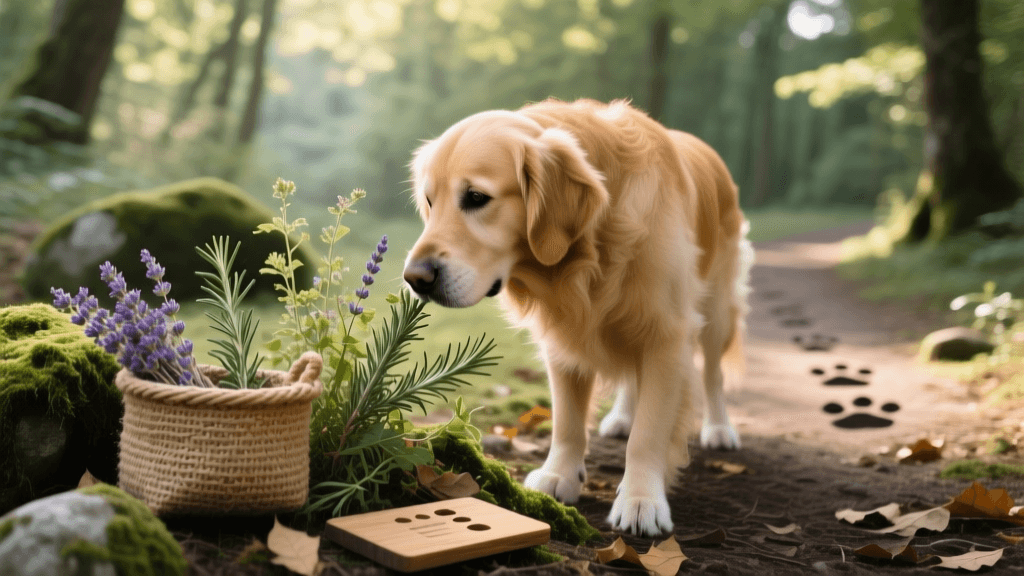
Take your dog to a natural, wooded trail rather than a paved suburban sidewalk. Paved areas are laden with synthetic chemical trails from tires, exhaust, and harsh municipal cleaning agents. Natural trails offer the complex, organic scents of wildlife, decaying flora, and damp earth that a dog's brain is evolutionarily designed to process.
Reading Your Dog's Calming Signals on a Sniffari
When you grant your dog the freedom to sniff, you will begin to notice subtle 'calming signals'—a concept pioneered by Norwegian canine behaviorist Turid Rugaas. These are natural body language cues dogs use to self-soothe and communicate peaceful intentions. During a successful sniffari, watch for:
- Deep, rhythmic breathing: The dog's ribcage expands fully as they draw in complex scent molecules.
- Soft, relaxed ears and eyes: Tension leaves the facial muscles, indicating a drop in sympathetic nervous system arousal.
- Slow, deliberate movements: Instead of frantic pulling, the dog moves methodically, tracking a scent trail with precision.
- Shake-offs: After an intense period of sniffing or encountering a strong scent (like deer urine), a dog will often 'shake off' from nose to tail. This is a natural neurological reset, physically releasing accumulated tension.
Safe Natural Scents and Botanicals for Enrichment
Holistic veterinarians in 2026 frequently recommend incorporating safe, natural botanicals into scent enrichment routines to promote relaxation, especially for dogs suffering from separation anxiety or noise phobias. You can create 'scent trails' in your home or yard using dog-safe essential oils (always heavily diluted in a carrier oil like fractionated coconut oil) or dried herbs.
- Lavender (Lavandula angustifolia): Known for its natural sedative properties. A few drops of diluted lavender oil on a bandana can help calm a reactive dog during a stressful sniffari in a busy park.
- Chamomile (Matricaria chamomilla): Excellent for soothing gastrointestinal nerves and promoting a relaxed state of mind. Scatter dried, organic chamomile flowers in the backyard forage zone.
- Valerian Root (Valeriana officinalis): Often used in holistic canine anxiety protocols. The earthy, pungent smell is highly stimulating for tracking games but promotes deep sleep afterward.
- Peppermint (Mentha piperita): Use with extreme caution and heavy dilution, but a tiny amount can provide a stimulating, invigorating scent trail for lethargic or senior dogs needing mental engagement.
Note: Always consult with a certified holistic veterinarian before introducing new essential oils or botanicals to your dog's environment, as some plants (like tea tree or eucalyptus) are highly toxic to canines.
Conclusion: Embracing the Nose to Heal the Mind
Understanding your dog requires looking at the world from their perspective—a world painted not in colors, but in rich, layered, three-dimensional scents. As we continue to advance our knowledge of canine psychology in 2026, the holistic sniffari stands out as one of the most effective, natural, and cost-free behavioral interventions available. By stepping back, loosening the leash, and allowing your dog to read the olfactory story of their environment, you are not just giving them a walk; you are providing a profound neurological and psychological therapy. Embrace the sniff, honor their instincts, and watch as your dog transforms into a calmer, more balanced, and deeply fulfilled companion.
aaron-whyte
All our authors care for dogs every day — read more of their work on the authors page.