Training Quiet Apartment Dog Breeds: 2026 Protocols
Discover 2026 training protocols to maintain calm, quiet behaviors in low-vocal apartment dog breeds using hallway desensitization and mat work.
The Myth of the Naturally Silent Apartment Dog
When urban dwellers search for the perfect canine companion in 2026, quiet dog breeds for apartments often top the list. Breeds like the Basenji, Greyhound, Cavalier King Charles Spaniel, and Shiba Inu are famous for their low-vocal tendencies. However, a common and dangerous misconception among new apartment owners is that quiet genetics equate to zero training required. In high-density housing environments, even the most stoic hound can develop reactive behaviors, stress-induced whining, or alert barking if not properly conditioned to the unique auditory landscape of apartment living.
Apartment noise is unpredictable. Elevators dinging, heavy footsteps in the hallway, doors slamming, and neighbors arguing can trigger a dog's natural alert instincts. If a naturally quiet breed is repeatedly exposed to these triggers without a structured training protocol, they may develop chronic anxiety or sudden vocal outbursts. To maintain a harmonious living space and avoid noise complaints from your landlord or condo board in 2026, proactive behavioral conditioning is absolutely essential.
The Auditory Landscape and Desensitization Science
According to the American Society for the Prevention of Cruelty to Animals (ASPCA), desensitization and counterconditioning are the gold standards for altering a dog's emotional response to environmental triggers. Desensitization involves exposing your dog to a trigger at a volume or intensity so low that it does not provoke a reactive response, then gradually increasing the intensity over time. Counterconditioning pairs that trigger with a high-value reward, changing the dog's emotional association from alert or danger to realizing that good things happen.
For apartment dwellers, this means we must systematically introduce hallway noises, elevator sounds, and neighbor movements in a controlled manner. You cannot wait for a loud, startling noise to occur naturally; you must engineer the training environment to set your dog up for success.
Phase 1: Hallway Noise Desensitization Protocol
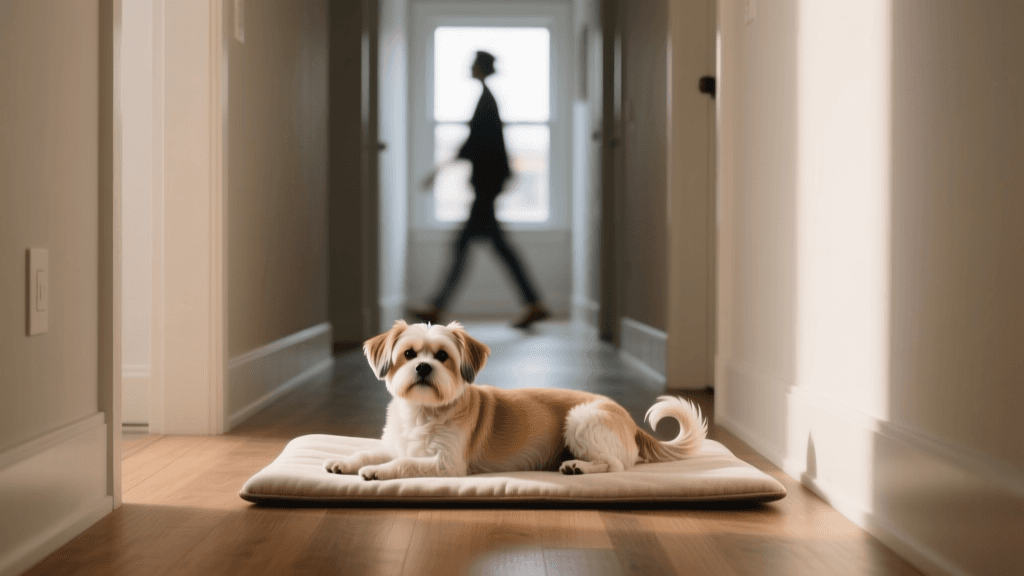
The most common trigger for apartment dogs is the sound of people walking past the front door. Even quiet breeds like the Greyhound or the Whippet, which rarely bark at home, may let out a sharp alert bark when they hear heavy boots in the corridor. Here is the step-by-step 2026 protocol for hallway desensitization:
Step 1: The Audio Setup
Record the specific sounds of your apartment building's hallway using your smartphone. Capture footsteps, the elevator ding, the mail slot clacking, and doors closing. Alternatively, search for apartment hallway white noise on streaming platforms, but custom recordings of your actual building are vastly superior because the acoustic resonance will match your dog's reality.
Step 2: Sub-Threshold Playback
Place your dog on their designated relaxation mat. Play the recorded hallway audio at a volume so low that your dog barely notices it. If their ears flick back but they do not lift their head or tense their body, you are at the correct sub-threshold level.
Step 3: Counterconditioning the Alert Ear Flick
The moment your dog's ears flick toward the sound, immediately mark the behavior with a calm yes and toss a high-value treat, such as Zuke's Mini Naturals or freeze-dried beef liver, directly to them. The goal is to teach the dog that hallway noises predict treats, not intruders. Over a period of four to six weeks, gradually increase the volume of the audio playback in small increments, continuing to reward calm, quiet observation.
Phase 2: Advanced Mat Training for High-Density Living
A quiet dog in an apartment needs a designated safe zone where they can retreat when the environment becomes overstimulating. The 'Place' command is the cornerstone of apartment tranquility. The American Kennel Club (AKC) emphasizes that teaching a dog to settle on a mat builds impulse control and provides a predictable routine that reduces overall anxiety.
In 2026, the best mats for apartment training are elevated, chew-proof cots like the Kuranda Chew-Proof Dog Bed or thick, sound-dampening orthopedic mats like the Big Barker Orthopedic Crate Pad. These provide physical separation from the cold, hard apartment floor, which can amplify vibrations from downstairs neighbors.
The 'Place' Command Progression
- Targeting: Use a treat to lure your dog's front paws onto the mat. Mark and reward.
- Full Body Commitment: Require all four paws on the mat before delivering the reward.
- Duration Building: Ask for a down on the mat. Delay the treat delivery by 3 seconds, then 5 seconds, then 10 seconds. Use a long-lasting chew, like a bully stick or a Kong Classic stuffed with frozen peanut butter, to anchor them to the mat for 15 to 20 minutes.
- Distance and Distraction: Walk toward the front door while your dog is on 'Place.' If they break the command, calmly guide them back without speaking. Return to the door only when they remain silent and settled.
Phase 3: Tech-Assisted Quiet Conditioning in 2026
Modern apartment training leverages smart home technology to reinforce quiet behaviors when the owner is at work or in another room. The Furbo 360 Dog Camera remains a top-tier tool in 2026 for monitoring and treating separation anxiety, which often manifests as whining or howling in naturally quiet breeds like the Shiba Inu when left alone.
Set the Furbo's bark alert sensitivity to low so it only notifies you of genuine distress rather than ambient apartment noise. When you receive a notification that your dog is whining, do not immediately use the two-way audio to speak to them, as this can inadvertently reward the vocalization. Instead, wait for a three-second pause in the whining, then use the treat-tossing feature to reward the silence. This conditions the dog to understand that quiet relaxation, not vocalizing, brings rewards from the magic camera.
Breed-Specific Training Profiles and Triggers
While the foundational protocols above apply to all canines, understanding the specific genetic predispositions of your quiet breed will help you tailor your 2026 training regimen. Below is a comparison chart detailing common quiet apartment breeds, their hidden triggers, and the specific training focus required to maintain their silence.
| Breed | Typical Vocalization Level | Hidden Apartment Trigger | Primary Training Focus |
|---|---|---|---|
| Basenji | Very Low (No traditional bark) | Separation Anxiety / Boredom | Enrichment puzzles to prevent yodeling and destructive chewing. |
| Greyhound | Low | Sudden Visual Movement (Windows) | Window film application and 'Look at That' counterconditioning. |
| Cavalier King Charles Spaniel | Low to Moderate | Doorbell / Knocking Sounds | Doorbell desensitization using smart doorbell chime volume control. |
| Shiba Inu | Low (Prone to Screams) | Nail Trimming / Grooming Stress | Cooperative care training and muzzle conditioning to prevent vocal outbursts. |
| Bernese Mountain Dog | Low | Space Restriction / Claustrophobia | Crate training with ample square footage and 'Place' command generalization. |
Managing Vocal Outbursts and Frustration
It is vital to address what happens when a typically quiet breed breaks their silence. The Shiba Inu is notorious for the high-pitched, piercing vocalization triggered by extreme displeasure, frustration, or overstimulation. In an apartment with thin walls, a single vocal outburst can result in immediate noise complaints.
Never attempt to yell over a screaming dog. Your raised voice will only validate their belief that the environment is chaotic and requires a loud response.
If your dog begins a vocal outburst, the most effective 2026 behavioral protocol is the negative punishment removal technique. Calmly and silently remove yourself from the room, closing the door behind you. Do not return until the dog has been completely silent for at least ten seconds. Upon returning, do not offer affection immediately; instead, ask for a simple sit or hand target to reset their brain into a working, compliant state, and then reward the calm behavior.
Consistency is the Key to Apartment Harmony
Living in an apartment with a dog requires a mutual contract of respect between you, your pet, and your neighbors. While selecting a naturally quiet breed gives you a significant head start, it is the daily, intentional training protocols that ensure long-term peace. By implementing hallway desensitization, mastering the 'Place' command, and utilizing modern smart-home reinforcement tools, you can cultivate a deeply relaxed, confident, and silent companion. Remember that behavioral conditioning is not a one-time event but a continuous lifestyle. Keep your training sessions short, positive, and highly rewarding, and your quiet breed will thrive in the heart of the concrete jungle.
aaron-whyte
All our authors care for dogs every day — read more of their work on the authors page.