How to Train a Dog to Settle: Step-by-Step Calmness Guide
Learn the psychology behind canine arousal and follow our step-by-step guide to training your dog to settle on a mat for lasting calmness.
The Psychology of Canine Arousal: Why Dogs Struggle to Relax
To truly understand how to train a 'settle' or 'place' command, we must first look through the lens of canine psychology and neurobiology. Many dog owners mistakenly believe that a dog pacing, whining, or demanding attention is simply being 'stubborn' or 'disobedient.' In reality, these behaviors are often symptoms of an overactive sympathetic nervous system. When a dog is in a state of high arousal—whether from excitement, fear, or environmental stimulation—their body floods with stress hormones like cortisol and adrenaline.
According to the American Kennel Club (AKC), hyperactivity and the inability to settle are frequently linked to a lack of mental enrichment and an overstimulated nervous system. What many owners do not realize is the concept of 'trigger stacking.' When a dog experiences multiple mild stressors or exciters throughout the day (the mail carrier arriving, a squirrel in the yard, a loud noise), their cortisol levels compound. It can take anywhere from 24 to 72 hours for cortisol to fully metabolize and leave a dog's bloodstream. During this window, the dog's threshold for frustration is drastically lowered, making them physically incapable of simply 'calming down' without guided intervention.
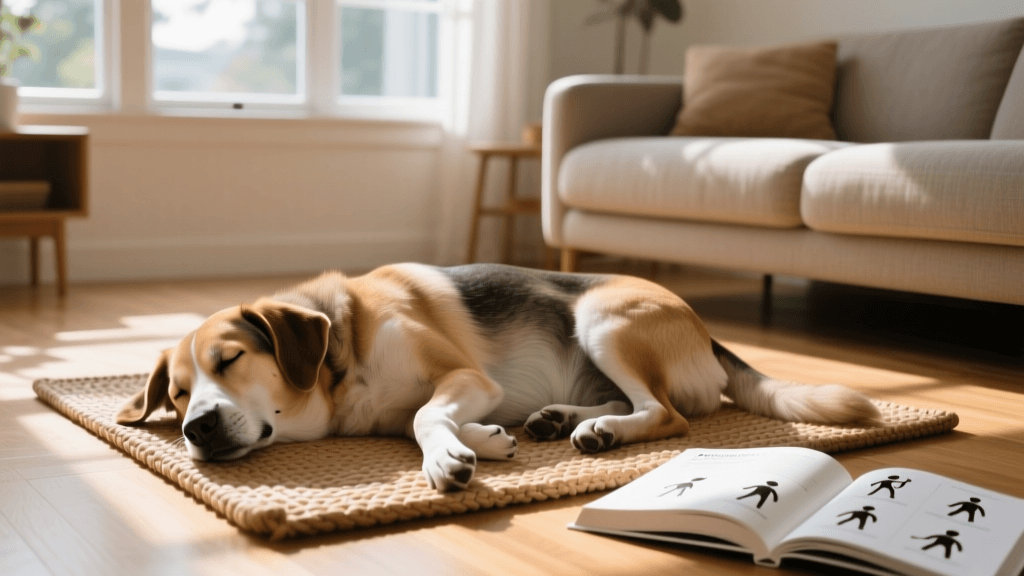
Therefore, teaching a dog to settle is not merely a parlor trick; it is a vital behavioral intervention that helps a dog access their parasympathetic nervous system (the 'rest and digest' state). By pairing a specific physical location with calming neurological activities, we can create an off-switch for our canine companions.
Essential Equipment for Settle Training
Before beginning your step-by-step training, gather the following specific tools. Success in behavioral modification relies heavily on environmental management and the right reinforcement tools.
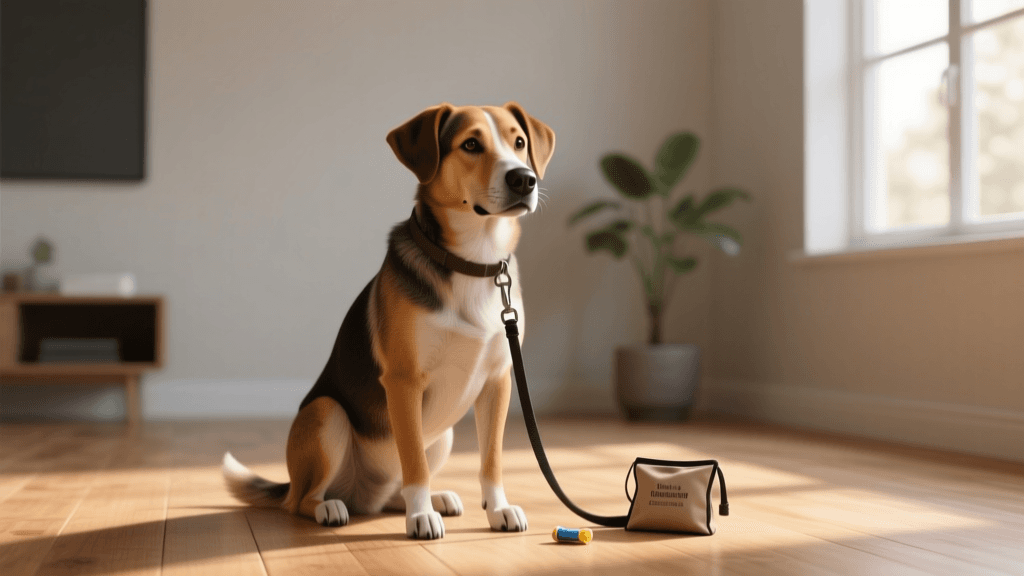
- The 'Place' Mat: Choose a mat with a distinct texture that is not present elsewhere in your home. A rubber-backed bath mat, a specific fleece blanket, or a raised training cot like the Kuranda Chewproof Cot work exceptionally well. The distinct texture provides clear tactile feedback to the dog.
- High-Value, Long-Lasting Chews: Licking and chewing are scientifically proven to release endorphins and lower heart rates in dogs. Use a LickiMat Soother spread with plain Greek yogurt and frozen, or a KONG Classic stuffed with soaked kibble and peanut butter.
- Low-Value Training Treats: For the initial shaping phases, you need treats that can be consumed in under two seconds to keep the training loop moving. Zuke's Mini Naturals or small pieces of boiled chicken breast (cut into 1/4-inch cubes) are ideal.
- A Marker: A mechanical clicker or a consistent verbal marker like the word 'Yes!' to pinpoint the exact moment the dog makes the correct choice.
Step-by-Step Guide: Training the 'Settle' Behavior
Now that we understand the psychological 'why,' let us dive into the practical 'how.' This protocol uses operant conditioning and shaping to build a robust settle behavior.
Step 1: Shaping the Mat Interaction (Days 1-3)
Place the mat on the floor in a low-distraction environment. Do not give any verbal commands. Simply wait. The moment your dog looks at the mat, click your clicker (or say 'Yes!') and toss a treat onto the mat. If the dog steps onto the mat to get the treat, click and toss another. We are shaping the dog to believe that the mat is a magical treat-generator. Repeat this for 3-minute sessions, three times a day. The goal is to build a strong positive conditioned emotional response (+CER) to the mat.
Step 2: Luring the 'Down' Position (Days 4-6)
Once the dog is confidently stepping onto the mat, we need to shape a lying-down position, as a dog cannot fully settle while standing. Hold a low-value treat in your hand, place it on the dog's nose, and slowly draw your hand straight down to the mat, then pull it slightly toward you along the floor (the 'L' shape lure). When the dog's elbows and hocks touch the mat, mark and reward. If the dog stands up, simply reset and try again. Do not add the verbal cue 'Settle' or 'Place' yet; adding a cue too early dilutes its meaning.
Step 3: Introducing the Calming Chew (Days 7-10)
This is where the psychological magic happens. Once the dog lies down on the mat, immediately present a long-lasting chew (like the frozen LickiMat or a bully stick). The act of licking and chewing will naturally engage the parasympathetic nervous system. If the dog picks up the chew and walks off the mat, calmly take the chew away (without scolding) and place it back on the mat. The dog learns a simple equation: The chew only exists when my body is on the mat. This builds duration effortlessly.
Step 4: Adding the Verbal Cue and Fading the Lure (Days 11-14)
Now that the dog reliably goes to the mat and lies down for a chew, you can attach the verbal cue. Say 'Settle' or 'Place' exactly one second before the dog steps onto the mat. Over the next few sessions, begin to fade the physical hand lure, relying only on a pointed finger and the verbal cue. Reward heavily with high-value treats for compliance, then transition to the long-lasting chew for duration.
Step 5: Proofing the Behavior (Weeks 3 and Beyond)
According to the ASPCA Dog Behavior Hub, dogs are highly contextual learners. A dog that settles perfectly in the living room may not understand the command in the kitchen or on a patio. You must 'proof' the behavior by practicing in different rooms, with different levels of background noise, and eventually with visitors present. Always lower your criteria (easier treats, shorter duration) when introducing a new, more distracting environment.
Troubleshooting Common Settle Challenges
Even with a solid understanding of canine psychology, training hurdles will arise. Below is a diagnostic table to help you troubleshoot common issues based on behavioral science.
| Challenge | Psychological Root Cause | Step-by-Step Solution |
|---|---|---|
| Dog breaks the stay immediately to follow you. | Separation anxiety or lack of impulse control; the dog's attachment drive overrides the settle drive. | Return to Step 3. Use a higher-value, longer-lasting chew (e.g., a frozen marrow bone) to increase the value of staying on the mat. Take only one step away before returning. |
| Dog paces around the mat but won't lie down. | Mat aversion (texture issue) or confusion due to moving too fast through the shaping steps. | Change the mat material (try a soft fleece if they dislike rubber). Drop your criteria back to Step 1: reward just for sniffing or standing on the mat. |
| Dog falls asleep, wakes up, and immediately leaves. | Natural sleep cycle completion; the dog views the mat as a bed, not a place to remain until released. | Introduce a clear release cue like 'All Done' or 'Free.' Toss a treat off the mat when you release them so they learn that leaving the mat only happens upon your cue. |
| Dog becomes frustrated and bites the mat. | Over-arousal and frustration from unclear criteria or sessions that are too long. | Keep sessions under 3 minutes. Ensure you are marking and rewarding before the frustration threshold is crossed. Refer to AVSAB guidelines on positive reinforcement to avoid punitive corrections. |
Capturing Calmness: Generalizing the Behavior
Once your dog has mastered the mat, you can expand this psychological framework to the entire house through a technique known as 'Capturing Calmness.' Coined by renowned canine behavior experts, this involves keeping a cup of low-value treats on your counter and randomly rewarding your dog whenever they independently choose to lie down and relax on the floor, without being asked.
Training a settle is not about suppressing your dog's natural energy; it is about teaching them the mechanics of emotional regulation and giving them a safe harbor in a chaotic human world.
By consistently rewarding voluntary calmness, you rewire your dog's baseline arousal levels. They begin to understand that relaxation is a highly rewarded behavior state, not just a physical location. This drastically reduces attention-seeking behaviors, door-dashing, and reactive barking over time.
Conclusion
Understanding your dog's nervous system is the key to unlocking lasting behavioral change. By combining the neurobiology of canine arousal with a structured, step-by-step operant conditioning protocol, you can teach your dog the invaluable skill of settling. Remember to manage the environment, utilize the calming power of chewing, and be patient as your dog's brain builds new, positive neural pathways. With consistency, your dog will learn to find peace on their mat, leading to a happier, more harmonious household.
beth-carrasco
All our authors care for dogs every day — read more of their work on the authors page.