Step-by-Step Guide to Curing Canine Resource Guarding
Learn the psychology behind canine resource guarding and follow our step-by-step training guide to safely build trust and eliminate aggressive behavior.
The Psychology Behind Resource Guarding
To effectively train a dog, we must first understand their psychological baseline. Resource guarding—the act of defending food, toys, beds, or even humans from perceived thieves—is deeply rooted in canine evolutionary biology. Dogs are opportunistic scavengers by design. In the wild, relinquishing a valuable resource often meant starvation. Therefore, guarding is a natural, survival-based instinct, not a sign of 'dominance,' 'spite,' or a lack of respect for the owner.
When a dog growls over a bone or stiffens when you approach their food bowl, they are communicating profound anxiety and a fear of loss. Understanding this psychological baseline is crucial for effective behavioral modification. According to the ASPCA, punishment-based training for guarding only suppresses the warning signs (like growling) without changing the underlying emotional response. This often leads to a far more dangerous scenario: a dog that bites without any prior warning.
Essential Tools and Setup (Costs & Measurements)
Before beginning your step-by-step training protocol, you must gather the right equipment to ensure safety and efficacy. Expect an initial investment of approximately $65 to $100.
- Treat Pouch ($15-$25): A hands-free pouch like the Ruffwear Treat Trader allows you to deliver rewards within the critical 1.5-second marking window, which is essential for canine associative learning.
- High-Value Treats ($15-$20): Standard kibble will not override the value of a guarded item. Use Stella & Chewy's freeze-dried beef liver or boiled chicken breast. Cut these into precise 1/4-inch pea-sized pieces to prevent overfeeding and maintain a high reward rate.
- Baby Gates ($40-$60): Use hardware-mounted gates (like the Regalo Easy Step) to manage the environment and prevent unsupervised access to high-risk areas like the kitchen or trash bins.
- 6-Foot Leather or Biothane Leash ($20-$30): Avoid retractable leashes. A standard 6-foot leash provides optimal control and tactile feedback without creating unnecessary tension that can trigger a guarding response.
Decoding Canine Body Language Signals
Successful training requires the human to recognize early signs of stress before they escalate into aggression. Dogs communicate in a ladder of escalation.
Early Warning Signs (Distance Required)
- Whale Eye: The dog turns their head away but keeps their eyes on you, revealing the whites of their eyes.
- Displacement Behaviors: Sudden, out-of-context yawning, rapid lip licking, or sniffing the ground intensely.
- Freezing: The dog stops chewing and becomes completely rigid.
Late Warning Signs (Immediate Retreat Required)
- Hard Stare: Unblinking, direct eye contact with a lowered head.
- Piloerection: Hackles raised along the spine and shoulders.
- Vocalization: Low, guttural chest growls or lip curling to expose teeth.
Step-by-Step Training Protocol
Step 1: Identify Triggers and Establish Thresholds
You must map your dog's specific triggers. Is it rawhides? Food bowls? Stolen socks? Next, determine the 'threshold distance.' If your dog stiffens or shows whale eye when you are 5 feet away from their food bowl, your working threshold is 6 feet. You must always start training below the threshold where the dog feels completely safe and relaxed.
Step 2: The 'Trade-Up' Game (Teaching 'Drop It')
Never forcibly pry an item from your dog's mouth. This confirms their fear that you are a thief. Instead, teach the Trade-Up game to build trust.
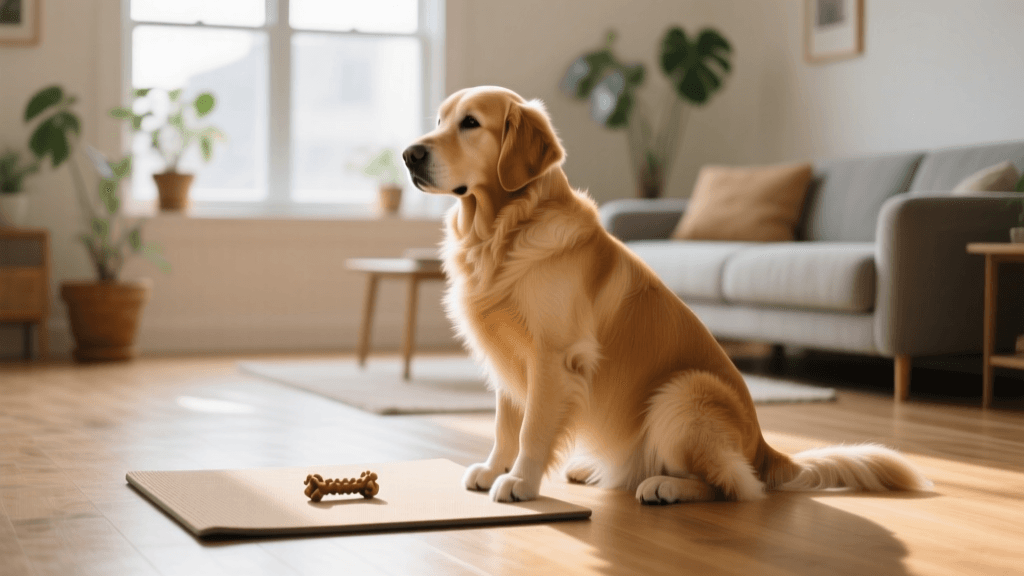
- Offer a low-value toy (e.g., a basic cotton rope).
- Once they take it, present a high-value treat (e.g., a 1/4-inch piece of freeze-dried liver) directly to their nose.
- The moment they drop the toy to eat the treat, say 'Yes!' and let them eat.
- Pick up the toy, then immediately give it back. This teaches the dog that giving up an item results in a better reward and the return of the original item.
Timing & Measurement: Keep sessions to exactly 5 to 10 minutes, twice a day. Canine cognitive fatigue sets in after 15 minutes, drastically reducing learning retention.
Step 3: Desensitization to the Human Approach
This step addresses guarding stationary items like food bowls or beds.
- Place your dog's empty bowl on the floor.
- Stand at your established threshold distance (e.g., 8 feet).
- Toss a high-value treat into or right next to the bowl.
- Walk away. Repeat this 10 times per session.
- Progression: Decrease the distance by exactly 1 foot every 3 consecutive successful sessions (where the dog shows zero signs of stress).
The goal is to change the dog's emotional response from 'Uh oh, they are coming to take my food' to 'Awesome, the human's approach means premium treats are arriving!'
Resource Guarding Severity & Action Matrix
Use the following data table to assess your dog's current behavior and determine the appropriate action plan. Do not attempt DIY training if your dog is exhibiting Level 3 or Level 4 behaviors.
| Severity Level | Canine Body Language | Action Plan |
|---|---|---|
| Level 1 | Freezing, hard stare, eating faster, mild whale eye. | Implement Trade-Up game, manage environment with baby gates. |
| Level 2 | Low growl, lip curling, stiffening, guarding multiple items. | Increase threshold distance, begin strict desensitization protocol. |
| Level 3 | Snapping, air biting, lunging on leash, intense vocalization. | Halt DIY training immediately, consult a certified behaviorist. |
| Level 4 | Biting, making skin contact, puncture wounds, bruising. | Immediate management (muzzle conditioning, strict confinement), veterinary behavioral referral. |
Common Mistakes to Avoid
The 'Alpha Roll' Myth: Forcibly pinning a dog to the ground to 'show dominance' is a debunked and dangerous practice. The American Kennel Club (AKC) explicitly warns against confrontational training methods, noting they drastically increase the risk of severe bites and permanently damage the human-animal bond.
Punishing the Growl: A growl is a gift; it is your dog's way of communicating discomfort before resorting to a bite. If you punish the growl, you strip away the warning system, creating a dog that bites without notice.
'Resource guarding is a symptom of anxiety, not a battle for dominance. Our goal is to change the dog's emotional response, not just suppress their behavior through fear.'
When to Call a Professional
If your dog is exhibiting Level 3 or Level 4 behaviors, DIY training is no longer safe. You must seek help from a qualified professional. Look for consultants certified by the International Association of Animal Behavior Consultants (IAABC) or a board-certified veterinary behaviorist (DACVB). Expect to invest between $150 and $300 per hour for specialized behavioral modification. This is a critical investment in your family's safety, your legal liability, and your dog's long-term psychological well-being. Remember, patience and consistency are your greatest tools in transforming a fearful guarder into a confident, trusting companion.
hannah-wickes
All our authors care for dogs every day — read more of their work on the authors page.