The Ultimate Step-by-Step Puppy Potty Training Guide
Master puppy potty training with our step-by-step guide. Learn ideal schedules, crate sizing, and expert tips to stop accidents fast.
Introduction to Puppy Potty Training
Bringing a new puppy home is an exciting milestone, but it quickly becomes apparent that house training is your first major hurdle. Puppies lack the physical bladder control and the instinctual understanding of where it is appropriate to eliminate. According to the ASPCA, a general rule of thumb is that a puppy can control their bladder for one hour for every month of age, up to about eight hours. This biological limitation means that a step-by-step, proactive approach is not just recommended; it is absolutely essential for your sanity and your puppy's success. In this comprehensive guide, we will walk you through the exact methodology, schedules, and supplies needed to potty train your puppy efficiently and humanely.
Understanding Your Puppy's Biology
Before diving into the training steps, it is crucial to understand the physiological limitations of a young dog. Puppies under the age of twelve weeks have very weak sphincter muscles. They simply cannot "hold it" for long periods, no matter how hard they try. Furthermore, their digestive systems are incredibly fast; a puppy will typically need to defecate within fifteen to thirty minutes after eating a meal. Recognizing these biological facts prevents frustration and sets realistic expectations. You are not just training a behavior; you are managing a biological timeline.
Essential Potty Training Supplies and Costs
Success in potty training requires the right tools. Investing in these items upfront will save you time, money, and frustration.
- Enzymatic Cleaner (e.g., Nature's Miracle Advanced Stain and Odor Eliminator, ~$15): Standard household cleaners do not break down uric acid crystals. An enzymatic cleaner is mandatory to completely remove the scent marker, preventing the puppy from returning to the same spot.
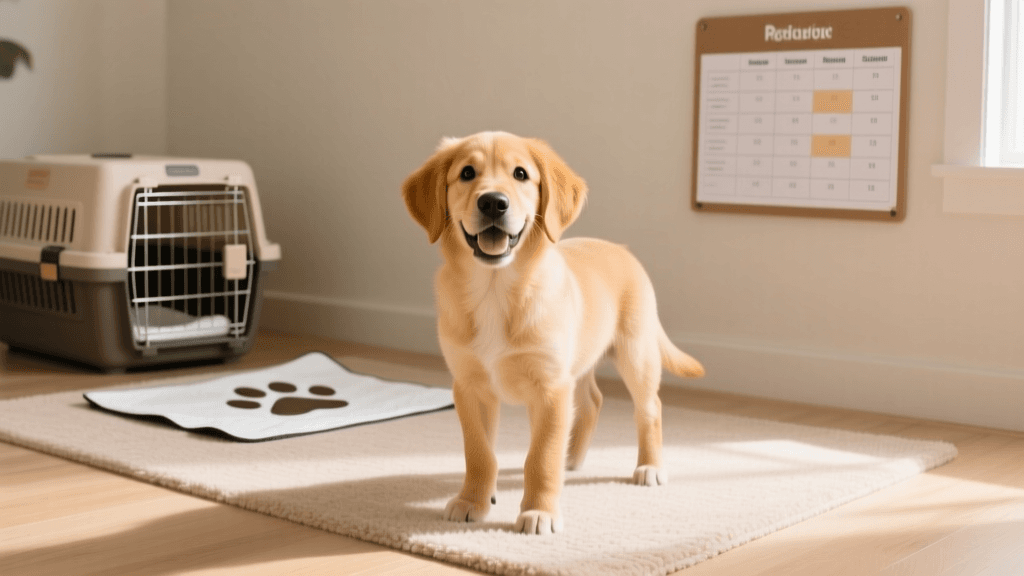
- Properly Sized Crate (e.g., MidWest Homes for Pets iCrate with Divider, ~$60-$80): Dogs naturally avoid soiling their sleeping area. A crate with a divider allows you to adjust the space as your puppy grows, ensuring it is just large enough for them to stand, turn around, and lie down.
- High-Value Training Treats (e.g., Zuke's Mini Naturals, ~$8): You need small, low-calorie, highly palatable treats to reward immediate success.
- Potty Bells (e.g., Mighty Paw Smart Bell or traditional door bells, ~$10-$25): These provide a tactile way for your puppy to communicate their need to go outside.
Step-by-Step Outdoor Potty Training Method
Step 1: Designate a Specific Potty Zone. Take your puppy to the exact same spot in your yard every single time. The accumulated scent will act as a natural trigger, signaling to your puppy's brain that this is the appropriate place to eliminate.
Step 2: Implement the Umbilical Cord Method. When your puppy is not in their crate, they should be tethered to you via a leash attached to your belt or wrist. This prevents them from wandering off into another room to have a secret accident. If you cannot supervise them 100%, they must be in their crate or a secure playpen.
Step 3: Introduce a Verbal Cue. As soon as your puppy begins to squat or lift their leg, say your chosen cue word, such as "Go Potty" or "Do Your Business." Do not say it before they start, or you risk associating the word with the act of walking outside rather than the act of eliminating.
Step 4: The 3-Second Reward Rule. The moment your puppy finishes eliminating, praise them enthusiastically and give them a high-value treat within three seconds. According to VCA Animal Hospitals, immediate positive reinforcement is the most effective way to cement a new behavior. If you wait until you get back inside to reward them, you are rewarding them for coming inside, not for pottying outside.
Reading Your Puppy's Body Language
Puppies rarely give a formal announcement before they need to go. You must learn to read their subtle cues. Common signs that your puppy needs to eliminate immediately include: intense sniffing of the floor, sudden circling in one spot, a sudden halt in playtime, whining or pacing near the door, or abruptly leaving the room to find a quiet corner. The moment you see any of these signs, scoop up your puppy or grab their leash and head straight to the designated potty zone.
The Puppy Potty Training Schedule by Age
Consistency is the backbone of house training. Below is a structured schedule to help you anticipate your puppy's needs based on their age.
| Puppy Age | Max Bladder Capacity | Daytime Potty Breaks | Nighttime Potty Breaks |
|---|---|---|---|
| 2 Months | 2 Hours | Every 1-2 Hours | Every 3-4 Hours |
| 3 Months | 3 Hours | Every 2-3 Hours | Every 4-5 Hours |
| 4 Months | 4 Hours | Every 3-4 Hours | Every 5-6 Hours |
| 6 Months | 6 Hours | Every 4-6 Hours | Every 6-8 Hours |
Note that these are maximum capacities. During active play, excitement, or immediately after drinking water, your puppy will need to go out much more frequently. Always take them out immediately upon waking up, after every meal, after vigorous play sessions, and right before bedtime.
Nighttime Potty Training Strategies
Nighttime training requires a slightly different approach. To minimize middle-of-the-night wake-ups, remove your puppy's water bowl exactly two hours before bedtime. Place their crate in your bedroom for the first few weeks; your presence is comforting, and you will be able to hear them whine or stir when they need to go out. When they wake you up at night, keep the interaction incredibly boring. Do not turn on bright lights, do not play, and do not speak in an excited voice. Simply carry them outside, wait for them to potty, reward them quietly, and put them right back to bed.
Handling Accidents and Setbacks
Accidents will happen. How you react to them will dictate how quickly your puppy learns. If you catch your puppy in the act, interrupt them with a neutral, sharp sound like "Oops!" or "Ah-ah!", quickly scoop them up, and carry them outside to finish. Reward them if they finish outdoors.
If you find an accident after the fact, do absolutely nothing to the puppy. As the Humane Society of the United States points out, punishing a puppy for an accident after the fact does not teach them what they did wrong; it only teaches them to fear you and to hide when they need to eliminate. Simply clean the area thoroughly with your enzymatic cleaner.
"Punishing a puppy for an accident after the fact does not teach them what they did wrong; it only teaches them to fear you and to hide when they need to eliminate."
— Humane Society of the United States
Pee Pads vs. Outdoor Training
Many new owners wonder if they should use indoor pee pads. While pads (costing around $25 for a box of 100) seem convenient, they can severely prolong the training process. Pee pads teach a puppy that it is acceptable to eliminate indoors on soft, absorbent surfaces. This often leads to confusion, causing the puppy to mistake your expensive area rugs or bathroom mats for pee pads. Unless you live in a high-rise apartment without immediate yard access, or you are dealing with extreme weather conditions, it is highly recommended to skip the pads and train your puppy to go directly outdoors from day one.
Final Thoughts on Patience and Consistency
Potty training is a marathon, not a sprint. Some puppies grasp the concept in a few weeks, while others may take several months. The key to success lies in your consistency, your supervision, and your patience. Stick to the schedule, manage their environment with a crate, and celebrate every small victory. By following this step-by-step guide, you will build a foundation of trust and clear communication, resulting in a reliably house-trained dog for life.
hannah-wickes
All our authors care for dogs every day — read more of their work on the authors page.