The Step-by-Step Guide to Crate Training Your New Dog
Learn how to crate train your newly adopted dog with our step-by-step guide. Discover timelines, essential gear, and expert tips for a smooth transition.
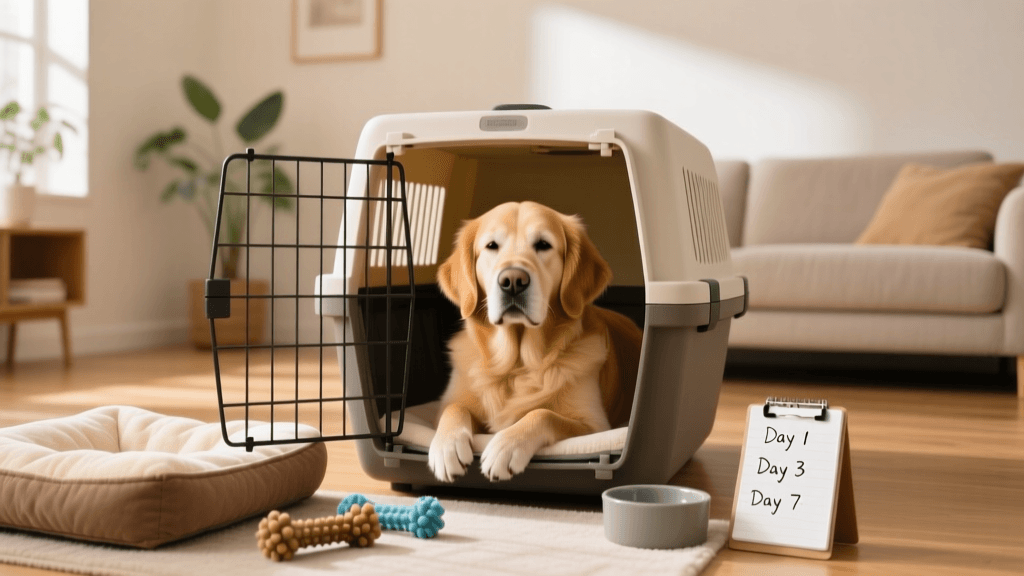
Why Crate Training is Essential for Your New Dog
Bringing a newly adopted dog or puppy into your home is an exhilarating experience, but it also comes with a unique set of challenges. One of the most critical first-day essentials for setting your new companion up for long-term success is crate training. Far from being a form of confinement or punishment, a crate serves as a personal sanctuary for your dog. It taps into their natural denning instincts, providing a secure environment where they can retreat when feeling overwhelmed by their new surroundings.
According to the American Society for the Prevention of Cruelty to Animals (ASPCA), crate training is a highly effective method for facilitating housebreaking, preventing destructive behavior when unsupervised, and ensuring your dog's safety during travel or when guests visit. By approaching crate training as a step-by-step positive reinforcement process, you can transform a wire or plastic enclosure into your dog's favorite spot in the house.
Essential Gear: Choosing the Right Crate and Accessories
Before initiating the training process, you must invest in the proper equipment. Selecting the wrong size or type of crate can lead to anxiety, accidents, and training regression. A properly sized crate should allow your dog to stand up without crouching, turn around comfortably, and lie down stretched out. If the crate is too large, your dog may use one corner as a bathroom and sleep in the other, defeating the purpose of den training.
Crate Types and Estimated Costs
- Wire Crates ($40 - $90): Excellent for visibility and ventilation. They often come with a divider panel, which is crucial for growing puppies. The MidWest Homes for Pets iCrate is a highly recommended, durable option.
- Plastic Kennels ($50 - $120): Ideal for travel and dogs who prefer a darker, more enclosed den. The Petmate Vari Kennel is an airline-approved staple.
- Soft-Sided Crates ($30 - $70): Best for fully trained adult dogs or travel. Not recommended for the initial training phase, as puppies or anxious dogs can easily chew through the mesh.
Sizing Guide: Crate Dimensions vs. Dog Weight
| Estimated Adult Dog Weight | Recommended Crate Length | Common Breed Examples |
|---|---|---|
| 1 - 10 lbs | 18" - 22" | Chihuahua, Pomeranian, Yorkshire Terrier |
| 11 - 25 lbs | 24" | Beagle, French Bulldog, Cocker Spaniel |
| 26 - 40 lbs | 30" | Border Collie, Basset Hound, Bulldog |
| 41 - 70 lbs | 36" | Boxer, Labrador Retriever, Golden Retriever |
| 71 - 90 lbs | 42" | German Shepherd, Rottweiler, Doberman |
| 91+ lbs | 48" - 54" | Great Dane, Mastiff, Saint Bernard |
Note: Always measure your dog from the tip of their nose to the base of their tail, and add 2 to 4 inches to determine the ideal crate length.
Step-by-Step Crate Training Guide (Day 1 to Week 4)
Patience is the cornerstone of crate training. Never force your dog into the crate or use it as a time-out for bad behavior. Follow this progressive timeline to build a positive association.
Step 1: Introduction and Positive Association (Day 1)
Set the crate up in a high-traffic family area, such as the living room, so your dog does not feel isolated. Leave the door securely open. Scatter a few high-value treats (like small pieces of boiled chicken or freeze-dried liver) near the entrance and inside the crate. You can also place a favorite chew toy or a classic red KONG stuffed with peanut butter inside. Let your dog explore the crate at their own pace. Praise them verbally every time they step inside, even if they immediately walk back out. The goal on day one is simply to teach them that the crate equals good things.
Step 2: Feeding Meals in the Crate (Days 2-3)
Food is a powerful motivator. Begin feeding your dog their regular meals inside the crate. If they are hesitant, place the bowl just inside the threshold. With each subsequent meal, push the bowl further toward the back of the crate. Once your dog is comfortably eating at the very back of the crate, you can begin to gently close the door while they eat, opening it immediately when they finish. This builds a strong, instinctual link between the crate and the satisfaction of a meal.
Step 3: Closing the Door for Short Durations (Days 4-7)
Once your dog is eating comfortably with the door closed, start extending the time the door remains shut after meals. Sit quietly nearby for 5 to 10 minutes. If your dog whines, do not open the door immediately, as this rewards the vocalization. Wait for a brief moment of silence before releasing them. Gradually increase the duration to 15, then 30 minutes, while you sit in the same room reading a book or watching television. This teaches your dog that being crated does not mean you are abandoning them.
Step 4: Leaving the Room and Nighttime Crating (Week 2)
Now that your dog can stay in the crate for 30 minutes with you present, practice leaving the room. Give the command "kennel" or "crate," toss a treat inside, and close the door. Leave the room for 5 minutes, then return, praise them calmly, and let them out. Slowly extend your absences to 15 minutes, 30 minutes, and eventually an hour. For nighttime crating, place the crate in your bedroom or just outside your door for the first few weeks. Hearing your breathing and scent will reduce separation anxiety. Expect to wake up once or twice during the night to let a young puppy out for a potty break. Puppies can generally hold their bladder for one hour per month of age (e.g., a 3-month-old puppy can hold it for about 3 hours).
Crate Training Schedule by Age
| Dog's Age | Maximum Daytime Crating | Maximum Nighttime Crating |
|---|---|---|
| 8 - 10 Weeks | 1 - 2 Hours | 2 - 3 Hours (Requires night breaks) |
| 11 - 14 Weeks | 1 - 3 Hours | 3 - 4 Hours |
| 15 - 16 Weeks | 3 - 4 Hours | 4 - 5 Hours |
| 17+ Weeks (Adult) | 4 - 6 Hours | 6 - 8 Hours |
Warning: No dog, regardless of age, should be crated for more than 8 hours at a time without a break for exercise, socialization, and elimination.
Troubleshooting Common Crate Training Issues
Even with a meticulous step-by-step approach, you may encounter hurdles. Here is how to handle the most common setbacks:
- Whining and Crying: If your dog whines after being settled for a while, they likely need to eliminate. Take them outside immediately on a leash. If they go to the bathroom, praise them and return them to the crate. If they do not, they are whining for attention. Ignore the whining completely until they are quiet for at least 10 seconds before letting them out.
- Separation Anxiety: The Humane Society of the United States notes that a crate is not a cure-all for severe separation anxiety. If your dog panics, injures themselves trying to escape, or exhibits extreme distress (excessive drooling, destructive chewing of the crate bars), stop crate training immediately and consult a certified veterinary behaviorist.
- Chewing the Crate Bars: If your dog is chewing the metal wires, they may be bored or under-stimulated. Ensure they receive at least 45 to 60 minutes of vigorous physical exercise and mental enrichment before being crated. Provide safe, long-lasting chews like yak cheese or bully sticks to keep their jaws occupied.
"A crate should never be used as a punishment. It must remain a safe, happy space. If your dog begins to view the crate negatively, you must take a step back in your training and rebuild the positive association with high-value rewards."
Conclusion
Crate training your newly adopted dog requires consistency, empathy, and a structured timeline. By carefully selecting the right equipment, utilizing high-value rewards, and progressing through the steps at your dog's unique pace, you will provide them with a lifelong sanctuary. Remember that every dog learns at a different speed; celebrate the small victories, maintain a predictable routine, and enjoy the peace of mind that comes with knowing your new best friend is safe and secure in their own personal den.
beth-carrasco
All our authors care for dogs every day — read more of their work on the authors page.