Best Soundproof Safe Den Setups for Anxious Dogs in 2026
Discover how to build a soundproof safe den for anxious dogs in 2026. Learn about acoustic panels, Adaptil diffusers, and white noise setups.
Why Noise Phobia Requires a Dedicated Safe Den in 2026
Living with a reactive or noise-phobic dog means navigating a world that can feel overwhelmingly loud to your canine companion. From sudden summer thunderstorms to neighborhood fireworks and urban construction, environmental triggers can send an anxious dog into a state of severe panic. In 2026, veterinary behaviorists emphasize that simply comforting a terrified dog is not enough; you must proactively manage their environment to prevent the nervous system from entering a fight-or-flight state. According to the American Kennel Club (AKC), dogs can hear frequencies up to 45,000 Hertz, making the sharp, concussive booms of fireworks and thunder physically painful, not just startling.
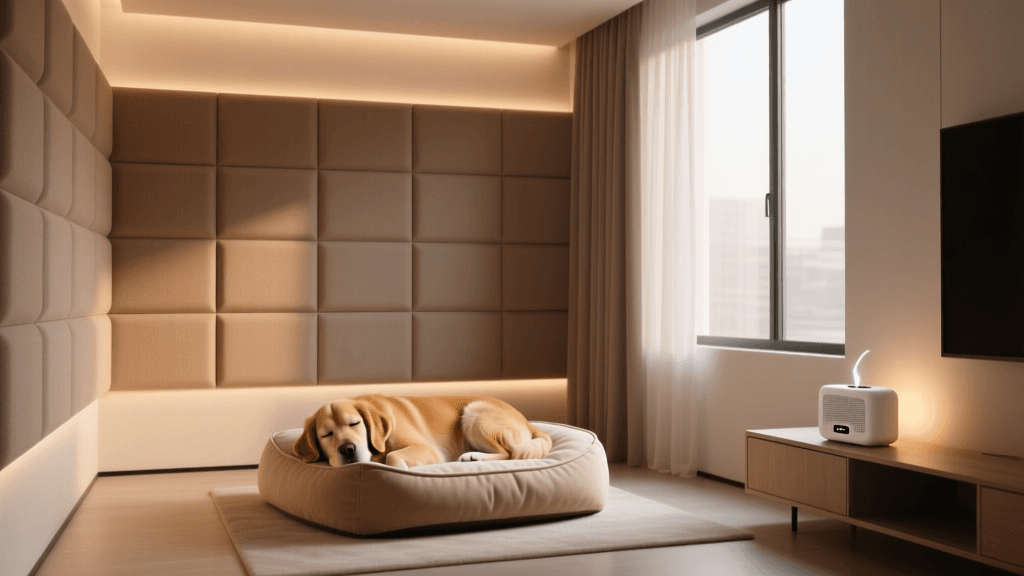
Creating a dedicated, sound-dampened "safe den" is one of the most effective management strategies for noise-phobic and reactive dogs. This is not merely a crate covered with a blanket; it is a scientifically structured micro-environment designed to reduce decibel levels, mask triggering frequencies, and provide olfactory calming cues. Below is a comprehensive, actionable guide to building the ultimate safe den for your anxious dog using the latest 2026 acoustic treatments, smart home integrations, and behavioral protocols.
Step 1: Selecting and Soundproofing the Right Room
The location of your safe den is just as critical as the gear you put inside it. You need an interior space with minimal exterior wall exposure and zero windows, as glass is a primary conductor of high-frequency sound waves. Walk-in closets, interior bathrooms, or under-stairway storage rooms are ideal candidates.
Applying Mass Loaded Vinyl (MLV)
To truly dampen sound, you need mass. In 2026, the gold standard for DIY residential soundproofing remains Mass Loaded Vinyl (MLV). A 1 lb per square foot roll of MLV costs approximately $1.50 per square foot and can reduce noise transmission by up to 27 decibels when applied correctly. Line the interior door and the shared walls of your chosen room with MLV, securing it with acoustic adhesive. For a standard 8x10 foot room, budget around $120 to $150 for the material.
Acoustic Absorption Panels
While MLV blocks sound from entering, acoustic foam prevents the sound that does enter from echoing and amplifying. Mounting a 12-pack of Auralex Studiofoam panels (approximately $130 in 2026) on the ceiling and upper walls of the den will absorb high-frequency echoes, creating a "dead" acoustic space that feels instantly calming to a dog's sensitive ears.
Step 2: Masking Triggers with White Noise and Pheromones
Once the physical space is dampened, you must mask the residual low-frequency rumbles (like thunder) that penetrate standard walls. This requires a multi-sensory approach combining audio masking and olfactory therapy.
Smart White Noise Integration
Standard fans are no longer sufficient for severe noise phobias. The Hatch Restore 3 (released in late 2025 and widely adopted in 2026) is a smart sound machine that offers deep, non-looping brown noise, which is far superior to white noise for masking low-end thunder rumbles. Priced at $170, it features smart home integration. By pairing it with a $40 SwitchBot Sound Meter, you can create an automation routine: if the room's decibel level spikes above 50 dB, the Hatch Restore 3 automatically powers on and fades up to 75 dB of brown noise, masking the trigger before your dog even registers it.
Olfactory Calming with Adaptil
Soundproofing must be paired with chemical calming signals. The Adaptil Calm Home Diffuser releases a synthetic copy of the dog-appeasing pheromone (DAP) produced by nursing mothers. The ASPCA notes that environmental enrichment and pheromone therapy can significantly reduce baseline anxiety in shelter and home environments. Plug the Adaptil diffuser into an outlet inside the den at least 48 hours before a predicted storm or holiday (like the Fourth of July or New Year's Eve). A 2026 starter kit costs around $55, with 30-day refills costing $25. Ensure the diffuser is placed away from the dog's direct sleeping area to prevent respiratory irritation, but close enough to circulate within the 700-square-foot coverage zone.
Step 3: Wearable Calming Gear for Severe Reactivity
For dogs whose reactivity exceeds the capabilities of a soundproofed room, wearable compression and hearing protection are vital additions to your 2026 management toolkit.
- MuttMuffs Canine Hearing Protection ($70): These over-the-ear muffs use the same acoustic foam found in human industrial earmuffs. They do not block all sound (which would cause panic), but they reduce the sharp, concussive decibel spikes of fireworks by up to 25 dB. They are secured with a dual-strap system that fits snugly under the jaw and over the head.
- Thundershirt Classic ($45): Applying gentle, constant pressure to the dog's torso, the Thundershirt stimulates the parasympathetic nervous system. It is highly effective when paired with the safe den, acting as a "swaddle" that grounds the dog while they rest in their soundproofed space.
2026 Safe Den Setup Cost & Gear Comparison
Building a professional-grade safe den is an investment in your dog's neurological health. Below is a breakdown of the essential 2026 gear, estimated costs, and their specific behavioral benefits.
| Gear Category | 2026 Recommended Model | Estimated Cost | Primary Benefit |
|---|---|---|---|
| Sound Blocking | 1lb Mass Loaded Vinyl (MLV) | $1.50 / sq ft | Adds mass to walls/doors to block airborne sound waves |
| Echo Absorption | Auralex Studiofoam (12-pack) | $130.00 | Prevents high-frequency sound from echoing in the den |
| Audio Masking | Hatch Restore 3 (Smart) | $170.00 | Generates deep brown noise to mask low-end thunder rumbles |
| Smart Trigger | SwitchBot Sound Meter | $40.00 | Auto-triggers white noise when environmental dB spikes |
| Pheromone Therapy | Adaptil Calm Home Diffuser | $55.00 | Releases synthetic DAP to lower baseline heart rate |
| Hearing Protection | MuttMuffs (Canine) | $70.00 | Reduces concussive decibel spikes from fireworks |
| Compression Wrap | Thundershirt Classic | $45.00 | Provides deep pressure therapy to soothe the nervous system |
Note: Total initial setup for a standard walk-in closet den ranges from $350 to $500, depending on the square footage requiring MLV treatment.
Desensitization Training: Pairing the Den with Positive Reinforcement
A soundproofed den is useless if your dog views it as a place of isolation or punishment. The den must become the highest-value real estate in your home. This requires a structured desensitization and counter-conditioning protocol.
Phase 1: The "Place" Command and High-Value Rewards
Begin training during a quiet, non-triggering time of day. Use a premium, high-value treat that your dog only receives inside the den, such as K9 Natural freeze-dried beef patties or Zuke's Z-Filets. Toss a treat into the den and mark the behavior with a calm "Yes" when all four paws cross the threshold. Gradually shape the behavior so the dog lies down on their orthopedic bed inside the den. Keep sessions short—no more than 3 to 5 minutes—to prevent frustration.
Phase 2: Audio Desensitization
Once the dog willingly enters and settles in the den, introduce recorded storm or firework sounds using a Bluetooth speaker placed outside the den. Start at a volume so low (around 10-15 dB) that your dog notices the sound but does not show signs of stress (lip licking, yawning, pacing). Feed high-value treats continuously while the audio plays. If the dog shows fear, the volume is too high; drop it immediately. Over several weeks, increase the volume by 2-3 dB increments, always pairing the sound with positive reinforcement.
Pro Tip for 2026: Never wait until the actual storm hits to introduce your dog to the safe den. If you only open the closet door and turn on the brown noise when thunder shakes the house, your dog will associate the den with the terrifying event. The den must be accessible 24/7 as a voluntary retreat for naps and chew sessions.
Conclusion: Consistency is the Key to Canine Calm
Managing a reactive, noise-phobic dog requires patience, environmental management, and a deep understanding of canine sensory perception. By investing in a dedicated, sound-dampened safe den equipped with 2026 smart audio masking, MLV acoustic treatments, and Adaptil pheromones, you are not just hiding your dog from the noise—you are actively regulating their nervous system. Combine this environmental setup with consistent, positive-reinforcement training, and you will transform your anxious dog's relationship with the loud, unpredictable world around them.
jonas-cole
All our authors care for dogs every day — read more of their work on the authors page.