Canine Foraging Psychology: Snuffle Mats vs Puzzle Toys in 2026
Discover the canine psychology behind foraging. Compare snuffle mats and Nina Ottosson puzzles to reduce anxiety and build confidence in 2026.
The Neuroscience of the Canine 'Seeking' System
To truly understand why mental enrichment is non-negotiable for modern dog ownership, we must look inside the canine brain. At the core of your dog's behavior is the 'seeking' system, a neural network extensively mapped by affective neuroscientists. When your dog engages in foraging, sniffing, and problem-solving, this system releases a steady stream of dopamine. This neurochemical reward doesn't just make your dog feel good; it actively lowers cortisol levels, reduces reactivity, and builds deep-seated confidence.
As we navigate the behavioral science trends of 2026, veterinary behaviorists emphasize that physical exercise alone is insufficient for breeds with high working drives or dogs suffering from leash reactivity. A 2026 consensus on canine enrichment highlights that 15 minutes of intensive scent-based foraging can provide the same mental fatigue as an hour of brisk walking. By replacing a standard food bowl with interactive enrichment tools, you are tapping into millions of years of evolutionary scavenging instincts, transforming mealtime into a profound psychological therapy session.
Snuffle Mats: The Psychology of Scent-Driven Decompression
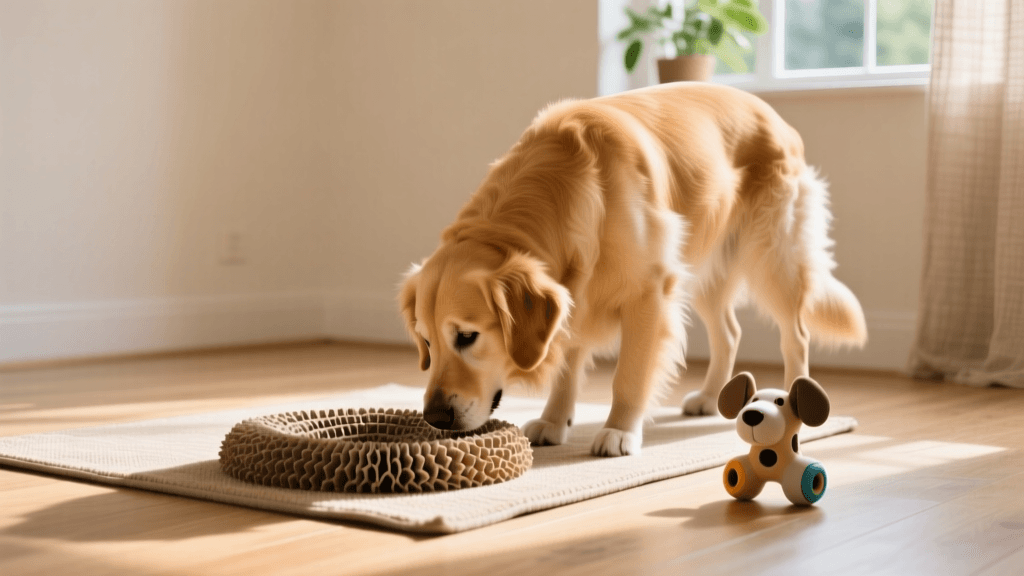
The snuffle mat is a deceptively simple tool composed of densely tied fleece strips that mimic the tactile and olfactory environment of tall grass. From a psychological perspective, snuffle mats are 'decompression' tools. They require continuous, deep inhalation, which physically slows the dog's heart rate and activates the parasympathetic nervous system—the body's 'rest and digest' mode.
For reactive or anxious dogs, the snuffle mat is a foundational confidence builder. Because there is no single 'correct' way to solve a snuffle mat, the dog experiences zero frustration. The continuous reinforcement of finding small pieces of kibble hidden within the fabric strips keeps the dog in a state of flow. According to the American Kennel Club's guidelines on mental enrichment, scent work is one of the most effective ways to tire out a high-energy dog while simultaneously teaching them to focus on their environment in a calm, methodical manner.
Best Use Cases for Snuffle Mats:
- Pre-Walk Decompression: Using a snuffle mat for 10 minutes before a walk lowers the dog's baseline arousal level, making them less likely to lunge or bark at triggers outside.
- Thunderstorm or Firework Anxiety: The intense focus required to sniff out treats can distract dogs from auditory stressors.
- Senior Dogs: For dogs with limited mobility or canine cognitive dysfunction, snuffle mats provide vital mental stimulation without requiring physical strain.
Nina Ottosson Dog Brick: Building Frustration Tolerance
While snuffle mats rely purely on olfactory scavenging, interactive puzzle toys like the Nina Ottosson Dog Brick (a Level 2 puzzle) engage the dog's executive functioning and spatial reasoning. The Dog Brick requires the dog to slide blocks, flip lids, and remove bone-shaped pegs to access hidden rewards. This introduces a vital psychological concept: frustration tolerance.
In 2026, the Dog Brick remains a gold standard for cognitive enrichment because it requires a sequence of physical actions. The dog must use paw-eye-nose coordination, experimenting with different physical manipulations until the puzzle yields a reward. This builds resilience. When a dog learns that they can overcome a minor obstacle to achieve a goal, they generalize this problem-solving confidence to other areas of their life, such as navigating novel environments or recovering from a sudden scare on a walk.
The ASPCA's comprehensive guide to dog enrichment notes that puzzle toys are critical for preventing destructive behaviors born from boredom. However, unlike the snuffle mat, the Dog Brick can cause stress if introduced too quickly. If the dog cannot figure out the sliding mechanism, they may resort to frantic chewing or give up entirely, which reinforces a sense of helplessness.
2026 Comparison Chart: Foraging Mats vs. Dog Brick Puzzles
| Feature | Heavy-Duty Fleece Snuffle Mat | Nina Ottosson Dog Brick (Level 2) |
|---|---|---|
| Primary Cognitive Load | Olfactory processing, sustained attention | Spatial reasoning, executive function, motor planning |
| Frustration Level | Very Low (Continuous reward) | Moderate (Requires problem-solving) |
| Best For | High anxiety, reactivity, senior dogs | Boredom, working breeds, confidence building |
| Average 2026 Cost | $25 - $45 (Artisan/Custom) | $18 - $24 (Mass market retail) |
| Cleaning Protocol | Machine washable (cold, air dry) | Dishwasher safe (top rack, BPA-free composite) |
| Time to Consume 1/4 Cup Kibble | 10 - 15 minutes | 3 - 7 minutes |
Reading Your Dog's Body Language During Puzzle Play
Understanding your dog's silent communication is crucial when introducing mental enrichment. A puzzle toy should challenge your dog, not terrify them. Here is a 2026 behavioral checklist to help you read your dog's body language during foraging sessions:
Signs of Healthy Engagement (Green Light)
- Soft, Blinking Eyes: Indicates a relaxed, processing brain state.
- Rhythmic Tail Sweeps: A low, sweeping wag shows contentment and focus.
- Deep, Audible Sniffing: The dog is actively utilizing their olfactory cortex.
- Methodical Pawing: Careful, deliberate movements show the dog is thinking through the physical puzzle.
Signs of Frustration or Stress (Yellow/Red Light)
- Lip Licking and Yawning: These are classic 'calming signals' indicating the dog is feeling internal conflict or stress about the puzzle.
- Frantic, Rapid Scratching: If the dog is violently digging at the Nina Ottosson brick rather than sliding the pieces, they have crossed the threshold of frustration.
- Whale Eye: Showing the whites of their eyes while keeping their head pointed at the toy indicates high anxiety.
- Walking Away and Barking at the Toy: The dog is expressing vocal frustration because they lack the motor skills to solve the current level.
'If your dog shows yellow or red light signals during a puzzle game, immediately lower the criteria. Lift the sliding blocks on the Dog Brick so the treats are fully visible, or scatter the kibble more shallowly on the snuffle mat. We want to build a history of success, not a history of failure.' — 2026 Veterinary Behaviorist Consensus on Enrichment
Step-by-Step Implementation for Reactive Dogs
To use these tools effectively for behavioral modification, follow this structured protocol:
- Caloric Management: Measure out your dog's daily kibble allotment. In 2026, veterinary nutritionists strongly advise against adding high-calorie treats on top of a full diet. Use your dog's regular, balanced kibble for the snuffle mat, and reserve high-value, single-ingredient treats (like freeze-dried beef lung) exclusively for the Nina Ottosson puzzle to maintain motivation.
- Environmental Setup: Place the puzzle on a non-slip yoga mat. Dogs with orthopedic issues or general anxiety will not engage in deep cognitive work if they feel physically unstable on slippery hardwood floors.
- The 'Show and Tell' Phase: For the first three sessions, do not hide the food deeply. Let the dog see you place the kibble. This builds a psychological map of the game and prevents early frustration.
- Supervised Decompression: Sit quietly nearby. Do not cheerlead or use a high-pitched 'find it!' voice. Your goal is to promote a calm, parasympathetic state, not an excited, sympathetic arousal state.
- Post-Game Observation: After the 15-minute session, observe your dog. You will likely notice a period of 'settling,' where the dog chooses to lay down and chew on a natural item (like a bully stick or coffee wood chew) or simply nap. This is the dopamine and endorphin afterglow taking effect.
Conclusion: Enrichment as a Window into the Canine Mind
Mental enrichment is not merely a way to pass the time while you work from home; it is a profound method of communicating with your dog in their native language. By understanding the distinct psychological benefits of scent-driven snuffle mats versus the spatial reasoning required by the Nina Ottosson Dog Brick, you can tailor your dog's environment to their specific emotional needs. Whether you are looking to soothe a reactive rescue or challenge a brilliant herding breed, leveraging the neuroscience of foraging in 2026 will result in a more balanced, confident, and deeply understood companion.
robin-maitland
All our authors care for dogs every day — read more of their work on the authors page.