Snuffle Mat Decompression Walks for Leash Reactivity in 2026
Discover how snuffle mat decompression walks lower cortisol and manage leash reactivity in dogs. Learn the 2026 protocol and top mat picks for anxious pups.
The Epidemic of Leash Reactivity in 2026
Leash reactivity remains one of the most challenging and emotionally taxing behavioral issues for dog owners in 2026. Characterized by barking, lunging, growling, and intense fixation when encountering triggers like unfamiliar dogs, strangers, or loud vehicles, reactivity is rarely a display of true aggression. Instead, it is almost always rooted in profound fear, anxiety, and barrier frustration. According to the ASPCA's guidelines on canine reactivity, dogs exhibit these explosive behaviors because they feel trapped by the leash and believe that creating distance through intimidation is their only survival strategy.
Traditional obedience training often fails to address the underlying emotional turmoil driving these reactions. In 2026, veterinary behaviorists and certified fear-free trainers are increasingly advocating for a paradigm shift: moving away from rigid heel-work and toward neurological regulation. One of the most effective, science-backed methods to achieve this is the Snuffle Mat Decompression Walk. By combining the environmental enrichment of a decompression walk with the parasympathetic nervous system activation of a portable snuffle mat, owners can fundamentally rewire their reactive dog's response to the outside world.
The Neurobiology of Foraging and Cortisol Reduction
To understand why a simple fabric mat covered in treats can stop a dog from lunging at a passing Golden Retriever, we must look at canine neurobiology. A dog's olfactory system is intricately linked to the limbic system, the brain's emotional center. When a dog is in a state of high arousal or fear, the amygdala triggers a fight-or-flight response, flooding the body with cortisol and adrenaline. In this state, learning is impossible.
However, the act of deep, sustained sniffing engages the parasympathetic nervous system—the body's 'rest and digest' mode. Sniffing naturally lowers a dog's heart rate and blood pressure. When we introduce a snuffle mat during a walk, we are not merely distracting the dog; we are providing a biological 'off-switch' for anxiety. The American Veterinary Society of Animal Behavior (AVSAB) consistently emphasizes that addressing the underlying emotional state of fear is paramount, rather than simply suppressing the outward symptoms of reactivity with corrective tools. Foraging on a snuffle mat allows the dog to self-soothe and process stress hormones safely.
What is a Snuffle Mat Decompression Walk?
A standard decompression walk involves taking a dog to a quiet, low-traffic area and allowing them to roam on a long line (typically 15 to 30 feet) to sniff and explore without the pressure of structured heeling. While highly beneficial for general anxiety, a standard decompression walk can fall apart the moment an unexpected trigger appears. The dog may still over threshold, and the owner may struggle to regain their focus.
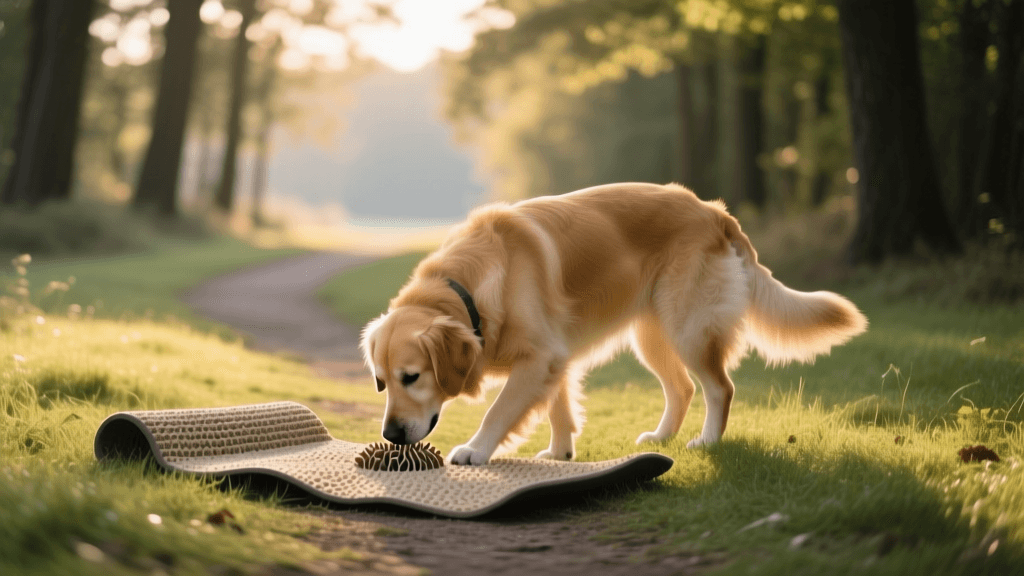
The Snuffle Mat Decompression Walk elevates this concept by using a portable foraging mat as a mobile 'settle station.' Instead of relying solely on the environment to provide enrichment, the handler brings a controlled, high-value foraging activity into the environment. This creates a predictable, safe anchor for the dog, even in moderately stimulating areas. As the Fear Free Pets initiative highlights, giving animals a sense of control and predictable positive outcomes in stressful environments is a cornerstone of reducing fear and anxiety.
The Engage-Disengage Snuffle Protocol
Integrating a snuffle mat into your reactivity training requires a specific protocol. It is not about throwing the mat down and hoping the dog ignores the trigger. It is about strategic deployment and threshold management.
Step 1: Environmental Selection and Setup
Choose a location where you can predict triggers from a distance. A park bench facing a distant walking path, or a quiet cul-de-sac with a wide field of vision, is ideal. Equip your dog with a well-fitted Y-front harness and a 15-foot biothane long line. Biothane is preferred in 2026 for its durability, ease of cleaning, and lack of friction burn if the dog suddenly pulls.
Step 2: The Anchor Deployment
Before the dog even notices a trigger, deploy the snuffle mat on the grass or pavement. Scatter high-value, aromatic treats into the fabric folds. For highly anxious dogs, standard kibble will not work. Use freeze-dried beef lung, grated parmesan cheese, or squeeze tubes of lickable dog food. Licking and deep sniffing both promote endorphin release.
Step 3: Trigger Management at Threshold
When a trigger (e.g., another dog) appears in the distance, your dog will likely pause their sniffing and look up. This is the 'Engage' phase. Because you are working below threshold (the distance at which the dog notices the trigger but does not react explosively), the dog should be able to 'Disengage' and look back at you or the mat. The moment they look away from the trigger, calmly point to the snuffle mat and use a cue like 'Find it.' The return to sniffing drops their heart rate and reinforces that the presence of a trigger predicts a high-value foraging opportunity, rather than a stressful confrontation.
2026 Snuffle Mat Comparison for Reactive Dogs
Not all snuffle mats are created equal, especially when you need to carry them on walks, deploy them quickly, and ensure they are durable enough for frantic, anxious sniffing. Below is a comparison of the top-rated portable snuffle mats for reactive dog management in 2026.
| Brand & Model | Material & Design | Portability | Best For | 2026 Est. Price |
|---|---|---|---|---|
| PAW5 Wooly Snuffle Mat | Hand-tied, upcycled wool strands; dense and heavy. | Medium (rolls up but bulky) | Power chewers and intense foragers who pull at fabric. | $48.00 |
| Doggy Dash Portable Forager | Fleece strips on a waterproof, weighted nylon base. | High (folds into an attached pouch) | Wet climates and handlers needing rapid deployment. | $36.00 |
| Stella Mat by SnuffleCo | Cotton blend with varying difficulty pockets and suction cups. | Medium (includes a travel drawstring bag) | Smart dogs needing complex puzzles to maintain focus. | $42.00 |
Note: When using suction cup models outdoors, ensure the surface is smooth (like a concrete retaining wall or a bench seat). For grass, weighted bases like the Doggy Dash are superior to prevent the dog from simply picking up the entire mat and shaking it.
Troubleshooting Anxious Behaviors During Decompression
Even with the best tools, managing a reactive dog is rarely a linear process. Here are common hurdles owners face during snuffle mat decompression walks and how to address them in 2026.
- The Dog Refuses to Eat or Sniff: If your dog ignores the high-value treats on the mat and stares rigidly at the environment, they are over threshold. Their digestive system has effectively shut down due to the adrenaline dump. Solution: Do not force the interaction. Calmly increase the distance from the trigger by 50 to 100 feet until the dog offers a 'shake off' (a full-body shake), which is a natural stress-relieving mechanism, and then re-present the mat.
- Resource Guarding the Mat: Some anxious dogs may begin to guard the snuffle mat from passing pedestrians or distant dogs, adding a layer of aggression to their reactivity. Solution: Transition from a stationary mat to a 'scatter feed' directly onto the grass, removing the object of guarding while maintaining the neurological benefit of ground-sniffing.
- Frantic, Destructive Digging: If the dog is frantically tearing at the mat rather than sniffing, the puzzle is too easy, or their arousal is too high. Solution: Pre-load the mat with treats pushed deep into the core folds before the walk begins, requiring slower, more deliberate olfactory work rather than rapid visual scavenging.
Integrating Veterinary Support and Holistic Wellness
While the snuffle mat decompression walk is a powerful behavioral modification tool, it is not a standalone cure for severe canine anxiety. In 2026, the gold standard for treating leash reactivity involves a multimodal approach. If your dog's reactivity is severely impacting their quality of life, causing them to pant, pace, or refuse food for hours after a walk, it is time to consult a board-certified veterinary behaviorist.
Medications such as SSRIs (Selective Serotonin Reuptake Inhibitors) or fast-acting situational anxiolytics like trazodone or gabapentin can lower the dog's baseline anxiety enough to allow the snuffle mat protocol to actually work. Think of medication as putting on a pair of glasses; it doesn't teach the dog to read, but it allows them to see the training clearly. Combine this with holistic wellness approaches—such as canine massage therapy, adaptogenic supplements like ashwagandha, and strict sleep hygiene (ensuring your dog gets 14-16 hours of sleep in a dark, quiet room)—and you will build a resilient, confident dog capable of navigating the world with a lowered heart rate and a wagging tail.
robin-maitland
All our authors care for dogs every day — read more of their work on the authors page.