Smart Home Tech Setup Guide for Bringing a New Dog Home
Discover the best smart home tech and gadgets to prepare for your new dog. From GPS trackers to pet cameras, set up a safe, modern home today.

Why Integrate Smart Tech Before Your Dog Arrives?
Bringing a new dog home is a milestone filled with joy, but it also introduces a whirlwind of logistical challenges. From establishing feeding schedules to managing sudden bouts of separation anxiety, the first few weeks test any owner's patience. Fortunately, the rise of modern pet technology offers unprecedented support. By setting up smart home ecosystems before your dog crosses the threshold, you create a safer, more structured environment that accelerates training and provides peace of mind. This guide explores the essential technology you need to prepare your home for a modern dog ownership experience.
1. Pet Cameras: Easing Separation Anxiety
Separation anxiety is one of the most common behavioral issues in newly adopted dogs. According to the ASPCA, dogs are highly social animals, and sudden isolation in a new environment can trigger severe stress. Smart pet cameras allow you to monitor your dog's behavior, dispense treats, and communicate via two-way audio, bridging the gap between your absence and their comfort.
Product Spotlight: The Furbo 360° Dog Camera (approx. $210) features a rotating lens, bark alerts, and a treat-tossing mechanism. For a budget-friendly alternative, the Wyze Cam v3 (approx. $50) offers excellent night vision and two-way audio, though it lacks treat dispensing.
Actionable Advice: Mount the camera at your dog's eye level in their primary resting area. During the first week, use the two-way audio sparingly; hearing your voice without seeing you can sometimes confuse or frustrate a new dog. Instead, rely on visual monitoring and automated treat dispensing to reward calm behavior when you leave the room.
2. GPS and Activity Trackers: Safety First
New dogs, especially rescues, are prone to bolting out of open doors or slipping collars while exploring unfamiliar neighborhoods. While microchipping is a non-negotiable baseline for pet recovery—as emphasized by the American Veterinary Medical Association (AVMA)—a GPS collar provides real-time tracking that a microchip cannot.
Product Spotlight: The Fi Series 3 Smart Dog Collar (approx. $149 + $99/year subscription) utilizes LTE-M technology, offering superior battery life (up to 3 months) and escape alerts. The Whistle Go (approx. $69 + $99/year) is a lightweight alternative that clips onto existing collars and tracks both location and health metrics like scratching or licking.
Actionable Advice: Set up 'Safe Zones' (geofences) in the companion app covering your home and yard. Test the GPS tracking in your neighborhood before the dog arrives to ensure adequate cellular coverage and familiarize yourself with the app's alert system.
3. Automated Feeders and Fountains: Building Routine
Consistency is the cornerstone of canine behavioral training. Smart feeders remove human error from the feeding equation, ensuring your dog receives precise portions at the exact same times daily, which aids in digestion and potty training predictability.
Product Spotlight: The Petlibro Granary WiFi Feeder (approx. $130) allows you to schedule up to 10 meals a day and monitor food levels via an app. Pair this with a smart water fountain like the PetSafe Drinkwell (approx. $90) to encourage hydration. Some newer fountain models connect to apps to track water intake and alert you when filters need changing.
Actionable Advice: Program the feeder to dispense a small 'welcome home' meal right before you walk through the door. This creates a positive association with your arrival and redirects the dog's excitement from jumping on you to engaging with their food bowl.
Smart Dog Tech Comparison Chart
| Device Type | Top Pick | Est. Cost | Key Feature | Best For |
|---|---|---|---|---|
| Pet Camera | Furbo 360° | $210 | Treat tossing & 360° view | Separation anxiety |
| GPS Tracker | Fi Series 3 | $149 + Sub | Escape alerts & LTE-M | Flight risks & hikers |
| Smart Feeder | Petlibro Granary | $130 | Portion control & app scheduling | Strict diets & routine |
| Smart Pet Door | SureFlap Connect | $200 | Microchip reading & curfews | Fenced yards & multi-pet homes |
4. Smart Pet Doors and Home Automation
If you have a fenced yard, a smart pet door grants your dog the freedom to potty without requiring you to constantly play doorman. Furthermore, integrating pet tech with broader home automation platforms like Amazon Alexa, Apple HomeKit, or Samsung SmartThings creates a seamless ecosystem.
Product Spotlight: The SureFlap Microchip Pet Door Connect (approx. $200) reads your dog's existing microchip to unlock the door, preventing wildlife or neighborhood stray cats from entering your home. The companion app lets you set curfews, locking the door automatically at night.
Actionable Advice: Link your pet camera's 'bark alert' to your smart home routine. For example, if the camera detects barking, your smart lights can automatically turn on to deter potential intruders or soothe a dog afraid of the dark.
5. Environmental Automation: Climate and Sound
Dogs, especially puppies and senior rescues, are sensitive to temperature fluctuations and environmental stressors. Smart thermostats (like Nest or Ecobee) can be programmed to maintain an optimal 68°F–72°F range in the dog's primary room. Additionally, smart speakers (Amazon Echo, Sonos) can be scheduled to play classical music or white noise during your work hours. Studies have shown that classical music can significantly reduce stress indicators in shelter and newly adopted dogs. By automating the auditory environment, you mask scary neighborhood noises and create a soothing baseline for your dog's first weeks.
Puppy-Proofing in the Digital Age
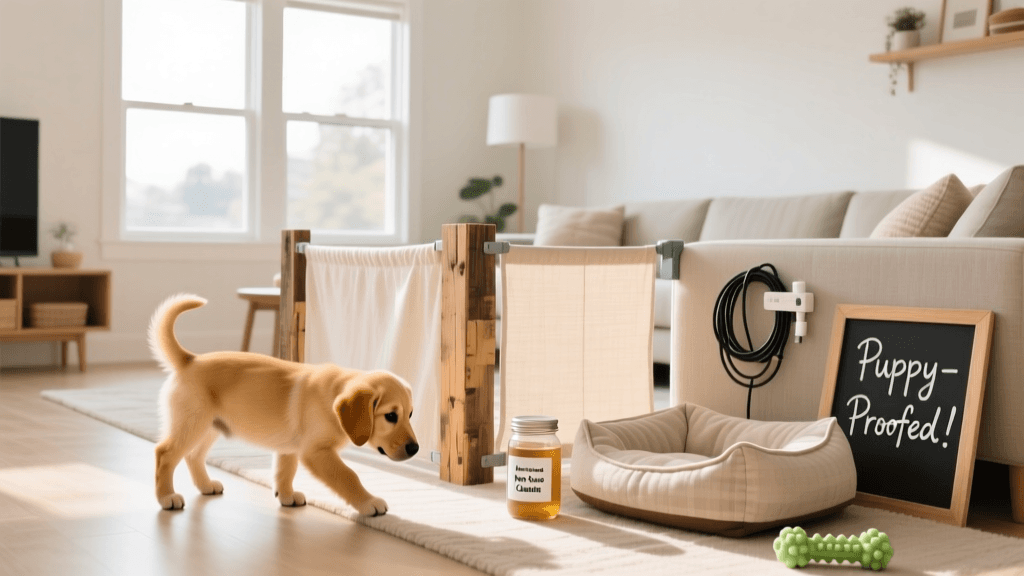
Introducing expensive electronics into a home with a teething puppy or an anxious rescue requires strategic puppy-proofing. The American Kennel Club (AKC) stresses the importance of securing electrical cords and removing toxic plants, but modern tech adds new variables.
- Cable Management: Use split loom tubing or adhesive cable channels to secure power cords for cameras and feeders. Puppies can easily chew through a $15 replacement cable, but the resulting electrical shock or intestinal blockage is life-threatening.
- Device Placement: Mount smart feeders on heavy, non-slip mats or secure them to baseboards to prevent tipping. A knocked-over feeder can result in binge eating and dangerous gastric dilatation-volvulus (bloat).
- Wi-Fi Bandwidth: Pet cameras and GPS hubs require stable 2.4GHz Wi-Fi networks. Ensure your router is positioned centrally, or invest in a mesh Wi-Fi system (like Eero or TP-Link Deco) to eliminate dead zones in the backyard where your GPS tracker needs to sync.
Managing Tech-Induced Overstimulation
While tech is helpful, constant alerts and screen time can distract you from reading your dog's subtle body language. Designate 'tech-free' training blocks where you turn off notifications and rely entirely on positive reinforcement, eye contact, and physical play. Your dog needs to learn to read you, not just respond to the mechanical whir of a treat dispenser.
Final Thoughts on the Modern Dog Welcome
Technology will never replace the irreplaceable bond, physical exercise, and hands-on training your new dog needs. However, leveraging smart home tech acts as a force multiplier for your care. By investing in a reliable camera, a robust GPS tracker, and automated feeding routines before your dog arrives, you eliminate daily friction. This allows you to focus less on logistical micromanagement and more on building a lifelong, trusting relationship with your new best friend.
anouk-beaumont
All our authors care for dogs every day — read more of their work on the authors page.