Service Dog Puppy Socialization 2026: Public Access Guide
Discover the 2026 standards for raising a service dog puppy. Learn early public access socialization, task-conditioning play, and evaluation metrics.
The Evolution of Service Dog Puppy Rearing in 2026
Raising a working or service dog puppy is a profound responsibility that extends far beyond basic obedience and housebreaking. As we navigate 2026, the science of canine behavioral development has refined how professional organizations and owner-trainers approach the critical first six months of a working dog's life. The modern paradigm has shifted away from simply exposing puppies to novel stimuli and toward cultivating active engagement, environmental neutrality, and foundational task-conditioning. Whether you are raising a mobility assistance dog, a psychiatric service dog, or a medical alert prospect, the blueprint for success is laid during the puppy's earliest developmental windows.
According to the latest guidelines observed by Assistance Dogs International (ADI), early socialization for service dog prospects must prioritize the puppy's emotional regulation and voluntary engagement over forced exposure. In 2026, top-tier training programs utilize bio-feedback and stress-monitoring to ensure puppies are not merely tolerating public environments, but are actively learning to thrive in them. This comprehensive guide will walk you through the modern methodologies for early public access socialization, task-oriented play, and the legal frameworks governing Service Dogs in Training (SDiT).
The 2026 Paradigm Shift: Neutrality Over Exposure
Historically, puppy socialization was often treated as a checklist of environments to visit. Today, behavioral scientists emphasize environmental neutrality. For a future service dog, a busy shopping mall or a noisy transit station should not be a source of excitement or fear; it should simply be the backdrop for their working life. The goal in 2026 is to teach the puppy that novel sounds, unusual surfaces, and passing strangers are entirely irrelevant to their core job of focusing on their handler.
To achieve this, trainers employ the "Engage-Disengage" protocol from a very young age. When a puppy notices a distraction (like a rolling suitcase or a loud siren), they are marked and rewarded for looking back at the handler. This builds a default behavior of checking in with the handler whenever the environment becomes chaotic, a trait that is absolutely non-negotiable for a mature working dog.
Core Public Access Milestones (0 to 6 Months)
The first six months are divided into distinct developmental phases. Pushing a puppy too fast can result in "socialization burnout" or public access reactivity, while moving too slowly can result in missed critical fear periods.
Months 1-2: Scent, Sound, and Surface Neutrality
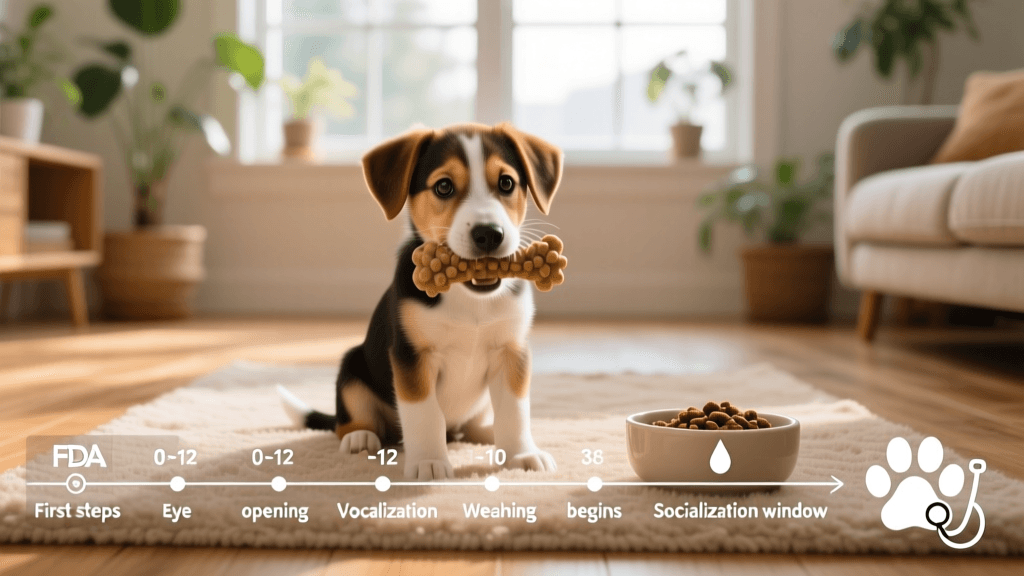
Before vaccinations are complete, public access is limited, but foundational work begins at home and in controlled outdoor spaces. Introduce the puppy to a variety of floor textures (grating, tarps, wobble boards) and household sounds (vacuums, blenders, dropping pans) at a low volume. Pair every novel experience with high-value treats, such as freeze-dried liver or commercial puppy pastes, to build a positive conditioned emotional response (+CER).
Months 3-4: Equipment Desensitization and the "Settle" Protocol
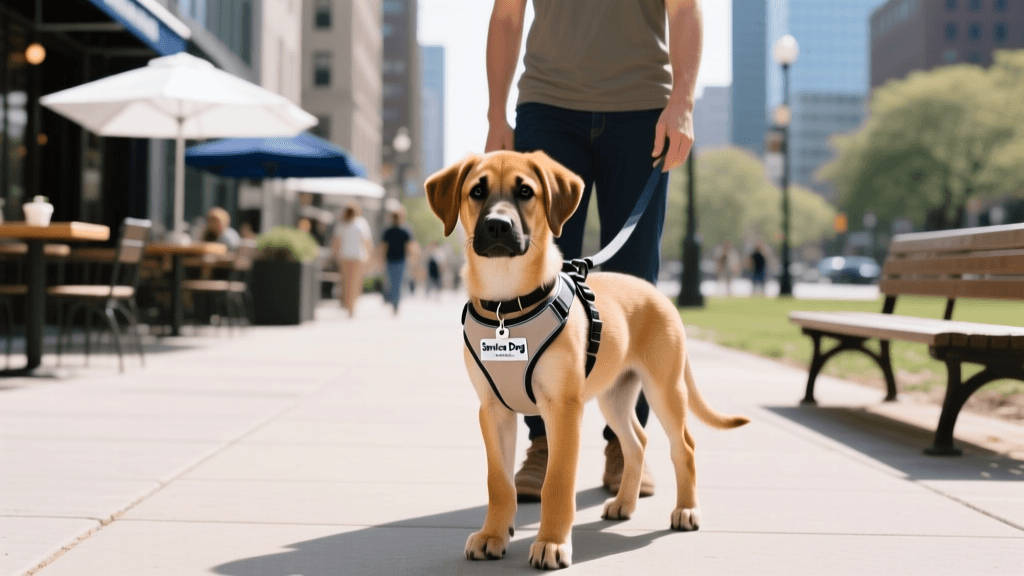
Once veterinary clearance is granted, the puppy begins wearing their working harness or vest for short durations. In 2026, ergonomic puppy harnesses like the Hurtta Puppy Harness or the Ruffwear Hi & Light are highly recommended to prevent joint strain and ensure the puppy associates the gear with comfort. Simultaneously, the "Settle" protocol is introduced. Using a portable training mat, the puppy learns to lie down and relax in low-distraction public areas, such as a quiet park bench or an empty outdoor cafe patio.
Months 5-6: High-Distraction Environments and Ignoring Food
As the puppy approaches adolescence, the difficulty of public access outings increases. The puppy must learn to navigate grocery store aisles, ignore dropped food, and remain neutral to approaching strangers and other dogs. This is where the "Leave It" and "Focus" commands are rigorously tested. Handlers practice dropping high-value items on the floor and rewarding the puppy heavily for ignoring the dropped item and maintaining eye contact.
Task-Conditioning Play: Building the Working Drive
A working dog must view their tasks as an extension of play. In 2026, trainers utilize "task-conditioning play" to build the physical and mental muscles required for complex service work without burning out the puppy's joints or mind.
- Retrieve Foundations: Using soft, lightweight toys like the Kong Signature Puppy or knotted fleece tugs, handlers play short, high-energy games of fetch in a hallway to build a natural carry-and-return instinct. This is the precursor to retrieving dropped items, opening doors, or fetching medical kits.
- Tug and Brace Conditioning: Controlled tug games on a sturdy rope attached to a low, stable object teach the puppy how to engage their hindquarters and pull with their body weight. This is the foundational play for future mobility tasks, such as bracing for balance or pulling a lightweight wheelchair.
- Scent and Alert Games: For medical alert prospects, hide-and-seek games utilizing specific scent oils (like cortisol or blood glucose simulants) are introduced in a game-like format. The puppy learns that finding the scent and performing a trained alert (like a nose boop or a paw tap) results in a jackpot reward.
Tracking Progress: The 2026 Service Puppy Evaluation Matrix
Professional organizations rely on strict metrics to determine if a puppy is suitable for continued service dog training. The table below outlines the standard evaluation matrix used by leading programs in 2026 to assess public access readiness at the 6-month mark.
| Age | Milestone | Evaluation Metric | Passing Criteria |
|---|---|---|---|
| 2 Months | Sound & Surface Neutrality | Reaction to sudden noises and unstable footing | Recovers within 3 seconds; seeks handler for comfort |
| 4 Months | Harness Acceptance & Settle | Duration of mat settling in a novel outdoor environment | Maintains a down-stay on mat for 5 minutes with mild distractions |
| 5 Months | Stranger Neutrality | Response to an approaching, friendly stranger | Remains seated or standing calmly; no jumping or excessive vocalization |
| 6 Months | Food & Environmental Refusal | Ignored dropped food in a retail environment | 100% success rate over 5 trials; maintains focus on handler |
Navigating Public Access Laws and Etiquette in 2026
Understanding the legal landscape is crucial for any handler raising a service dog prospect. The U.S. Department of Justice ADA guidelines clearly define the rights of fully trained service animals, but the laws regarding Service Dogs in Training (SDiT) vary significantly by state and municipality. In 2026, many states have updated their SDiT statutes to grant handler-trainers the same public access rights as those with fully trained dogs, provided the puppy is under strict control and wearing appropriate identification.
However, ethical etiquette remains paramount. As noted by the American Kennel Club (AKC), a puppy in training should never be brought into environments they are not developmentally prepared to handle. If a puppy becomes overwhelmed, exhibits fear, or has an accident in a public space, the ethical handler must immediately remove the dog from the environment. Pushing a struggling puppy not only damages their confidence but also reflects poorly on the broader service dog community.
"A service dog in training is a student, not a finished product. Public access is a privilege earned through demonstrated reliability, not a right to be exercised at the expense of the puppy's mental well-being or the public's comfort." — 2026 ADI Best Practices Committee
Avoiding Burnout: The Enforced Rest Protocol
One of the most common mistakes novice owner-trainers make in 2026 is over-socializing. Working breeds, such as Labrador Retrievers, Golden Retrievers, and German Shepherds, often possess an "off-switch" that must be manually installed. A puppy that is constantly on the go, attending daily outings, and engaging in continuous training will quickly suffer from behavioral fallout, manifesting as hyperactivity, reactivity, or chronic stress.
Implement an Enforced Rest Protocol. Puppies under six months require 18 to 20 hours of sleep per day. Utilize a crate or a designated puppy-proofed pen to mandate naps after every 45 to 60 minutes of wakefulness. During these rest periods, the puppy's brain processes the complex environmental data gathered during public access outings, solidifying neural pathways and ensuring the puppy wakes up calm, focused, and ready to learn. By balancing rigorous public access training with uncompromising rest, you lay the unbreakable foundation required for a successful, life-saving working dog.
jonas-cole
All our authors care for dogs every day — read more of their work on the authors page.