Raising a Service Dog Puppy: 2026 Socialization Guide
Discover the essential 2026 public access socialization checklist for service dog puppies, covering early milestones, gear, and exposure techniques.
The Critical Window for Service Dog Prospects
Raising a puppy destined for working or service dog duties requires a fundamentally different approach than raising a standard family companion. The first twelve months of a puppy's life are characterized by rapid neurological development, and for a future service dog, this period is the foundation of their entire career. According to the American Veterinary Society of Animal Behavior (AVSAB), the primary and most critical period for puppy socialization is the first three months of life. During this time, puppies must be exposed to a vast array of stimuli to prevent the development of fear-based behaviors that would immediately disqualify them from public access work.
For a puppy to succeed as a mobility, psychiatric, or medical alert dog in 2026, they must learn to remain neutral, focused, and confident in highly stimulating environments. This means moving beyond basic neighborhood walks and actively engineering exposures to the sights, sounds, and surfaces they will encounter while working alongside their future handler.
Essential Gear for Public Access Training in 2026
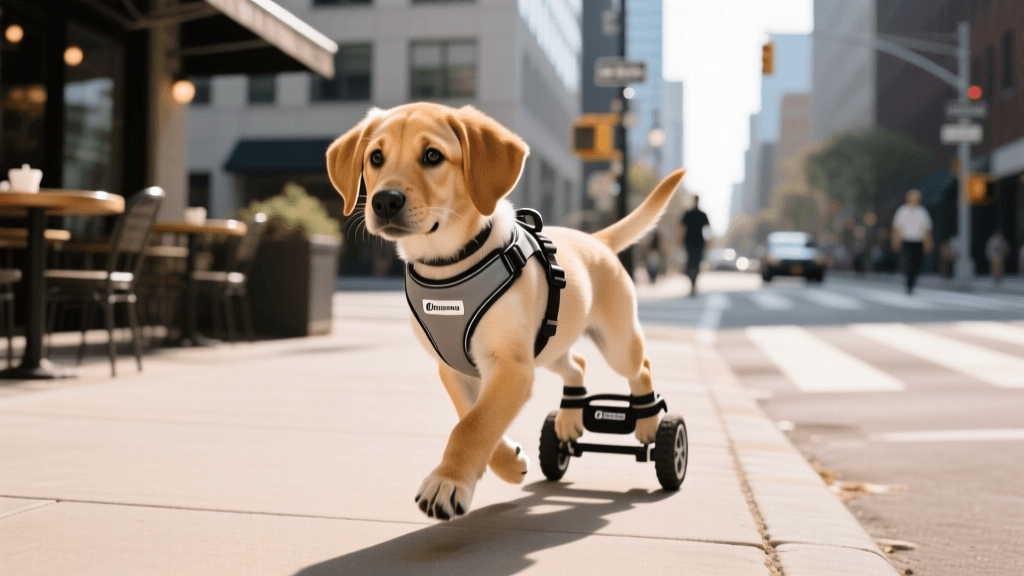
Before stepping into public environments, equipping your puppy with the right gear is paramount for safety and training clarity. In 2026, the industry standard for early service dog prospects emphasizes ergonomic support and clear visual communication.
- Harness: The 2026 edition of the Ruffwear Front Range Harness is highly recommended for early leash training. Its dual leash attachment points allow you to gently redirect a puppy's forward momentum without putting pressure on their developing trachea.
- Vest: While puppies do not legally require a service dog vest, wearing a lightweight, breathable mesh "In Training" vest helps condition the puppy to understand that when the vest goes on, it is time to work and focus.
- Mat: A portable, non-slip training mat (like the Kurgo G-Train Mat) is essential. Teaching a puppy to "settle" on a mat is the foundational behavior for resting quietly under a table at a restaurant or in a waiting room.
The 2026 Public Access Socialization Checklist
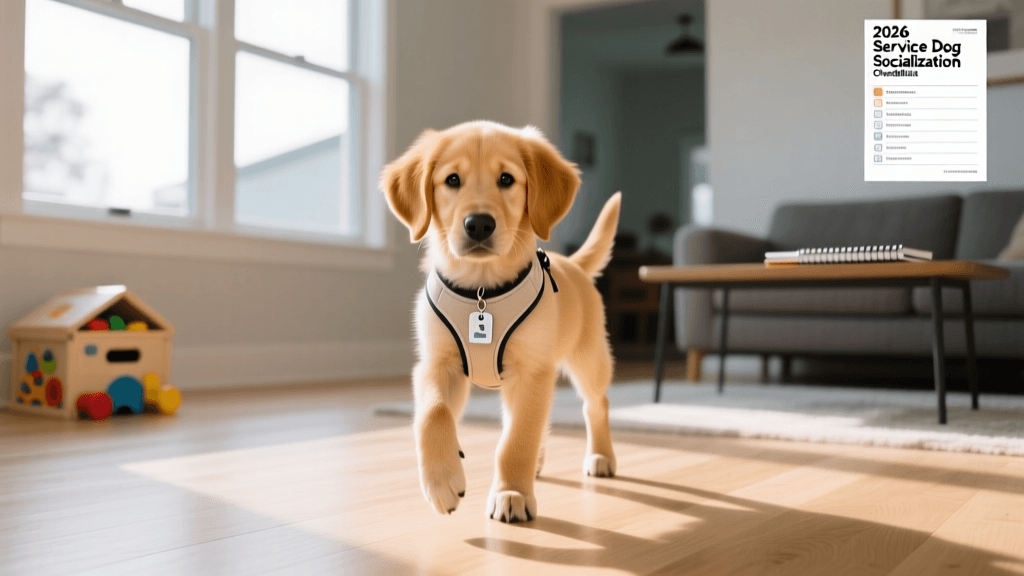
A structured approach to socialization ensures you do not miss critical developmental windows. Below is a milestone checklist tailored specifically for service dog prospects during their first year.
| Age Range | Public Access Focus | Working Dog Milestone |
|---|---|---|
| 8-12 Weeks | Surface exposure, automatic doors, shopping carts | Neutrality to rolling objects and strange footing |
| 12-16 Weeks | Elevators, escalators, public transit, crowds | Confident boarding and settling in confined spaces |
| 4-6 Months | Loud noises, dropping items, sudden movements | Rapid recovery from startle responses (Bounce-back) |
| 6-9 Months | Ignoring dropped food, greeting strangers politely | Leave-it reliability and handler focus in high-distraction |
| 9-12 Months | Prolonged settling, complex task foundations | Sustained "under" command for 45+ minutes in public |
Sound Desensitization for Psychiatric and Autism Prospects
Puppies being raised for psychiatric service work or autism support must possess an exceptionally high startle threshold. In 2026, trainers heavily utilize bio-acoustic desensitization protocols. This involves playing high-fidelity recordings of sirens, crying babies, thunderstorms, and sudden shouts at very low volumes while the puppy is eating or playing. Gradually increasing the volume over weeks ensures the puppy forms a positive or neutral association with jarring noises. If a puppy shows signs of noise sensitivity during the 4-to-6-month fear imprint period, it is critical to consult a veterinary behaviorist immediately to prevent permanent sound phobias.
Mobility Task Foundations: Protecting Growth Plates
A common mistake novice trainers make is attempting to teach pulling or bracing tasks to puppies. Current 2026 veterinary orthopedic guidelines strictly forbid any weight-bearing mobility tasks until a dog's growth plates have fully closed, typically between 18 and 24 months of age depending on the breed. Instead, the first year should focus on positioning and targeting. Teach the puppy to walk tightly against your left leg (heel position), to target their nose or chin to your hand, and to step over obstacles. These body-awareness exercises build the proprioception necessary for future mobility work without risking joint damage.
Navigating Puppy Teething in Public Spaces
The teething phase, which peaks between 4 and 6 months, can derail public access training if not managed correctly. A teething puppy is highly motivated to chew on table legs, chair rungs, and even the handler's clothing. When taking your service dog prospect to hardware stores or cafes, always carry a frozen, water-soaked rope toy or a Kong Extreme filled with a high-value, puppy-safe paste. Providing an appropriate, soothing outlet for their chewing urges prevents them from seeking out inappropriate items in public environments, preserving their "leave it" conditioning.
Surface Generalization for Potty Training
Service dogs must be able to eliminate on command in a variety of environments, often on surfaces they have never encountered before. A puppy that will only potty on grass will be highly stressed during long layovers at an airport or when staying in a hotel with only concrete access. Practice "surface generalization" by taking your puppy to gravel lots, mulch beds, sand, and concrete. Pair a specific verbal cue (such as "go potty" or "do your business") with the action. For indoor hotel training or high-rise apartment living, utilizing real-grass delivery services like DoggieLawn or Fresh Patch can bridge the gap between outdoor elimination and indoor necessities, ensuring the puppy remains comfortable and reliable during travel.
Building the Foundation for the AKC Canine Good Citizen
While public access rights are governed by the ADA and not by specific certifications, the American Kennel Club (AKC) highly recommends using the Canine Good Citizen (CGC) test as a benchmark for service dog prospects. The CGC evaluates essential skills such as accepting a friendly stranger, sitting politely for petting, and reacting calmly to another dog. Preparing your puppy for the CGC during their first year provides a structured, measurable framework for your training journey. Furthermore, organizations like Assistance Dogs International (ADI) emphasize that a solid foundation in basic obedience and public manners is the absolute prerequisite before any specialized task training begins.
Conclusion
Raising a service dog puppy is a profound commitment that requires meticulous planning, endless patience, and a deep understanding of canine development. By adhering to the 2026 socialization checklists, protecting their physical development, and prioritizing neutrality over obedience in the early months, you set your puppy on the path to becoming a life-changing partner for someone in need.
robin-maitland
All our authors care for dogs every day — read more of their work on the authors page.