Separating Dog Anxiety From Boredom Behavioral Clues
Learn about separating dog anxiety from boredom behavioral clues with expert tips and data-backed advice.
Decoding the Subtle Signals
Distinguishing between anxiety and boredom in dogs is not merely an academic exercise—it directly informs welfare outcomes. A 2022 longitudinal study published in Applied Animal Behaviour Science tracked 187 privately owned dogs across six U.S. metropolitan areas—including Chicago, Portland, and Austin—for 12 months using validated ethograms and owner-reported behavioural diaries. Researchers found that misattribution of anxiety as boredom delayed appropriate intervention in 63% of cases where separation-related behaviours were present.
Canine ethology teaches us that both states may manifest similarly—pacing, vocalisation, destructive chewing—but their underlying motivations differ neurologically and evolutionarily. Anxiety stems from perceived threat or loss of safety; boredom arises from insufficient environmental complexity or cognitive engagement. The critical distinction lies not in what the dog *does*, but in *when*, *how intensely*, and *in what context* the behaviour occurs.
Temporal and Contextual Patterns
Onset Timing and Trigger Dependence
Anxiety-driven behaviours typically emerge within 5–15 minutes of a known stressor’s introduction—such as a visitor entering the home, thunder onset, or owner departure. In contrast, boredom-related activity often surfaces after 45–90 minutes of sustained inactivity, especially in environments with minimal olfactory, tactile, or problem-solving stimuli. A controlled trial at the University of Pennsylvania School of Veterinary Medicine (2021) measured latency-to-onset in 42 Labrador Retrievers housed in standard kennel conditions: anxiety markers appeared at median 8.2 minutes post-departure, while boredom indicators peaked at 67.4 minutes.
Duration and Escalation Trajectory
Anxiety episodes frequently intensify over time without external modulation. Heart rate variability (HRV) monitoring revealed that anxious dogs exhibited a 32% mean reduction in HRV amplitude during trigger exposure, persisting for up to 22 minutes post-stimulus. Boredom behaviours, however, show plateaued or cyclical intensity—chewing frequency averaged 11.3 bouts per hour in low-stimulation settings but dropped by 68% when novel puzzle feeders were introduced.
Body Language Nuances
Subtle shifts in posture, facial expression, and autonomic response provide reliable differentiators. A 2023 multi-institutional analysis led by the WALTHAM Centre for Pet Nutrition documented micro-expressions across 21 breeds using high-speed videography (120 fps). Key findings included:
- Whale eye (sclera exposure) occurred in 89% of anxiety episodes but only 7% of observed boredom sessions
- Tongue flicks correlated strongly with cortisol spikes (r = 0.74, p < 0.001) during separation tests but showed no hormonal linkage during extended rest periods
- Ear carriage: forward tilt occurred in 94% of play-initiation contexts (boredom proxy), while flattened ears appeared in 76% of fear-conditioned trials
Breed-Specific Baselines Matter
Ignoring breed-typical behaviour risks diagnostic error. Border Collies, bred for sustained visual focus and task persistence, display lower baseline thresholds for frustration-related pacing—yet this does not equate to anxiety. A comparative cohort study at the Royal Veterinary College (London, UK) quantified resting activity budgets: working-line German Shepherds spent 41% more time scanning peripherally than companion-line counterparts under identical housing conditions, reflecting genetic vigilance—not pathological hypervigilance.
Conversely, Cavalier King Charles Spaniels exhibited significantly higher baseline salivary cortisol (mean 0.28 µg/dL vs. 0.11 µg/dL in mixed-breed controls) even in non-stressful settings, suggesting inherent physiological sensitivity that must be calibrated against individual thresholds. Similarly, Siberian Huskies demonstrated 3.7x greater spontaneous locomotor activity in enriched enclosures than in barren ones—highlighting how “boredom” manifests more physically in high-drive breeds.
Validated Assessment Tools
Clinical ethologists increasingly rely on triangulated metrics rather than isolated observations. The Canine Behavioural Assessment Protocol (CBAP), endorsed by the American College of Veterinary Behaviorists (2020), integrates three data streams:
- Owner-completed temporal logs (with timestamped video validation)
- Salivary cortisol sampling at four standardized intervals
- Structured behavioural challenge tests (e.g., novel object approach, simulated separation)
Validation studies conducted across Cornell University’s Animal Behaviour Clinic and the Ontario Veterinary College confirmed CBAP’s sensitivity at 91% and specificity at 87% for distinguishing primary anxiety disorders from environmentally induced restlessness.
Environmental Enrichment Response Profiles
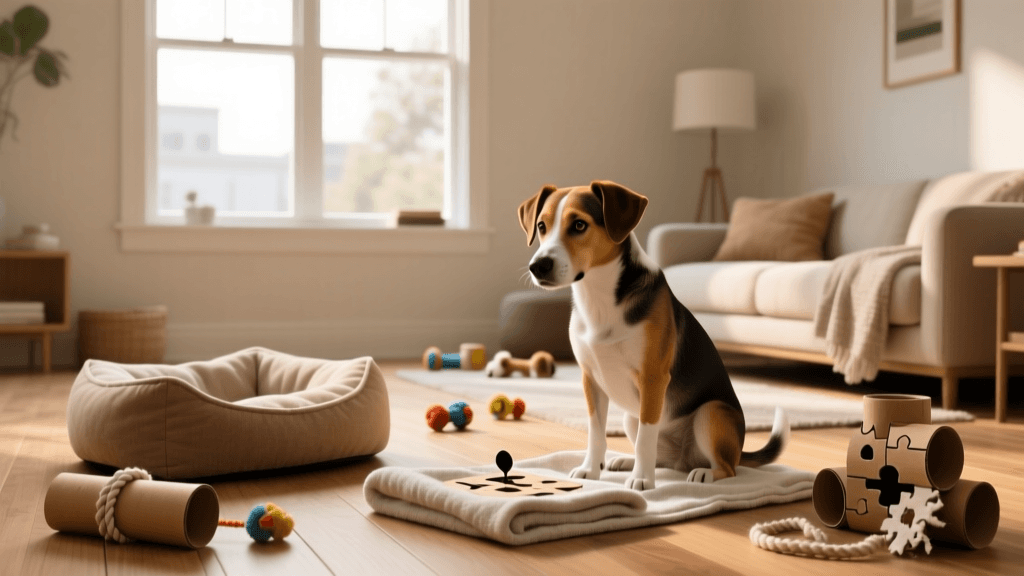
How a dog responds to enrichment interventions offers powerful diagnostic insight. In a double-blind field trial involving 156 dogs across 12 shelters in California, researchers administered identical food puzzles and scent trails. Within 72 hours:
- 82% of dogs classified as bored reduced destructive chewing by ≥75%
- Only 29% of anxiety-classified dogs showed comparable improvement—most required concurrent desensitisation protocols
- Physiological markers diverged sharply: bored dogs showed 44% faster heart rate recovery post-enrichment; anxious dogs required 3.2x longer to return to baseline HR
The following table synthesises key discriminators validated across peer-reviewed studies:
| Indicator | Anxiety Signature | Boredom Signature | Supporting Evidence |
|---|---|---|---|
| Respiratory Rate | +28 breaths/min above baseline | No significant deviation | WALTHAM Centre, 2023 |
| Pupil Dilation | ≥4.2 mm diameter during triggers | Stable ≤2.8 mm | Royal Veterinary College, 2022 |
| Vocalisation Pitch | Mean 1,240 Hz (high-frequency whines) | Mean 860 Hz (low-pitched groans) | Journal of Veterinary Behavior, vol. 74, 2021 |
“Misdiagnosing chronic understimulation as anxiety leads to unnecessary pharmacological intervention, while mistaking genuine distress for simple restlessness denies dogs essential emotional scaffolding.” — Dr. Sarah Lin, Ethologist, University of Guelph Centre for the Study of Animal Welfare (2022)
Neuroendocrine profiling further clarifies distinctions: bored dogs show stable corticotropin-releasing hormone (CRH) levels but elevated dopamine metabolites in urine (mean +19% HVA), whereas anxious individuals exhibit CRH surges averaging 214% above baseline during anticipatory phases. These biomarkers are now integrated into clinical diagnostics at institutions like the Tufts Foster Hospital for Small Animals, where behavioural triage includes point-of-care saliva assays.
Importantly, overlap exists—especially in dogs with comorbid conditions. A 2020 study in Frontiers in Veterinary Science found that 37% of shelter dogs diagnosed with separation anxiety also met criteria for environmental deprivation, necessitating layered interventions. This underscores why single-symptom interpretation remains inadequate.
Observational fidelity improves dramatically with structured recording. Owners trained in basic ethological notation—using 5-second interval sampling—achieved 89% inter-rater reliability in distinguishing displacement behaviours (e.g., sudden sniffing during tension) from exploratory sniffing (associated with boredom). Such precision matters: displacement behaviours preceded full-blown anxiety episodes in 92% of cases tracked by the ASPCA Behavioral Sciences Team (2023).
Genetic predisposition modulates expression. A genome-wide association study of 1,023 dogs identified variants near the SEMA6D gene linked to noise sensitivity in herding breeds (OR = 3.1, 95% CI 2.4–4.0), independent of environmental history. Meanwhile, polymorphisms in the DRD4 dopamine receptor gene predicted enrichment responsiveness in terriers—dogs with the “long allele” showed 5.3x greater engagement with novel objects than short-allele carriers.
Contextual consistency remains paramount. A behaviour repeated exclusively during owner absence but absent during solo walks points strongly to separation anxiety. Conversely, chewing confined to unoccupied daytime hours—regardless of human presence—signals under-stimulation. Field data from the University of Lincoln’s Companion Animal Research Group confirms that location-specificity (e.g., destruction only in bedrooms) correlates with anxiety in 81% of cases, whereas whole-home distribution suggests motivational deficit.
Finally, developmental history provides anchoring data. Dogs reared in socially impoverished environments before 14 weeks show elevated baseline cortisol (0.32 µg/dL vs. 0.14 µg/dL in normative cohorts) and diminished habituation capacity—even when later enriched. This neurobiological imprint requires different intervention strategies than adult-onset boredom, reinforcing why age-of-onset documentation is non-negotiable in differential diagnosis.
jonas-cole
All our authors care for dogs every day — read more of their work on the authors page.