The Science of Decompression Walks for Reactive Dogs
Discover the behavioral science behind decompression walks for reactive dogs. Learn gear setups, sniffing protocols, and stress-reduction techniques.
The Behavioral Science Behind Decompression
Life with a reactive or chronically stressed dog requires more than just basic obedience; it demands a deep understanding of canine ethology and applied behavior analysis (ABA). When a dog exhibits reactivity—lunging, barking, or freezing at triggers—their sympathetic nervous system is in overdrive. Traditional "heel" walks often exacerbate this frustration by restricting movement and preventing the dog from engaging in natural stress-regulating behaviors. Enter the decompression walk: a scientifically grounded approach to lowering cortisol levels and resetting the canine nervous system.
From a behaviorist's perspective, sniffing is not merely a distraction; it is a primary reinforcer and a self-soothing mechanism. The canine olfactory bulb is proportionally much larger than ours, and processing complex scentscapes requires significant cognitive engagement. According to the American Kennel Club, mental enrichment through scent work can be as physically exhausting as rigorous exercise. More importantly, the physical act of lowering the head to sniff shifts the dog's weight distribution and encourages deep, rhythmic breathing, which stimulates the vagus nerve and activates the parasympathetic nervous system.
The Neurochemistry of Sniffing and Scent Processing
To truly appreciate the decompression walk from an expert behavior analysis perspective, we must look at the neurochemistry of the canine brain. When a dog engages in deep, sustained sniffing, their brain releases dopamine—the neurotransmitter associated with reward, motivation, and pleasure. Unlike the quick dopamine spike from eating a treat, the dopamine released during environmental scent processing is sustained, promoting a state of flow and focus.
Furthermore, the rhythmic breathing required to process complex odor particles (often involving the vomeronasal organ) stimulates the parasympathetic nervous system. This actively lowers the production of cortisol and adrenaline, the primary stress hormones. For a reactive dog whose baseline cortisol levels may be chronically elevated due to frequent triggering in urban environments, a 20-minute sniffing session acts as a biological reset button. This is why behaviorists often prescribe "sniffaris" before introducing formal counter-conditioning protocols; a regulated nervous system is a prerequisite for neuroplasticity and learning.
Structured Walks vs. Decompression Walks
To understand why decompression walks are vital for behavioral modification, we must contrast them with traditional structured walks. In ABA, the function of a behavior dictates the intervention. A structured walk serves the function of physical exercise and impulse control training, while a decompression walk serves the function of emotional regulation and environmental enrichment.
| Feature | Structured Heel Walk | Decompression Walk |
|---|---|---|
| Primary Goal | Impulse control, physical exercise | Cortisol reduction, nervous system reset |
| Leash Tension | Loose, but restricted radius | Long-line, allowing full radius exploration |
| Pacing | Human-directed, steady rhythm | Dog-directed, erratic and stop-and-go |
| Reinforcement | Food/toy for maintaining position | Access to environment (sniffing) as functional reinforcer |
| Impact on Reactivity | Can cause barrier frustration if triggers are present | Lowers baseline arousal, increasing trigger thresholds |
Essential Gear for Antecedent Arrangement
In applied behavior analysis, modifying the antecedent (the environment and conditions before a behavior occurs) is crucial for success. You cannot expect a dog to decompress if their equipment causes discomfort or restricts natural movement. Investing in the right gear costs between $70 and $120 but yields immense behavioral dividends.
The Harness: Y-Front Design
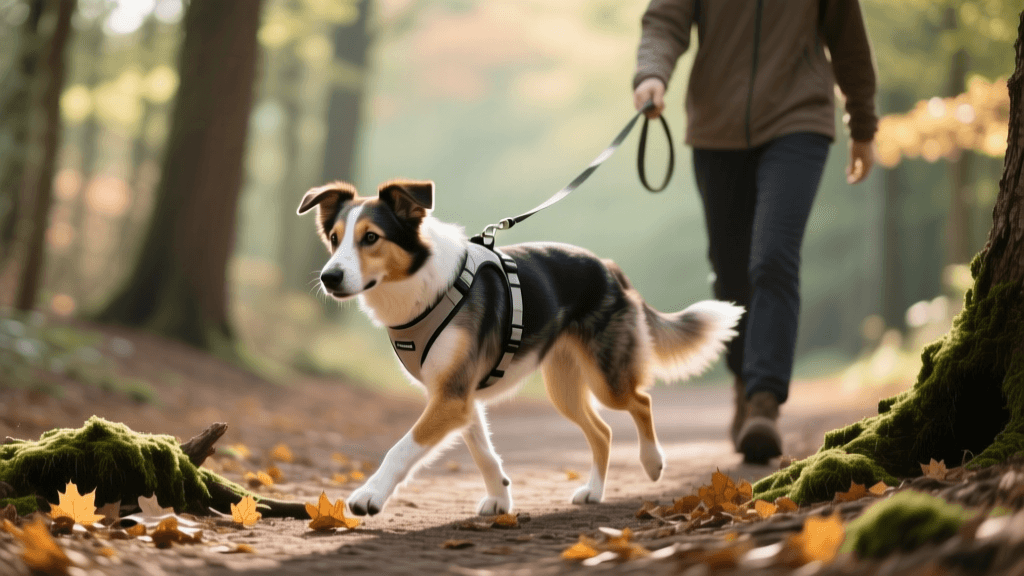
Avoid step-in or restrictive "no-pull" harnesses that tighten across the shoulders. These create physical tension, which translates to psychological tension. Opt for a Y-front harness like the Perfect Fit Harness ($60-$75) or the Ruffwear Front Range ($40). These allow full scapular extension, ensuring the dog's biomechanics remain relaxed while they explore.
The Long-Line: Biothane over Nylon
A standard 6-foot leash creates a "bubble" of barrier frustration. For decompression, you need a 15 to 30-foot long line. I strongly recommend Biothane long lines ($35-$55). Unlike nylon, Biothane does not absorb water, mud, or urine, and it won't cause friction burns if the dog suddenly bolts. Never use retractable leashes (like the Flexi brand); the internal spring mechanism maintains constant, light tension on the harness. Through operant conditioning, this constant tension inadvertently teaches the dog to pull against pressure, entirely defeating the purpose of a relaxed walk.
The Treat Pouch: Timing and Accessibility
While the decompression walk relies heavily on environmental reinforcement, you must still carry high-value treats for emergency disengagement or to initiate scatter feeding. Avoid bulky, slow-opening treat bags. Opt for a magnetic-closure pouch like the Dog Gone Smart Guru Treat Pouch ($25) or the Ruffwear Treat Trader ($35). In behavior analysis, the timing of reinforcement is critical. If a dog voluntarily disengages from a distant trigger to check in with you, your reinforcement must be delivered within 1.5 seconds to effectively mark and strengthen that alternative behavior.
Step-by-Step Implementation Protocol
Implementing a decompression walk requires strategic planning. The ASPCA emphasizes that true enrichment must be tailored to the individual dog's sensory needs and stress thresholds.
Step 1: Select the Right Environment (Antecedent Control)
Do not attempt a decompression walk in a high-traffic urban area. The goal is to keep the dog "under threshold"—meaning they are aware of their environment but not reacting to it. Use apps like Sniffspot to rent private, fenced fields, or drive to a quiet, secluded nature trail. The cost of a Sniffspot rental is typically $5 to $15 per hour, a worthwhile investment for uninterrupted behavioral rehabilitation.
Step 2: The "Sniffari" Release Cue
When you arrive at the location, attach the long line to the front or back clip of the Y-harness (back clip is preferred for decompression to avoid steering). Give a distinct release cue, such as "Go sniff" or "Free." This cue acts as a discriminative stimulus, signaling to the dog that the rules of the structured walk are suspended, and environmental exploration is now the primary reinforcement.
Step 3: Passive Observation and Line Management
Your job is to act as a passive anchor. Follow the dog, keeping the long line loose and draped. If the line gets caught on a bush, quietly free it without calling the dog back. If the dog reaches the end of the line, simply stop walking and wait. Do not reel them in. The absence of pressure allows the dog to self-regulate.
Step 4: Timing and Duration
Research indicates that 20 to 30 minutes of intense, uninterrupted sniffing can lower a dog's heart rate and provide the same mental fatigue as a one-hour run. Limit these sessions to 30 minutes to prevent olfactory fatigue and overstimulation.
Troubleshooting: What If the Dog Won't Sniff?
A common hurdle behaviorists face is the "velcro dog" or the highly anxious dog that paces and scans for threats rather than sniffing. Sniffing is a vulnerable position; a dog will not lower its head if it feels unsafe.
- Scatter Feeding (Shaping the Behavior): Bring high-value, strongly scented treats like dehydrated beef liver or Zuke's Mini Naturals. Toss a handful into the grass. This uses classical conditioning to pair the environment with positive outcomes, eventually luring the dog into a natural sniffing posture.
- Model the Behavior: Get down on your hands and knees and interact with the grass or leaves. While it feels silly, canine social learning is powerful. Your interaction with the environment can serve as a social cue that the area is safe.
- Assess the Threshold: If the dog is panting heavily, lip-licking, or refusing treats, they are over threshold. The environment is too stimulating. You must increase the distance from triggers or choose a more sterile, quiet location for the next session.
The Post-Walk Transition: Maintaining the Parasympathetic State
The decompression walk does not end the moment you reach your front door. A common mistake owners make is immediately demanding obedience or engaging in high-arousal play upon returning home, which instantly spikes the dog's heart rate and negates the cortisol-lowering benefits of the walk.
Instead, implement a structured "cool-down" antecedent arrangement. When you enter the home, unclip the long line silently. Provide a long-lasting, species-appropriate chewing item, such as a frozen Kong stuffed with plain pumpkin and low-sodium bone broth, or a natural beef bully stick ($8-$12). The mechanical act of chewing releases endorphins and further stimulates the vagus nerve, cementing the parasympathetic state achieved during the walk. Allow the dog to retreat to a designated "safe zone" or crate for 30 to 45 minutes of unstructured sleep. This consolidation period is vital for the brain to process the environmental data gathered during the sniffing session.
Long-Term Behavioral Benefits
Integrating decompression walks into your daily routine fundamentally alters your dog's baseline arousal levels. According to the RSPCA, providing dogs with the freedom to express natural foraging and scenting behaviors significantly reduces destructive and stereotypic behaviors in the home. By viewing walks not as a physical chore, but as a critical behavioral intervention, you empower your dog to navigate the world with confidence, resilience, and a regulated nervous system.
"Behavior modification is not just about changing what a dog does; it is about changing how a dog feels. Decompression walks address the emotional root of reactivity by giving the dog agency and control over their environment."
robin-maitland
All our authors care for dogs every day — read more of their work on the authors page.