Best Force-Free Harnesses for Urban Loose-Leash Walking 2026
Discover the best force-free harnesses and positive reinforcement techniques for urban loose-leash walking in 2026. Train your dog without aversives.
The 2026 Standard for Urban Dog Walking
Navigating the bustling streets, crowded sidewalks, and unpredictable triggers of a modern city requires a dog who is engaged, comfortable, and willingly walking by your side. As we move through 2026, the dog training community has definitively moved away from outdated, aversive tools like prong collars, slip leads, and electronic shock collars. Today, veterinary behaviorists and certified force-free trainers universally advocate for positive reinforcement and biomechanically sound harnesses to achieve reliable loose-leash walking.
Urban environments present unique challenges: sudden loud noises, passing skateboards, dense crowds, and a myriad of enticing smells. Relying on pain or fear to suppress a dog's natural pulling instinct not only damages the human-animal bond but often exacerbates leash reactivity. Instead, modern force-free methods focus on teaching the dog that staying near the handler is the most rewarding and comfortable option. This comprehensive guide explores the best force-free harnesses available in 2026 and outlines a positive reinforcement protocol for mastering city streets.
Why Ditch the Aversive Collars?
The shift toward force-free urban walking is backed by extensive behavioral science. According to the American Veterinary Society of Animal Behavior (AVSAB), aversive training methods carry significant risks, including increased fear, anxiety, and aggression. When a dog pulls on a flat collar or choke chain, the pressure is applied directly to the delicate structures of the neck, risking tracheal collapse, cervical spine issues, and restricted blood flow.
Furthermore, pain creates negative associations. If a dog sees another dog and receives a painful correction, they may begin to associate the presence of other dogs with pain, leading to leash reactivity. Force-free methods, conversely, utilize positive reinforcement (adding a reward to increase a desired behavior) and negative punishment (removing the reward—such as forward motion—to decrease an undesired behavior). This empowers the dog to make choices and builds a foundation of trust.
Top Force-Free Harnesses for City Streets
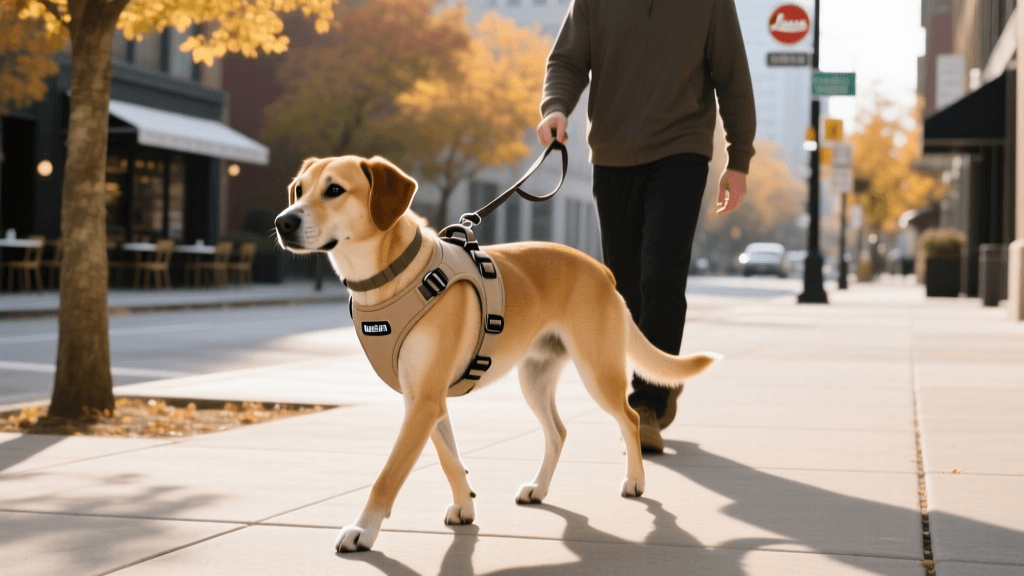
A well-fitted harness is the cornerstone of force-free leash training. By distributing pressure across the dog's chest and shoulders, a harness protects their neck. More importantly, a dual-clip harness with a front chest ring provides gentle, biomechanical steering. When a dog pulls, the front clip gently turns their shoulders toward the handler, naturally interrupting the pulling motion without causing pain.
| Harness Model | Best For | Clip Options | Approx. 2026 Price |
|---|---|---|---|
| Ruffwear Front Range | All-around city walking & durability | Front Chest & Back | $45.00 |
| Haqihana Saddle Harness | Sensitive dogs & anatomical fit | Front Chest & Back | $68.00 |
| Perfect Fit Modular | Escape artists & custom sizing | Front Chest & Back | $75.00 |
Ruffwear Front Range Harness (2026 Edition)
The Ruffwear Front Range remains a top recommendation for urban dwellers. The latest 2026 iteration features enhanced recycled materials and an even softer fleece lining around the belly and chest straps. The aluminum V-ring on the chest is perfectly positioned to redirect forward momentum, making it an excellent management tool while your dog is actively learning loose-leash skills.
Haqihana Saddle Harness
Designed in Italy, the Haqihana is revered among force-free professionals for its anatomical precision. It completely avoids the shoulder joints, allowing for a full, unrestricted range of motion. For city dogs who are easily spooked or have physical sensitivities, the Haqihana's soft, non-abrasive webbing and secure dual-clip system offer unparalleled comfort and control.
Perfect Fit Modular Harness
If your dog is a notorious escape artist or has a hard-to-fit body shape (like a deep-chested Greyhound or a barrel-chested Frenchie), the Perfect Fit is the ultimate solution. It consists of three separate, interchangeable pieces, ensuring a millimeter-perfect fit. A secure, comfortable dog is a dog who can focus on training rather than trying to back out of their gear.
Essential Positive Reinforcement Gear
A harness manages the physical aspect of pulling, but positive reinforcement teaches the dog what you want them to do instead. To train effectively in a high-distraction urban environment, your treat delivery system must be flawless.
- Ruffwear Treat Trader (2026 Model): This waist-worn treat pouch features a silent, one-handed magnetic closure. In the city, fumbling with zippers or velcro (which can startle noise-sensitive dogs) ruins your training timing. The magnetic hinge allows you to mark, reward, and close the pouch in a fraction of a second.
- High-Value Urban Treats: Kibble rarely works on a busy sidewalk. Use high-value, easily consumable treats like freeze-dried minnows, boiled chicken breast, or low-sodium turkey hotdogs cut into pea-sized pieces. The goal is rapid consumption so the dog can immediately return their focus to you.
- Marker Word or Clicker: Use a consistent marker like the word "Yes!" or a mechanical clicker to pinpoint the exact moment the dog offers a loose leash or makes eye contact.
Step-by-Step Force-Free Urban Training Protocol
According to the ASPCA's guidelines on loose-leash walking, consistency and patience are vital. Start these exercises in a low-distraction environment (like your hallway or a quiet courtyard) before taking them to the busy city streets.
Step 1: The Engagement Game
Before you even take a step, stand still. Wait for your dog to look up at you. The second they make eye contact, mark with a "Yes!" and deliver a treat right to the seam of your pants, near their nose. This teaches them that the area right next to your leg is a highly rewarding place to be. Repeat this until the dog is offering frequent, sustained eye contact.
Step 2: Red Light, Green Light (Negative Punishment)
Begin walking. The moment your dog surges ahead and the leash goes tight, stop immediately. Become a tree. Do not yank the leash, do not scold the dog. Simply wait. When the dog eventually turns back to look at you or takes a step back to relieve the tension on the leash, mark "Yes!", invite them back to your side, and begin walking again. This teaches the dog that pulling makes forward motion stop, while a loose leash makes forward motion continue.
Step 3: The Emergency U-Turn
In the city, you will inevitably encounter unexpected triggers, like a loose dog or a loud siren. Teach a cheerful U-turn. Say a cue like "Let's go!", pivot 180 degrees, and run a few steps in the opposite direction, tossing a high-value treat on the ground behind you. This builds a reflex where the dog happily follows you away from danger or overstimulation without feeling forced or dragged.
Step 4: Engage-Disengage for Urban Triggers
When your dog spots a trigger (e.g., a skateboarder), they are "engaged." Watch them closely. Before they have a chance to lunge or bark, the moment they look away from the trigger and back toward you ("disengage"), mark and reward heavily. Over time, you can cue this behavior, teaching your dog that seeing a scary or exciting city trigger is simply a cue to look at their handler for a treat.
Troubleshooting Common City Setbacks
Urban environments are inherently unpredictable. Here is how to handle common force-free training hurdles:
- Treat Refusal: If your dog will not eat on the sidewalk, they are over their stress threshold. Increase your distance from the trigger (cross the street) or move to a quieter environment. A dog in fight-or-flight mode cannot digest food or learn new behaviors.
- Sniffing as a Reward: The Humane Society of the United States notes that sniffing is a natural stress-reliever for dogs. Use the "Premack Principle" to your advantage. Ask for a few steps of polite heel walking, and then release your dog with a "Go Sniff!" cue. Sniffing becomes a powerful reward for loose-leash walking.
- Leash Tangling: In busy pedestrian traffic, a long leash can be a tripping hazard. Use a standard 4-to-6-foot leather or biothane leash. Avoid retractable leashes entirely, as they teach the dog that pulling against tension is the only way to move forward, which directly contradicts loose-leash training.
Conclusion
Mastering urban loose-leash walking in 2026 is entirely achievable without resorting to fear or pain. By investing in a high-quality, dual-clip force-free harness like the Ruffwear Front Range or Haqihana, utilizing a rapid-delivery treat pouch, and applying the science of positive reinforcement, you can transform your daily city walks from a stressful tug-of-war into a joyful, connected experience. Remember that loose-leash walking is a marathon, not a sprint; celebrate the small victories, manage the environment, and enjoy exploring the city with your best friend.
hannah-wickes
All our authors care for dogs every day — read more of their work on the authors page.