Best No Pull Dog Harness Training Tips For City Walks 2026
Discover how to stop leash pulling on busy city streets using a front-clip no pull dog harness. Expert training tips and 2026 gear reviews.
The Urban Walking Challenge in 2026
Living in a metropolitan area in 2026 presents a unique set of challenges for dog owners. Urban sidewalks are more crowded than ever, shared with e-bikes, autonomous delivery robots, outdoor dining patios, and a constant stream of pedestrian traffic. For a dog with a high prey drive or general leash reactivity, this environment is a sensory overload. When a dog pulls on the leash in these environments, it is not just a minor annoyance; it is a significant safety hazard that can lead to dropped leashes, traffic accidents, or injuries to both the dog and the handler. According to the Humane Society of the United States, using the proper equipment combined with positive reinforcement training is the most effective way to manage and eventually eliminate leash pulling.
The cornerstone of managing this behavior is the front-clip no pull dog harness. However, simply strapping a harness onto your dog will not magically cure their pulling. It is a management tool that must be paired with a structured training protocol. In this comprehensive guide, we will explore the biomechanics of pulling, review the top harnesses available this year, and provide a step-by-step urban training protocol to help you achieve loose-leash walking.
The Biomechanics of Pulling: Why Back-Clip Harnesses Fail
To understand why a no pull dog harness works, we must first understand why dogs pull. Dogs naturally oppose pressure—a phenomenon known as the oppositional reflex. When a dog feels pressure on their chest or neck from a back-clip harness or flat collar, their instinct is to lean into that pressure and pull forward. This is the same instinct that makes sled dogs excellent at pulling heavy loads across the snow.
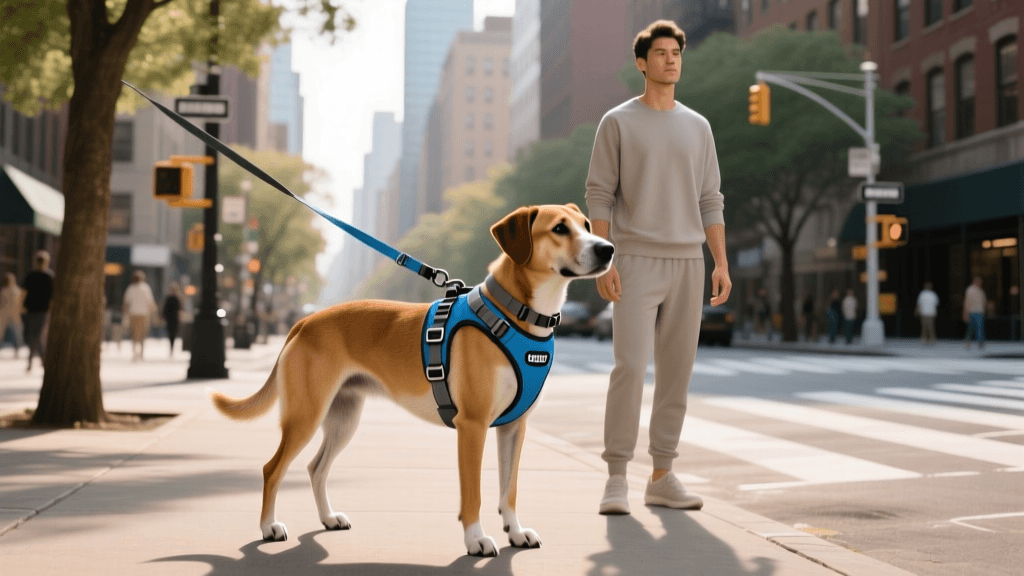
Back-clip harnesses distribute weight comfortably, which is great for hiking or car safety, but they actually facilitate pulling by allowing the dog to use their powerful chest and shoulder muscles to drag the handler forward. A front-clip harness, which features a leash attachment ring located on the dog's sternum, completely changes the physics of the walk. When the dog pulls forward and reaches the end of the leash, the front attachment point gently redirects their momentum sideways, turning them back toward the handler. This disrupts their forward drive without causing pain or tracheal damage, making it an essential tool for city environments.
Top 3 Front-Clip No Pull Harnesses for 2026
When selecting a harness for urban training, durability, adjustability, and comfort are paramount. Here are the top-rated no pull dog harnesses for city walking in 2026, complete with current pricing and features.
1. Ruffwear Front Range (2026 Eco-Update)
The Ruffwear Front Range remains the gold standard for everyday urban walking. The 2026 iteration features an updated shell made from 100% recycled ocean-bound plastics, maintaining the brand's commitment to sustainability without sacrificing durability. It features four points of adjustment, ensuring a customized fit for barrel-chested breeds like French Bulldogs or deep-chested breeds like Greyhounds. The front webbing loop is reinforced with a metal V-ring for secure steering. Price: $44.95.
2. 2 Hounds Design Freedom No-Pull Harness
This harness is a favorite among professional dog trainers for severe pullers. It features a patented martingale-style loop on the back that gently tightens around the dog's ribcage when they pull, providing a safe, non-choking corrective sensation. When used with a dual-clip leash (attached to both the front and back rings), it offers unparalleled steering control. The velvet-lined chest strap prevents chafing, a common issue with cheaper nylon harnesses. Price: $42.99.
3. Kurgo Tru-Fit Smart Harness
For city dwellers who frequently use rideshares or drive to different parks, the Kurgo Tru-Fit is an excellent dual-purpose option. It has been crash-tested up to 75 lbs using child safety seat standards. The front D-ring is mounted on a padded chest plate that pivots, redirecting the dog smoothly when they lunge at passing e-scooters. Price: $34.99.
Harness Comparison Chart
| Harness Model | Best For | Front Clip Type | 2026 Price |
|---|---|---|---|
| Ruffwear Front Range | Everyday city walks, active dogs | Reinforced Webbing Loop | $44.95 |
| 2 Hounds Freedom | Severe pullers, training sessions | Swivel Metal Snap | $42.99 |
| Kurgo Tru-Fit | Commuters, rideshare users | Padded Pivoting D-Ring | $34.99 |
The Golden Rule of Sizing and Fit
A no pull dog harness is only effective if it fits correctly. A poorly fitted harness can cause chafing, restrict shoulder movement, or allow the dog to back out and escape into traffic. To measure your dog, use a soft tailor's tape measure around the widest part of their ribcage, just behind the front legs.
The Two-Finger Rule: Once the harness is on, you should be able to comfortably slide exactly two fingers between the harness straps and your dog's skin at all adjustment points. If you can fit more, it is too loose and risks an escape. If you can fit fewer, it is too tight and will cause friction burns. Always check the fit monthly, as dogs can gain or lose weight seasonally.
4-Step Loose-Leash Training Protocol for City Dogs
As noted by the American Kennel Club, equipment alone does not teach a dog how to walk; it merely manages the behavior while the dog learns. Follow this protocol to train your dog using your new front-clip harness.
Step 1: Indoor Acclimation and Desensitization
Do not put a new harness on your dog and immediately take them to a busy city street. Start indoors. Let them sniff the harness, and reward them with high-value treats (like freeze-dried beef liver or boiled chicken). Slip it over their head, feed a treat, and take it off. Repeat this until the dog shows excitement when the harness appears. Once it is on, let them drag a light 4-foot leash around the house under supervision to get used to the weight.
Step 2: The 'Penalty Yard' Technique
Begin your outdoor training in a low-distraction area, like a quiet residential street or an empty parking lot. Hold the leash in your hand and keep your arm relaxed. The moment the leash goes taut and the front-clip pulls your dog sideways, stop walking immediately. Become a tree. Do not yank the leash; simply hold your ground. Wait for your dog to look back at you or take a step toward you to create slack in the leash. The instant there is slack, mark the behavior with a 'Yes!' and resume walking. This teaches the dog that a tight leash equals zero forward progress.
Step 3: Rewarding the 'Check-In'
City dogs are easily distracted. You want to teach your dog that paying attention to you is more rewarding than sniffing a fire hydrant. Every time your dog voluntarily looks up at you while walking, mark the behavior and deliver a treat right at the seam of your pants. This 'check-in' behavior builds engagement and keeps their focus on you rather than the environment.
Step 4: Navigating 2026 Urban Distractions
Once your dog is walking well in quiet areas, gradually increase the difficulty. In 2026, urban distractions include silent electric vehicles and delivery drones. When you see a high-level distraction approaching, proactively increase your distance. Cross the street or step into a driveway before your dog reacts. Ask for a 'sit' or 'watch me' and feed treats continuously while the distraction passes. This is known as desensitization and counter-conditioning. If your dog lunges, you are too close; increase the distance next time.
Essential Gear to Pair with Your Harness
- The Right Leash: Ditch the retractable leash. Use a 4-foot or 6-foot Biothane or leather leash. Biothane is highly recommended for city walking in 2026 because it is waterproof, easy to wipe clean after dropping in a puddle, and provides excellent grip even when wet.
- Treat Pouch: A high-quality treat pouch that clips to your waist keeps your hands free for managing the leash and picking up waste.
- Long-Line for Decompression: City walks are highly structured. Take your dog to a local park once a week and use a 15-foot long-line attached to the back-clip of their harness to allow them to sniff and decompress without the pressure of heel-walking.
Final Thoughts on Urban Walking
Transitioning to a no pull dog harness is the first step toward a safer, more enjoyable urban walking experience. By combining a high-quality front-clip harness like the Ruffwear Front Range or 2 Hounds Freedom with consistent, reward-based training, you can transform your dog from a chaotic puller into a polite city companion. Remember that patience is key; loose-leash walking is a complex skill that takes months of consistent practice in highly distracting environments. Stick to the protocol, keep your training sessions short (10 to 15 minutes), and celebrate the small victories along the way.
aaron-whyte
All our authors care for dogs every day — read more of their work on the authors page.