Best Remote Work Puppy Breeds & Training Guide 2026
Discover the best puppy breeds for remote workers in 2026 and learn essential place-command training techniques for a peaceful home office environment.
The 2026 Home Office: Why Breed Selection and Training Matter
As remote and hybrid work models solidify in 2026, the home office has become a permanent fixture for millions of professionals. For many, this shift has sparked the desire to bring a puppy into the household. However, balancing Zoom calls, deep-work sessions, and puppy rearing requires strategic planning. Not all breeds are naturally suited to the quiet, confined environment of a home office, and even the most laid-back puppy requires specialized behavioral conditioning to thrive in this setting.
The secret to a harmonious work-from-home (WFH) experience lies in selecting a breed with a natural inclination for low-energy indoor settling, combined with a rigorous "Home Office Conditioning" training protocol. In this guide, we explore the best puppy breeds for remote workers in 2026 and detail the exact training frameworks required to teach your new companion how to be the ultimate, unobtrusive office mate.
Top 3 Puppy Breeds for Remote Workers
When selecting a puppy for a home office environment, you want to prioritize breeds with low bark-drive, moderate energy levels, and a high capacity for "mat training" (the ability to settle on a designated bed or rug for extended periods). Here are the top three breeds that fit this profile.
1. Cavalier King Charles Spaniel
The Cavalier King Charles Spaniel is widely considered the gold standard for apartment and home-office living. Bred primarily as companion dogs, they possess an innate desire to simply be near their humans without demanding constant, high-octane interaction. Their eagerness to please makes them highly responsive to positive reinforcement training, particularly when teaching the "quiet" cue and desensitizing them to household noises.
- WFH Superpower: High adaptability and low territorial barking.
- Training Focus: Impulse control and desensitization to doorbell/delivery notifications.
- Energy Level: Low to Moderate. A brisk 30-minute morning walk is usually sufficient to prepare them for a day of napping under your desk.
2. Greyhound
While often misunderstood as high-energy racing dogs, Greyhounds are famously known in the canine community as "45-mph couch potatoes." Retired racers or young Greyhound puppies (when properly exercised in short bursts) spend the vast majority of their day sleeping. Their short coats and quiet demeanor make them exceptional office companions who rarely vocalize.
- WFH Superpower: Extreme capacity for prolonged resting and lounging.
- Training Focus: "Place" command and orthopedic bed targeting.
- Energy Level: Low (indoors). Requires a secure, fenced area for occasional sprinting, but otherwise excels at indoor settling.
3. Basset Hound
If your home office requires absolute silence and minimal movement, the Basset Hound is a stellar choice. Driven almost entirely by their nose and their stomach, Bassets are notoriously low-energy indoors. While their stubborn streak can make recall training a challenge, their food motivation makes crate training and "settle" commands highly achievable.
- WFH Superpower: Unmatched ability to sleep through loud keyboard typing and virtual meetings.
- Training Focus: Scent-based enrichment and crate duration training.
- Energy Level: Very Low. Prone to weight gain, so portion control and mental enrichment are vital.
Essential WFH Training Protocols for Puppies
Choosing the right breed is only 20% of the equation; the remaining 80% is dedicated training. To ensure your puppy does not disrupt your professional life, you must implement the following behavioral conditioning protocols.
Protocol 1: The "Place" Command and Mat Training
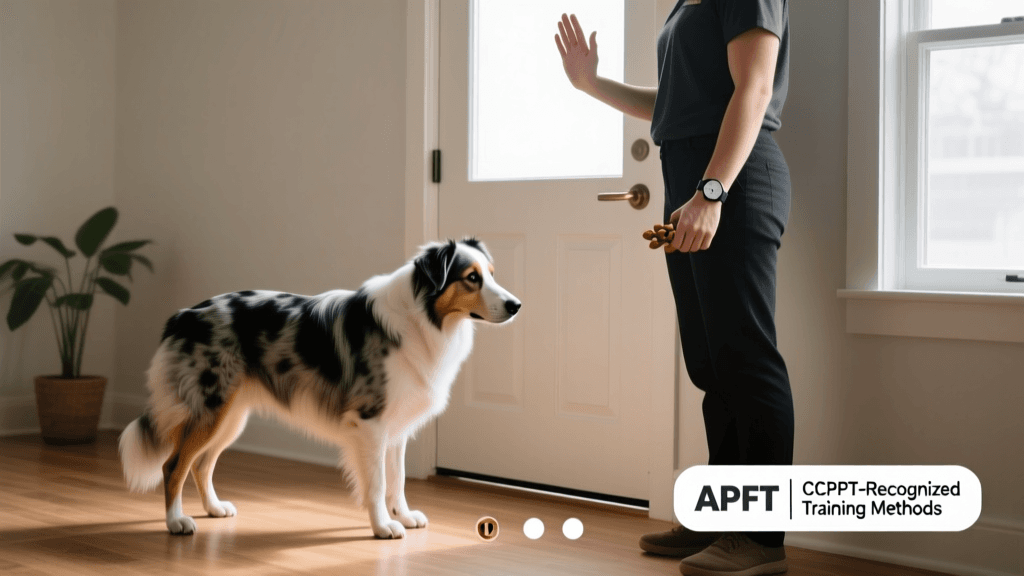
The "Place" command is the cornerstone of home office harmony. It teaches your dog to go to a specific mat or bed and remain there until released. According to the American Kennel Club's guide on place training, this command provides dogs with a clear boundary and a safe space, reducing anxiety and wandering during your work hours.
- Target Selection: Choose a distinct, textured mat (like a Kotobuki dog mat or a specific raised cot) that is only brought out during work hours.
- Luring and Marking: With your puppy on a leash, toss a high-value treat onto the mat. The moment all four paws touch the mat, use a clicker or a verbal marker like "Yes!"
- Adding the Cue: Once the puppy reliably steps on the mat for the treat, add the verbal cue "Place" right before they step on.
- Building Duration: Transition from treating continuously to treating intermittently. Start with 10 seconds of duration, gradually increasing to 5, 10, and eventually 30 minutes while you sit at your desk.
- Generalization: Move the mat to different spots in your office so the dog associates the command with the mat itself, not just a specific corner of the room.
Protocol 2: Tech Sound Desensitization
In 2026, our digital environments are filled with auditory triggers: Slack pings, Zoom chimes, email notifications, and smart home alerts. To a puppy, these sudden, high-pitched noises can trigger alert barking or anxiety. You must systematically desensitize your puppy to your specific tech ecosystem.
- Record Your Sounds: Compile a playlist of your most common notification sounds.
- Sub-Threshold Playback: Play these sounds at a volume so low that the puppy notices but does not react (no ear flicking, no barking).
- Pair with High-Value Rewards: Every time the sound plays, immediately feed a piece of freeze-dried liver or chicken. This builds a classical conditioning response where the Slack ping predicts a delicious treat, rather than signaling an intruder.
- Gradual Volume Increase: Over several weeks, slowly raise the volume to normal levels while maintaining the treat-pairing protocol.
Protocol 3: Independence and Separation Conditioning
Remote workers often make the mistake of having their puppy by their side 24/7. This creates severe separation anxiety when you eventually need to run errands, attend an in-person meeting, or even just close the bathroom door. The ASPCA's resources on separation anxiety emphasize the critical need for dogs to learn how to self-soothe and entertain themselves independently of their owners.
"A dog that cannot tolerate being alone is a dog that will suffer in a modern household. Independence training is not about isolation; it is about building canine confidence." - 2026 Veterinary Behaviorist Consensus Guidelines
Actionable Step: Implement the "Nap in the Pen" rule. Even if you are home all day, your puppy must spend at least two hours in their exercise pen or crate in a separate room with a long-lasting chew (like a stuffed West Paw Toppl or a Yak cheese chew). This simulates your absence and prevents hyper-attachment.
2026 WFH Puppy Gear Comparison
Equipping your home office with the right tools is essential for maintaining your training protocols. Below is a comparison of the top-rated WFH puppy management gear available in 2026.
| Product Category | Recommended 2026 Model | Primary Training Use | Estimated Cost |
|---|---|---|---|
| Raised Training Cot | Kurgo Loft Bed & Cot | "Place" command duration and boundary training | $85 - $110 |
| Smart Treat Camera | Furbo 4 (360° Auto-Tracking) | Remote rewarding for quiet settling while you are on calls | $199 |
| Long-Lasting Enrichment | West Paw Toppl (Large + Small interlocked) | Independence training and crate conditioning | $28 |
| Sound Masking Machine | Hatch Restore 3 | Drowning out delivery drivers and neighborhood noise | $129 |
Managing Expectations: The Puppy Phase
It is crucial to remember that no puppy, regardless of breed, is born knowing how to behave in a home office. The first six to nine months will require meticulous management. You will need to utilize baby gates, exercise pens, and tethering to prevent your puppy from chewing on expensive PC cables or eliminating on your ergonomic desk chair.
Schedule your most demanding, focus-heavy work tasks during the puppy's natural mid-morning and mid-afternoon nap cycles. Save your routine emails and administrative tasks for when the puppy is awake and requires active training and engagement. By aligning your work schedule with your puppy's biological rhythms, you reduce frustration and create a more sustainable routine.
Conclusion
Integrating a puppy into your remote work lifestyle in 2026 is entirely achievable when you pair the right breed with intentional, proactive training. Breeds like the Cavalier King Charles Spaniel, Greyhound, and Basset Hound offer the genetic foundation for a calm office presence, but it is your dedication to the "Place" command, tech desensitization, and independence conditioning that will ultimately guarantee success. Invest the time in these foundational protocols during the first few months, and you will be rewarded with a loyal, quiet companion who makes your home office a happier, more balanced environment for years to come.
jonas-cole
All our authors care for dogs every day — read more of their work on the authors page.