Best Puppy Breeds for Remote Workers: Top 2026 Picks
Discover the best puppy breeds for remote workers in 2026. Learn about breed psychology, independence levels, and WFH compatibility for your home office.
The Psychology of the Work-From-Home Dog
As remote and hybrid work models continue to dominate the professional landscape in 2026, the dream of raising a puppy while working from the home office has never been more appealing. However, merging the demanding schedule of a remote worker with the developmental needs of a puppy requires a deep understanding of canine psychology. Not all dogs are wired for the home office environment. The constant presence of a human can trigger severe separation anxiety the moment you step away for a coffee run, while certain breed instincts can turn a quiet Zoom meeting into a chaotic barking session.
Understanding your dog's inherent breed traits is the first step toward a harmonious work-from-home (WFH) lifestyle. According to behavioral experts, a dog's baseline reactivity, independence level, and vocalization tendencies are heavily dictated by their genetics. Before bringing a new puppy into your home office, it is crucial to evaluate how their natural instincts will interact with your daily routine, from deep-focus blocks to virtual team collaborations.
Why Breed Instincts Matter for Virtual Meetings
When selecting a puppy for a remote work environment, you must consider their alert-barking threshold. Terriers and herding breeds, for instance, were historically bred to vocalize at the slightest movement or sound. In a modern home office, a delivery driver dropping off a package or a neighbor walking past your window can trigger an instinctual barking fit that disrupts your professional calls. Conversely, breeds with lower reactivity thresholds can sleep peacefully through the loudest keyboard typing sessions.
Furthermore, the phenomenon of the 'velcro dog' presents a unique psychological challenge for remote workers. While having a dog rest its head on your foot during a spreadsheet session sounds idyllic, velcro breeds often struggle to self-soothe. If your job requires you to leave the house for networking events, co-working days, or off-site meetings, a highly dependent breed may develop distress behaviors. The ASPCA notes that separation anxiety is often exacerbated in dogs that have never been taught to be comfortable with independent downtime, a common pitfall for remote workers who are home 24/7 during the puppy's critical socialization window.
Top 5 Puppy Breeds for Remote Workers in 2026
1. The Greyhound: The 45-MPH Couch Potato
Despite their racing heritage, retired racing Greyhounds and well-bred puppies are notoriously low-energy indoors. Psychologically, they are sprinters, not marathoners. Once they have had their daily 30-minute burst of exercise, they are biologically wired to sleep for up to 18 hours a day. Their independent yet affectionate nature means they are happy to share a room with you without demanding constant physical contact, making them ideal for professionals who need uninterrupted focus time.
2. The Basset Hound: The Zen Master of Deep Work
Basset Hounds possess a remarkably low reactivity threshold. Originally bred for slow, methodical scent tracking, their psychology is grounded in patience and persistence rather than sudden alertness. They are highly unlikely to bark at a doorbell or a notification ping. Their heavy bone structure and calm demeanor make them excellent under-desk companions. However, their stubbornness requires patient, positive-reinforcement training during their puppy months to ensure they respond to basic recall commands.
3. The Shiba Inu: The Independent Roommate
If your work requires long hours of deep, solitary focus, the Shiba Inu is a fascinating psychological match. Known for their cat-like independence, Shibas do not typically exhibit the 'velcro' trait found in many companion breeds. They are content to observe you from their bed across the room. They are fastidious, quiet, and highly self-entertaining. The trade-off is that they are not naturally eager to please, requiring a remote worker who respects canine boundaries and understands that affection is given on the dog's terms.
4. The Cavalier King Charles Spaniel: The Velcro Companion
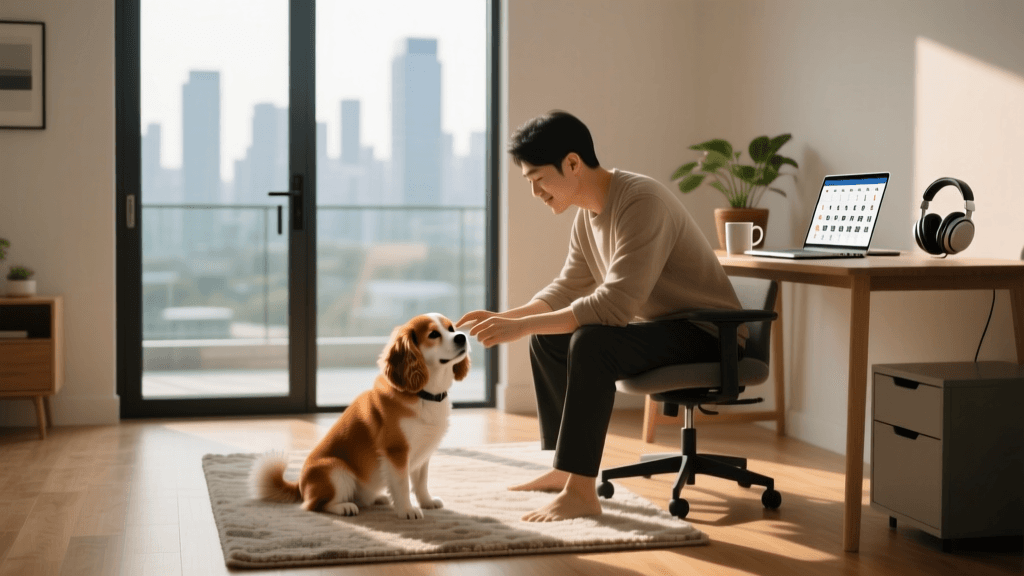
For remote workers who rarely leave their home office and crave constant physical proximity, the Cavalier is the ultimate companion. Psychologically, they are bred purely for companionship and thrive on human connection. They will happily curl up in your lap during reading-heavy tasks. However, to prevent separation anxiety, you must proactively train them to use a designated mat or bed while you work, utilizing puzzle toys to build their independent confidence. According to the American Kennel Club, early socialization and boundary training are vital for companion breeds to ensure they remain well-adjusted when you eventually need to step away.
5. The Standard Poodle: The Trainable Genius
Standard Poodles are highly intelligent, observant, and remarkably adaptable to their owner's schedule. Their psychological need for mental stimulation can be easily met with a 15-minute morning training session, leaving them relaxed for the workday. They are highly responsive to the 'place' command and can be taught to remain quietly on a cot for hours. Additionally, their low-shedding coats are ideal for keeping your home office furniture and tech equipment free of pet hair.
2026 WFH Breed Compatibility Chart
To help you visualize which breed aligns with your specific remote work lifestyle, refer to the compatibility table below. Note that estimated puppy costs reflect early 2026 market averages from reputable, health-tested breeders.
| Breed | Indoor Energy | Alert Barking | Independence Level | 2026 Avg. Puppy Cost |
|---|---|---|---|---|
| Greyhound | Very Low | Low | High | $1,500 - $2,500 |
| Basset Hound | Low | Very Low | Medium | $1,200 - $2,000 |
| Shiba Inu | Medium | Medium | Very High | $2,000 - $3,500 |
| Cavalier King Charles | Low-Medium | Low | Very Low | $2,500 - $4,000 |
| Standard Poodle | Medium | Medium | Medium | $2,500 - $4,500 |
Actionable Home Office Training Protocols
Choosing the right breed is only half the equation. To maintain a professional environment, you must implement specific training protocols tailored to the home office.
Desensitizing to Keyboard and Doorbell Triggers
Puppies are highly sensitive to novel sounds. The rapid clacking of a mechanical keyboard or the sudden chime of a smart doorbell can trigger a stress response. Begin desensitization on day one. Record the sound of your doorbell and play it at a very low volume while feeding your puppy high-value treats, such as freeze-dried liver. Gradually increase the volume over several weeks. Similarly, place your puppy near your desk while you type, rewarding them for remaining calm. This rewires their psychological association from 'alert/protect' to 'calm/reward'.
The 'Place' Command and Smart Treat Dispensers
The 'place' command is the most valuable tool for a remote worker. Train your puppy to go to a specific raised cot or mat on command. Start with short durations and gradually build up to two-hour blocks. To reinforce this behavior while you are on a muted video call, utilize modern smart pet cameras. In 2026, treat-tossing cameras allow you to silently reward your dog for staying on their mat without breaking eye contact with your webcam. Stuffing a durable rubber chew toy with frozen peanut butter and yogurt can also provide up to 45 minutes of quiet, soothing licking behavior, which naturally releases endorphins and calms the canine nervous system.
Pro Tip: Never use your home office as a punishment zone or a place for time-outs. Your dog must psychologically associate your workspace with calm, positive experiences, not isolation or stress.
Final Thoughts on Canine Companionship
Integrating a puppy into your remote work life is a deeply rewarding endeavor that requires strategic planning and an understanding of breed-specific psychology. By selecting a breed whose natural instincts align with your professional demands, and by proactively training them to respect the boundaries of your workspace, you can cultivate a peaceful, productive, and joyful environment. Whether you choose the independent Shiba Inu or the affectionate Cavalier, the key to success in 2026 lies in honoring your dog's unique behavioral blueprint while gently guiding them to become the perfect co-worker.
aaron-whyte
All our authors care for dogs every day — read more of their work on the authors page.