Mobility Service Dog Puppy Training: 2026 Gear & Milestones
Discover essential 2026 milestones, socialization tips, and the best harness gear for raising a mobility service dog puppy in their critical first year.
The Foundation of a Mobility Service Dog
Raising a mobility service dog puppy is a profound commitment that extends far beyond standard pet ownership. While a family pet only needs to navigate the comforts of a home and a local dog park, a mobility assistance dog must remain completely neutral in chaotic public environments, perform physically demanding tasks, and maintain unwavering focus on their handler. In 2026, the standards for assistance dog training have evolved significantly, emphasizing early neurological stimulation, surface generalization, and 'neutrality over obedience' during the critical first year of life.
The first twelve months of a working dog's life are dedicated to building a robust psychological and physical foundation. You are not teaching a ten-week-old puppy to pull a wheelchair or brace for balance; instead, you are teaching them how to process environmental stressors, how to offer calm behaviors, and how to associate specific gear with their future working role. This guide outlines the essential developmental milestones, specialized gear, and training protocols required to raise a successful mobility service dog puppy in 2026.
Critical First-Year Developmental Milestones
8 to 12 Weeks: Neutrality and Environmental Processing
During the earliest weeks, the primary goal is environmental exposure without forced interaction. According to the American Kennel Club's socialization guidelines, puppies experience a critical fear period and a primary socialization window during this time. For a mobility service dog candidate, this means exposing the puppy to the sounds of dropping crutches, the mechanical whir of electric wheelchairs, and the slick floors of hospitals or grocery stores.
Training at this stage focuses on 'engagement and disengagement.' The puppy must learn that looking at a distraction and then voluntarily looking back at the handler yields a reward. Neutrality is the cornerstone of public access work; a service dog cannot greet strangers or sniff other dogs while on duty.
3 to 6 Months: Impulse Control and Surface Generalization
As the puppy grows, their physical coordination improves, making this the ideal time to introduce varied terrain. Mobility dogs must be confident walking on metal grates, slippery tiles, gravel, and elevator thresholds. Introduce these surfaces gradually, using high-value treats to build positive associations. Never force a hesitant puppy onto a scary surface; instead, use shaping techniques to allow them to offer a single paw touch, rewarding heavily for bravery.
Impulse control is also heavily emphasized during these months. Teach the 'settle' command on a specific training mat. The puppy must learn to lie down and remain calm for extended periods, simulating the behavior required when their handler is sitting in a restaurant, attending a medical appointment, or working in an office.
6 to 12 Months: Advanced Public Access and Task Introduction
Between six and twelve months, the puppy enters adolescence, which can bring about temporary regressions in training and heightened environmental awareness. This is the time to begin introducing the concept of 'pressure.' Using a specialized handling harness, you can teach the puppy to lean into gentle pressure, which is the foundational mechanic for future mobility tasks like bracing or counterbalance work.
Public access excursions become more frequent and complex. The puppy should be practicing automatic sits at curbs, ignoring dropped food in food courts, and remaining settled under tables. As outlined by Assistance Dogs International (ADI), the welfare and physical soundness of the dog are paramount; therefore, no heavy pulling or weight-bearing tasks should be introduced until the dog's growth plates have fully closed, typically between 18 and 24 months of age.
Essential Harness Gear for Growing Puppies
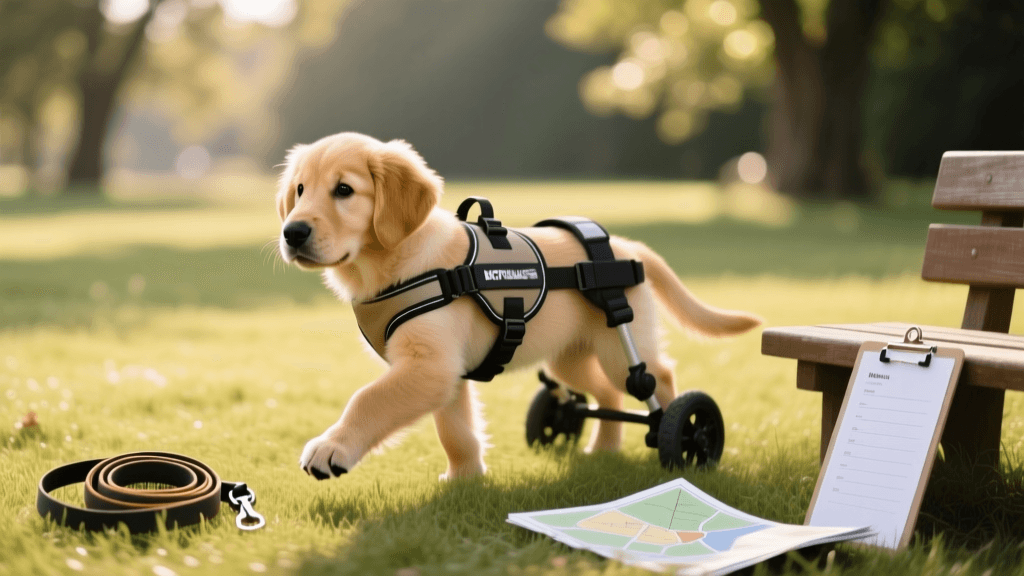
One of the most common mistakes novice puppy raisers make is purchasing a heavy-duty mobility pull harness for a young puppy. A puppy's skeletal structure is entirely cartilage and soft bone; placing a weighted harness on them can cause irreversible joint damage. In 2026, the industry standard is to use 'handling harnesses' or 'training vests' during the first year. These tools teach the puppy to accept the feeling of wearing gear and respond to directional leash pressure without bearing any physical weight.
| Harness Model | Best For | 2026 Price Range | Key Feature |
|---|---|---|---|
| Ruffwear Web Master | Early balance & handling | $90 - $120 | 5-point adjustment & padded chest |
| Julius-K9 IDC Baby | Visual identification | $40 - $60 | Modular patches for 'In Training' signs |
| Chai's Choice Vest | Basic public access | $30 - $45 | Front clip D-ring for leash manners |
The Ruffwear Web Master Harness is widely considered the gold standard for early mobility puppy training. Its anatomical design and sturdy top handle allow handlers to safely assist the puppy over obstacles or lift them out of harm's way without damaging their developing joints. The five points of adjustment ensure that as the puppy experiences rapid growth spurts, the harness can be resized to prevent chafing.
For visual identification, the Julius-K9 IDC Baby series allows you to attach custom Velcro patches. Slapping a 'Service Dog In Training' or 'Do Not Pet' patch on the harness signals to the public that the puppy is working, significantly reducing unwanted interactions that can derail a training session.
Potty Training: The 'On-Command' Protocol
Potty training a service dog puppy requires a completely different methodology than training a pet. A mobility service dog must be able to eliminate on command, on a variety of surfaces, and in close proximity to their handler's wheelchair or mobility aids. You cannot wait for the puppy to 'find a spot' in a busy urban environment or an airport terminal.
Begin by selecting a specific verbal cue, such as 'Get Busy' or 'Hurry Up.' Every single time the puppy begins to eliminate naturally, say the cue word, and immediately reward with a high-value treat the moment they finish. Over time, the puppy will associate the verbal cue with the action.
Crucially, you must generalize the potty command across different surfaces. A mobility dog may need to use a concrete alleyway, a patch of artificial turf, or a gravel shoulder. During the first year, actively seek out these different textures and practice the on-command protocol. Always reward heavily for surface versatility, ensuring the dog never develops a strict preference for grass, which may not be available in urban or indoor settings.
Teething and Bite Inhibition in Working Lines
The teething phase, which peaks between four and six months of age, is a critical juncture for working dogs. A puppy that learns to mouth or nip out of frustration or excitement is a massive liability in public access settings. A service dog that nips at a passing child or chews on their handler's medical equipment will be washed out of training programs immediately.
Provide an abundance of appropriate chew toys, such as frozen Kongs stuffed with puppy-safe peanut butter or durable nylon chews. Redirect any inappropriate mouthing immediately. Furthermore, use this time to practice 'handling exercises.' Gently touch the puppy's paws, ears, mouth, and tail while they are chewing on a toy. This builds tolerance for the physical manipulation they will experience during veterinary exams, grooming, and public access encounters where strangers may accidentally bump into them.
Authoritative Standards and Next Steps
Raising a mobility service dog is a marathon, not a sprint. The first year is entirely about building a confident, environmentally neutral, and physically sound canine partner. By focusing on early surface generalization, utilizing the correct age-appropriate handling harnesses, and implementing strict on-command potty protocols, you set your puppy up for success in their advanced task training years.
For handlers and puppy raisers looking to align their training with global best practices, reviewing the standards set by Assistance Dogs International is highly recommended. Their guidelines ensure that the welfare of the dog remains the top priority while preparing them for a lifetime of vital service. Remember, patience and consistency during these foundational months will forge an unbreakable bond and a highly capable working partner for the future.
robin-maitland
All our authors care for dogs every day — read more of their work on the authors page.