Raising Mobility Service Puppies: Joint Care Guide 2026
Learn how to protect your mobility service puppy's joints in 2026. Discover early conditioning, safe exercise limits, and proper harness fitting tips.
The High Stakes of Mobility Service Puppy Joint Health
Raising a puppy destined for mobility assistance work—such as wheelchair pulling, bracing, or item retrieval for handlers with physical disabilities—requires a meticulous approach to physical development. Unlike companion pets, a mobility service dog must possess the orthopedic integrity to safely bear weight and exert sustained force. A single developmental misstep during the first twelve months can lead to early-onset osteoarthritis, hip dysplasia, or shoulder instability, ultimately washing a promising candidate out of an intensive training program. In 2026, veterinary rehabilitation and canine sports medicine have advanced significantly, offering prospective handlers and breeders precise, science-backed protocols to safeguard these vital working joints.
Moving Beyond the Outdated '5-Minute Rule'
For decades, the golden rule of puppy exercise was 'five minutes of structured walking per month of age.' However, 2026 canine sports medicine consensus views this metric as overly simplistic. According to the Cornell University Riney Canine Health Center, joint stress is dictated more by the type of movement and the surface traction than by strict time limits. Repetitive, high-impact activities (like fetching a ball on concrete or jumping into vehicles) are far more damaging to open growth plates than an hour of unstructured, free-choice sniffing and wandering on soft, uneven natural terrain.
Today, top working dog organizations utilize biometric tracking. Smart collars and gait-analysis wearables allow handlers to monitor a puppy's stride symmetry and activity intensity in real-time, ensuring that the puppy is not overexerting one side of their body, which can indicate early compensatory pain or fatigue.
Early Proprioception and Foundation Conditioning
Before a mobility dog can learn to brace or pull, they must develop elite body awareness, known as proprioception. This is the neurological understanding of where their limbs are in space. Building this neural pathway in the first year strengthens the stabilizing muscles around the joints, acting as a biological shock absorber.
Safe Puppy Equipment for 2026
- Cavaletti Poles: Set at ground level or just above the puppy's carpus (wrist). Walking slowly over these poles encourages deliberate foot placement and hip flexion without high impact.
- Inflatable Balance Discs: Brands like FitPAWS offer peanut-shaped or disc-shaped inflatable tools. Having a puppy place just their front paws on an unstable surface engages the core and shoulder stabilizers safely.
- Target Mats: Teaching a puppy to step onto and hold a specific mat builds rear-end awareness, a critical skill for a dog that will eventually need to tuck their hindquarters neatly under a wheelchair or handler.
Environmental Management: The Hidden Dangers of Slippery Floors
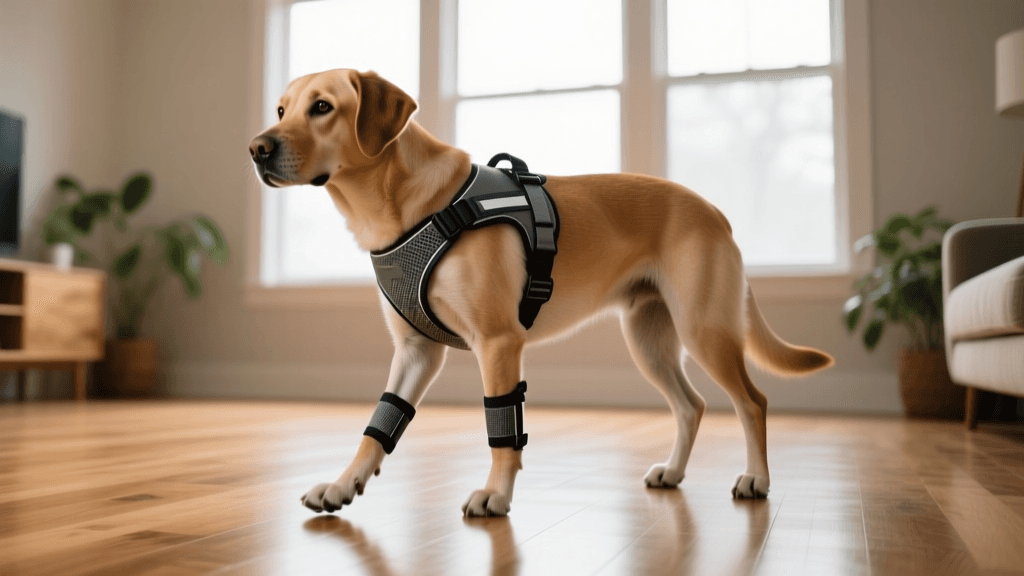
One of the most frequently overlooked hazards in raising a working prospect is indoor flooring. Hardwood, laminate, and tile floors offer zero traction for a puppy's developing paws. When a puppy slips, they instinctively splay their legs to catch their balance. This sudden, unnatural outward force places immense torque on the hip joints and the inguinal region, potentially causing micro-tears in the joint capsule or exacerbating underlying hip dysplasia. In 2026, professional service dog raisers mandate the use of interlocking foam mats, yoga mats, or area rugs with high-grip backing in all primary living and training spaces. If your puppy is sliding when they run or turn, the environment is not safe for a future mobility dog.
Nutrition: Feeding the Future Working Athlete
You cannot out-train a poor diet, especially when it comes to skeletal development. The WSAVA Global Nutrition Committee emphasizes that large-breed puppies (which comprise the majority of mobility dogs, such as Labrador Retrievers and Golden Retrievers) must be fed diets specifically formulated to control their growth rate. Rapid growth stretches the joint capsules and increases the risk of developmental orthopedic diseases (DOD).
Veterinary nutritionists recommend feeding a diet that meets the AAFCO nutrient profiles for growth, but with strictly controlled calcium and phosphorus ratios (typically between 1:1 and 1.5:1) and a caloric density that prevents excess body fat. Even a 5% overweight condition in a puppy places exponential, damaging stress on developing cartilage. Supplementing with high-quality Omega-3 fatty acids (EPA and DHA) from marine sources has also been clinically shown to modulate inflammatory pathways in developing joints.
Harness Desensitization vs. Load Bearing
A common and dangerous mistake made by novice handler-trainers is introducing a mobility harness and asking the puppy to pull weight before their growth plates have closed. Growth plates in large breed dogs typically do not fuse until 18 to 24 months of age.
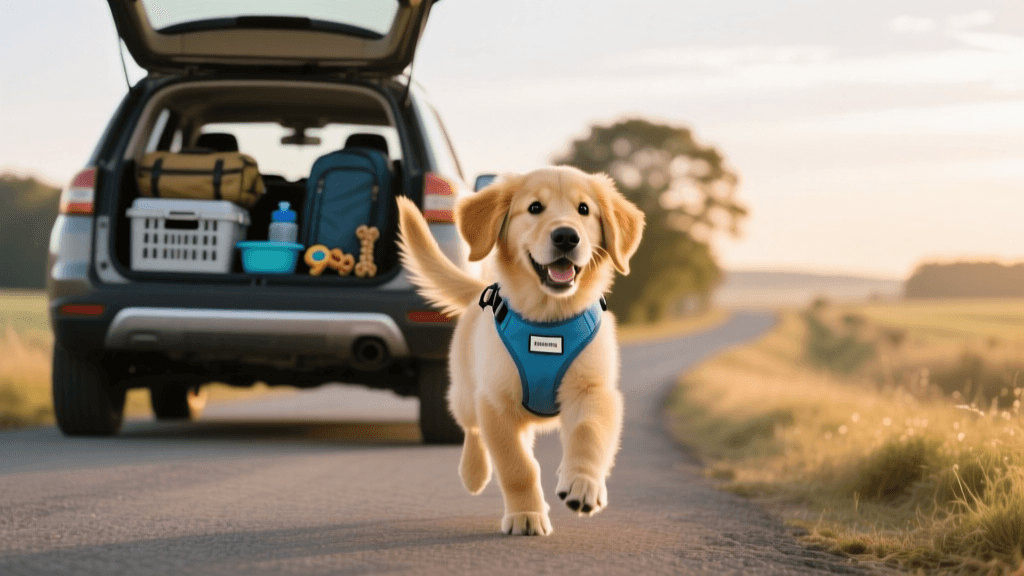
The 2026 Protocol: Between 8 weeks and 14 months, the harness is strictly a desensitization tool. The puppy should wear a lightweight, custom-fitted harness for short durations to build positive associations, tolerate the feeling of straps around their chest and girth, and learn to walk without chewing the equipment. Absolutely zero weight, drag, or resistance should be applied. The dog must learn the mechanics of the harness without the orthopedic load.
Mobility Puppy Development & Conditioning Timeline
| Puppy Age | Orthopedic Status | Safe Conditioning Focus | Mobility Harness Rules |
|---|---|---|---|
| 8 - 16 Weeks | Highly cartilaginous, extremely vulnerable growth plates. | Free-choice play on grass, basic target training, flat cavaletti. | No harness. Focus on collar/handling desensitization. |
| 4 - 8 Months | Rapid bone growth, high risk of panosteitis or HOD. | Proprioception on unstable surfaces (front paws only), scent work. | Lightweight vest only for 5-10 mins. ZERO pulling or weight. |
| 9 - 14 Months | Growth plates begin to calcify; joints remain immature. | Rear-end awareness, slow uphill walking, core stabilization. | Custom-fitted mobility harness worn for public access desensitization. NO load. |
| 15 - 24 Months | Growth plates closing/closed. Skeletal maturity approaching. | Endurance building, swimming, trotting on varied terrain. | Gradual introduction of light drag ONLY after vet clearance. |
Recognizing Early Signs of Joint Fatigue and Pain
Puppies are notoriously stoic and driven, especially those bred from working lines with high drive. They will often work through discomfort to please their handler. You must become an expert at reading subtle canine body language. Signs of early joint fatigue or orthopedic discomfort include:
- Bunny-hopping: Using both hind legs simultaneously when running, rather than a fluid, alternating stride.
- Sitting asymmetrically: Consistently rolling onto one hip or leaving one hind leg extended outward.
- Reluctance to jump: Hesitation before leaping onto a couch, bed, or into a vehicle.
- Lagging behind: Slowing down or sitting during walks that previously elicited excitement.
- Excessive licking: Repeatedly licking the carpus (wrist), hock (ankle), or shoulder joints after exercise.
If you observe any of these behaviors, cease all structured conditioning immediately and consult a veterinary rehabilitation specialist. Early intervention with laser therapy, hydrotherapy, or targeted physical therapy can often correct minor imbalances before they become career-ending injuries.
Veterinary Screening and OFA Certifications
To ensure a puppy has the genetic and structural foundation for mobility work, rigorous screening is non-negotiable. The Orthopedic Foundation for Animals (OFA) maintains the gold standard database for canine joint health. While you cannot certify a puppy's hips or elbows until they are 24 months old, reputable working dog breeders will provide the OFA clearance numbers for the sire and dam. Furthermore, preliminary PennHIP evaluations can be performed as early as 16 weeks to assess joint laxity and predict the likelihood of osteoarthritis, allowing handlers to make informed decisions about a puppy's future career path before investing a year into advanced training.
Final Thoughts on Protecting Your Investment
Raising a mobility service puppy is a marathon of patience. The urge to test their working drive and physical capabilities early is strong, but restraint is the ultimate act of advocacy for your dog. By adhering to modern 2026 conditioning protocols, prioritizing joint-sparing nutrition, and respecting the biological timeline of skeletal maturity, you give your future working partner the best possible chance at a long, pain-free career of service.
jonas-cole
All our authors care for dogs every day — read more of their work on the authors page.