Puppy socialisation checklist before twelve weeks
The four-week window that shapes a confident adult dog — what to expose your puppy to, and how to do it safely without overwhelming them.
The First Twelve Weeks: A Window That Closes Fast
Every puppy arrives in the world neurologically incomplete. Their eyes are sealed, their ears are shut, and their brains are still assembling the architecture that will govern how they respond to the world for the rest of their lives. What happens between birth and roughly twelve weeks of age shapes that architecture more profoundly than almost anything that comes after. Breeders, veterinarians, and behavioural scientists have spent decades studying this period, and the evidence is consistent: puppies who receive structured, positive exposure to a wide range of stimuli before twelve weeks grow into calmer, more adaptable, and more resilient adult dogs.
This is not a soft claim. Research published by the American Veterinary Society of Animal Behavior (AVSAB, 2008) states that the primary and most important time for puppy socialisation is the first three months of life. Missing this window does not mean a dog is ruined, but it does mean that every subsequent lesson requires significantly more effort, repetition, and patience to achieve the same result.
Understanding the Developmental Stages
Canine development does not proceed in a smooth, continuous arc. It moves in distinct phases, each with its own neurological signature and its own implications for what a puppy can absorb and how they absorb it.
The Neonatal Period: Birth to Two Weeks
During the first two weeks, a puppy's sensory world is almost entirely tactile and olfactory. They cannot see, cannot hear, and cannot regulate their own body temperature. Their nervous system is responsive to touch, however, and this is where early neurological stimulation (ENS) protocols become relevant. The U.S. Military's Biosensor Program, sometimes called the "Super Dog" program, identified five specific handling exercises — tactical stimulation between the toes, head held erect, head pointed down, supine position, and thermal stimulation — that, when applied daily between days three and sixteen, produced measurable improvements in cardiovascular performance, stronger adrenal glands, greater tolerance to stress, and improved disease resistance in adult dogs.
Breeders at Avidog International, a canine reproduction and puppy development education company based in the United States, have incorporated ENS into their standard whelping protocols for over a decade. Founder Gayle Watkins reports that litters raised with ENS consistently show lower stress responses during veterinary handling and novel environment testing compared to litters raised without it.
The Transitional Period: Two to Three Weeks
Around day fourteen, the eyes open. By day twenty-one, the ear canals unseal. This two-week window is brief but significant: the puppy's brain is suddenly receiving a flood of new sensory input, and the neural pathways being laid down during this period will form the foundation of their perceptual world. Gentle introduction of mild sounds — a radio playing softly in the whelping room, the sound of a vacuum cleaner at a distance — begins to normalise auditory stimuli before the fear response has fully developed.
The Socialisation Period: Three to Twelve Weeks
This is the period that most people mean when they talk about puppy socialisation. Research by Scott and Fuller, conducted at the Jackson Laboratory in Bar Harbor, Maine, and published in their landmark 1965 book Genetics and the Social Behavior of the Dog, identified this window with precision. Their work demonstrated that puppies isolated from human contact until fourteen weeks showed persistent fearfulness toward people that could not be fully reversed through later exposure. Puppies who had regular human contact from three weeks onward showed none of this deficit.
The fear imprint period, which begins around eight weeks and intensifies through week ten, sits squarely inside this socialisation window. This is not a reason to slow down socialisation — it is a reason to ensure that every experience during this time is positive, controlled, and ends on a good note.
Week-by-Week Socialisation Targets
Structuring socialisation by week helps breeders and new owners track progress and avoid the common mistake of front-loading all exposure into a single overwhelming outing. The following framework draws on guidance from the American Kennel Club Canine Health Foundation and the work of veterinary behaviourist Dr. Ian Dunbar, who developed the concept of the puppy socialisation checklist in the 1980s.
| Age Range | Primary Responsibility | Key Targets |
|---|---|---|
| Birth – 2 weeks | Breeder | ENS handling, gentle touch, varied surfaces in whelping box |
| 3 – 4 weeks | Breeder | Mild sounds, multiple handlers, novel objects in play area |
| 5 – 6 weeks | Breeder | Children, men, women, other animals, outdoor surfaces, car rides |
| 7 – 8 weeks | Breeder / New Owner | Veterinary handling simulation, crate introduction, separation tolerance |
| 9 – 12 weeks | New Owner | Urban environments, public transport, crowds, grooming, puppy classes |
The handover at seven to eight weeks is a critical transition point. A puppy leaving a well-run breeding programme at this age has already had five weeks of structured socialisation. A new owner who does nothing for the following four weeks — waiting for full vaccination before any outside exposure — loses the most neurologically receptive portion of the window. The AVSAB position statement explicitly addresses this, noting that the risk of behavioural problems from under-socialisation outweighs the small infectious disease risk of carefully managed early exposure.
What the Checklist Actually Covers
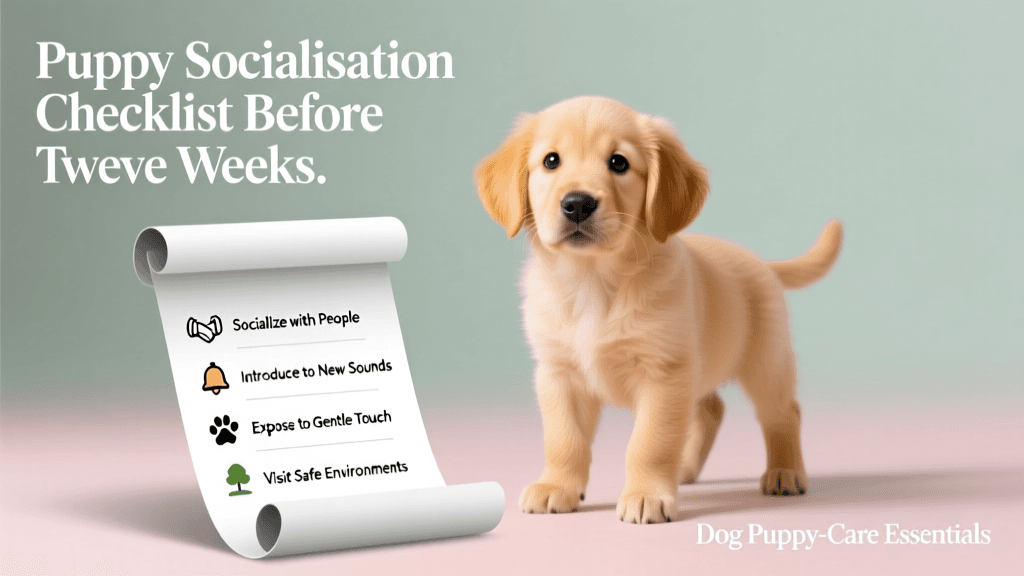
A socialisation checklist is not a list of places to visit. It is a catalogue of sensory categories, each of which needs to be introduced in a way that the puppy experiences as neutral or positive. The categories fall into several broad groups.
People
Puppies need to meet a minimum of 100 different people before twelve weeks, according to Dr. Dunbar's original guidance — a figure that sounds extreme until you start counting. The goal is not just quantity but variety: men with beards, people wearing hats, people using walking frames or wheelchairs, children running, people in high-visibility vests, people carrying umbrellas. Each of these represents a distinct visual stimulus that an under-socialised dog may later perceive as threatening.
- Infants and toddlers (supervised, stationary contact)
- Older children (ages 5–12, including children playing actively)
- Teenagers
- Adult men and women of varied appearance
- Elderly people, including those with mobility aids
- People in uniforms: postal workers, delivery drivers, veterinary staff
- People wearing hats, hoods, sunglasses, or face coverings
Environments and Surfaces
The tactile world of a puppy raised on newspaper in a single room is impoverished. By twelve weeks, a well-socialised puppy should have walked on grass, gravel, sand, wet pavement, metal grating, carpet, tile, and wooden decking. They should have experienced stairs, ramps, and uneven terrain. They should have been in a car, in a lift, and in a building with echoing acoustics.
- Grass (wet and dry)
- Gravel and loose stone
- Metal surfaces (including grating that moves underfoot)
- Slippery floors (tile, polished wood)
- Stairs and ramps
- Outdoor urban environments with traffic noise
- Indoor public spaces (pet-friendly shops, veterinary waiting rooms)
The Vaccination Question and Managed Risk
The most common reason new owners give for delaying socialisation is incomplete vaccination. This concern is legitimate but often misapplied. The standard puppy vaccination schedule in the United Kingdom, as outlined by the British Veterinary Association, typically completes at ten to twelve weeks, with a two-week wait before full outdoor access. This means that if an owner waits for full protection before beginning socialisation, the window has already closed.
The practical solution is managed risk rather than avoidance. Puppy classes held on clean indoor surfaces with health-screened participants carry a very low disease transmission risk. Carrying a puppy in arms through a busy street provides full sensory exposure with no ground contact. Visiting the homes of vaccinated adult dogs is considered safe by most veterinary behaviourists. The Battersea Dogs and Cats Home in London, one of the United Kingdom's largest and most respected animal welfare organisations, recommends beginning puppy socialisation classes as early as seven to eight weeks, provided the puppy has received at least one vaccination and is otherwise healthy.
A puppy class run by a qualified trainer using positive reinforcement methods does more than socialise a puppy to other dogs. It introduces the puppy to a novel environment, novel people, novel sounds, and the experience of learning while mildly aroused — a skill that will serve them throughout their life. The Association of Pet Dog Trainers (APDT, UK) maintains a register of qualified trainers who meet minimum standards for both training methodology and puppy class management.
"Socialisation is not about flooding a puppy with stimuli. It is about building a bank of positive associations so broad that the world, in all its variety, feels familiar rather than threatening."
— Dr. Sophia Yin, veterinary behaviourist and author, in Perfect Puppy in 7 Days (2011)
Signs That Socialisation Is Working — and When It Is Not
A well-socialised puppy does not need to be fearless. Mild curiosity followed by approach is the target response to novel stimuli, not complete indifference. A puppy who startles at a loud noise but recovers within thirty seconds and returns to play is responding normally. A puppy who freezes, tucks their tail, and refuses to move for several minutes after a mild stimulus is showing a stress response that warrants attention.
Owners should watch for the following signs that socialisation is proceeding well: the puppy approaches novel objects voluntarily after an initial pause; the puppy recovers quickly from mild frights; the puppy eats, plays, and explores in new environments; the puppy tolerates handling of paws, ears, and mouth without struggling. These behaviours indicate that the puppy's stress response system is calibrated appropriately and that their confidence is building.
Red flags include persistent hiding, refusal to eat in any novel environment, aggression or snapping during routine handling, and inability to settle after mild startles. These responses, particularly if they appear before ten weeks, may indicate a genetic predisposition to anxiety that socialisation alone cannot fully address. In these cases, early consultation with a veterinary behaviourist — rather than waiting to see if the puppy "grows out of it" — gives the best chance of a positive outcome.
The twelve-week mark is not a cliff edge. Socialisation continues throughout adolescence and into adulthood, and positive experiences at any age contribute to a dog's behavioural resilience. But the work done before twelve weeks is qualitatively different from the work done after: it is written into the brain's architecture during a period of extraordinary plasticity, and it forms the baseline from which all future learning proceeds. Getting it right during this window is the single highest-leverage investment an owner or breeder can make in a puppy's lifelong wellbeing.
Jonas Cole
All our authors care for dogs every day — read more of their work on the authors page.