Puppy Proofing Guide: Diagnose Hazards and Secure Your Home
Discover hidden household dangers before bringing your new dog home. Learn how to diagnose hazards and apply proven puppy-proofing solutions room by room.
Why "Puppy Eyes" Can Lead to Emergency Vet Visits
Bringing a new dog or puppy into your home is a milestone filled with joy, excitement, and the promise of lifelong companionship. However, the transition from a shelter or breeder to your living room is fraught with hidden dangers. Puppies and newly adopted adult dogs explore their new environments primarily through their mouths and noses. What looks like a harmless living space to a human can be an obstacle course of toxic substances, choking hazards, and electrical dangers to a curious canine. According to the American Kennel Club (AKC), thousands of pets end up in emergency veterinary clinics each year due to preventable household accidents. To ensure a safe homecoming, new owners must adopt a "Problem Diagnosis & Solutions" approach to puppy-proofing, systematically identifying risks and implementing physical barriers before the dog ever crosses the threshold.
The Floor-Level Diagnostic Method
The most effective way to diagnose household hazards is to change your perspective. Before bringing your dog home, get down on your hands and knees in every room. Crawl around the floors, look under furniture, and examine the backs of cabinets. This floor-level diagnostic method reveals dropped pills, loose change, exposed baseboard nails, and dangling electrical cords that are entirely invisible from a standing position. By diagnosing the environment from your dog’s eye level, you can accurately map out the specific solutions required for each zone of your home.
Room-by-Room Problem Diagnosis & Solutions
The Kitchen: Toxins, Trash, and Xylitol
The Problem: The kitchen is arguably the most dangerous room in the house. It harbors toxic foods, accessible trash, and concentrated cleaning chemicals. Foods like grapes, raisins, onions, and macadamia nuts are highly toxic to dogs. Furthermore, the artificial sweetener xylitol, commonly found in sugar-free gum, baked goods, and some peanut butters, can cause rapid, fatal hypoglycemia and liver failure in dogs, as noted by the Pet Poison Helpline.
The Diagnosis: Open your lower cabinets. Are your cleaning supplies easily accessible? Is your trash can freestanding or easily nudged open? Are sugar-free products stored in low-hanging pantry baskets?
The Solutions:
- Cabinet Locks: Install magnetic cabinet locks, such as the Safety 1st Magnetic Locking System (approx. $25 for a multi-pack). These remain invisible from the outside but require a magnetic key to open, completely securing bleach, detergents, and dish soaps.
- Secure Trash: Replace open-top bins with heavy, locking-lid trash cans. The simplehuman Locking Lid Trash Can (approx. $80-$120) features a physical latch that prevents even large, determined breeds from foraging for discarded chicken bones or onion scraps.
- High-Shelf Storage: Relocate all xylitol-containing products, chocolate, and toxic produce to upper cabinets or inside the refrigerator.
The Living Room: Cords, Choking, and Houseplants
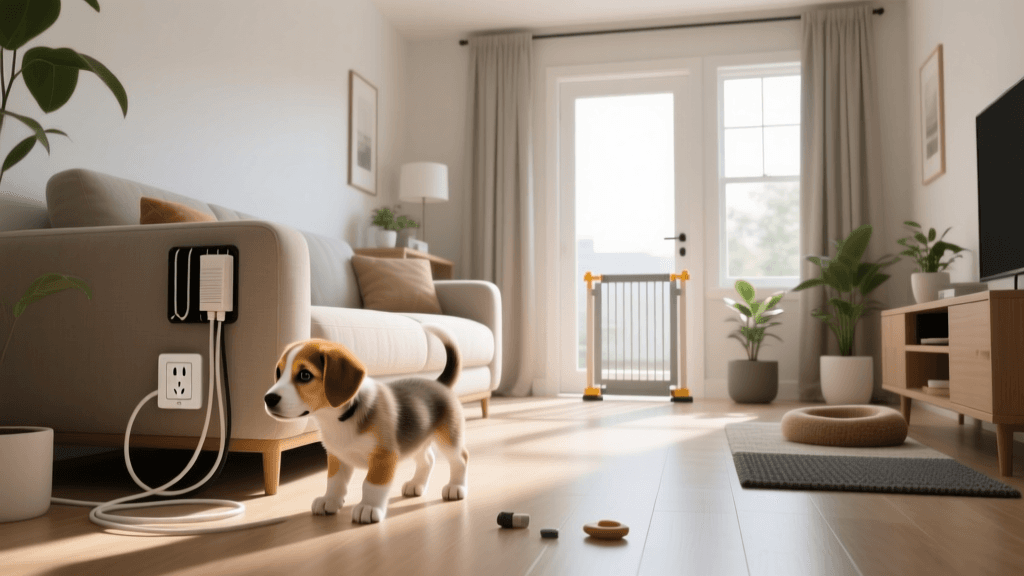
The Problem: Living rooms are filled with electrical cords, small decorative items, and potentially toxic houseplants. Puppies teethe between 3 and 6 months of age, and chewing on a live electrical cord can result in severe oral burns or fatal pulmonary edema.
The Diagnosis: Trace every lamp, TV, and router cord. Look at your coffee table for small items like coins, hair ties, or children’s toys. Finally, audit your indoor greenery against the ASPCA’s Toxic and Non-Toxic Plants list. Common culprits like the Sago Palm, Pothos, and Peace Lily can cause severe gastrointestinal and neurological distress.
The Solutions:
- Cord Concealment: Use split-loom tubing or cord management boxes (e.g., JOTO Cord Management Sleeves, approx. $15) to bundle and hide wires behind media consoles.
- Taste Deterrents: Apply Grannick’s Bitter Apple Spray (approx. $12) to baseboards, wooden furniture legs, and cord covers. Reapply daily for the first two weeks to condition the dog to avoid these textures.
- Plant Relocation: Move toxic plants to high, unreachable hanging planters, or rehome them entirely and replace them with pet-safe alternatives like Spider Plants or Boston Ferns.
The Bathroom: Chemicals and Open Water
The Problem: Bathrooms present drowning risks for very small puppies and chemical hazards from human medications and toilet bowl cleaners.
The Diagnosis: Check if your toilet lid stays up or can be easily nudged open by a paw. Look at your vanity counter—are human medications like ibuprofen, acetaminophen, or antidepressants left in daily pill organizers?
The Solutions:
- Toilet Lid Locks: Install a simple adhesive toilet lid lock (approx. $8) to prevent access to toilet water, which may contain harmful bacteria or residual blue cleaning tablets.
- Medication Storage: Never leave human medications on counters. Store all pill bottles in high, closed cabinets. Remember that dogs can easily chew through plastic amber pill bottles if they fall to the floor.
The Yard and Garage: Escapes and Antifreeze
The Problem: Outdoor spaces pose escape risks and exposure to automotive chemicals. Ethylene glycol, the primary ingredient in traditional antifreeze, has a sweet taste that attracts dogs but is lethal even in tiny amounts (as little as a few teaspoons for a medium-sized dog).
The Diagnosis: Walk your entire fence line. Look for gaps larger than 3 inches, loose boards, or areas where soil has eroded under the fence. In the garage, check for puddles of automotive fluids and the type of mulch used in adjacent garden beds (cocoa bean mulch contains theobromine, the same toxic compound found in chocolate).
The Solutions:
- Perimeter Repair: Bury chicken wire or hardware cloth along the base of the fence to prevent digging escapes. Repair any gaps exceeding 2 inches.
- Chemical Audits: Switch to propylene glycol-based antifreeze, which is significantly less toxic. Store all fertilizers, pesticides, and automotive fluids in locked garage cabinets.
- Mulch Replacement: Remove cocoa bean mulch and replace it with pet-safe cedar or pine bark mulch.
Puppy-Proofing Cost & Action Plan
Budgeting for a new dog goes beyond food and toys; it requires an investment in home safety. Below is a structured diagnostic action plan with estimated costs to secure a standard 3-bedroom home.
| Home Area | Primary Hazard | Diagnostic Action | Recommended Solution | Est. Cost |
|---|---|---|---|---|
| Kitchen | Cleaning chemicals, trash | Check lower cabinet accessibility | Safety 1st Magnetic Locks | $25 |
| Kitchen | Scavenging toxic food waste | Test trash can lid stability | simplehuman Locking Bin | $90 |
| Living Room | Electrocution via chewing | Trace all exposed power cords | JOTO Cord Sleeves & Tape | $20 |
| Living Room | Furniture destruction | Identify chewable wooden edges | Grannick's Bitter Apple Spray | $12 |
| Bathroom | Toilet water ingestion | Test toilet lid resistance | Adhesive Toilet Lid Locks | $8 |
| Yard | Digging escapes | Inspect fence base for soil gaps | Hardware cloth & landscaping staples | $45 |
The First 48 Hours: Behavioral Diagnosis & Monitoring
Even the most thoroughly puppy-proofed home requires active supervision during the first 48 hours. This period is critical for behavioral diagnosis. Watch where your dog naturally gravitates. Do they immediately sniff the baseboards? Do they try to jump on the kitchen counters? Do they pace near the back door?
"Supervision is the ultimate puppy-proofing tool. A tether, a crate, or an exercise pen should be used whenever you cannot provide 100% active visual supervision during the first month of ownership." — Veterinary Behaviorist Best Practices
If you diagnose a strong interest in a specific area (e.g., the TV stand), proactively redirect that behavior. Provide an appropriate alternative, such as a frozen Kong toy stuffed with dog-safe peanut butter, to satisfy the urge to chew while keeping them safely anchored in a designated zone.
Final Thoughts Before Homecoming
Preparing your home is an exercise in empathy and foresight. By diagnosing hazards from the floor up and implementing robust, physical solutions, you remove the burden of constant discipline from your shoulders. A secure environment allows your new dog to decompress, explore safely, and build trust in their new forever home. Complete your room-by-room audit at least one week before arrival, ensuring all locks, barriers, and toxic items are fully secured before those paws touch your floors for the very first time.
aaron-whyte
All our authors care for dogs every day — read more of their work on the authors page.