Puppy Potty Training: From Midnight Accidents to Success
Discover how to transform chaotic puppy potty training into a consistent routine. Learn schedules, crate tips, and product recommendations for success.

Welcome to the Potty Training Trenches
If you are reading this, you probably have a bottle of enzymatic cleaner in one hand and a cold cup of coffee in the other. The "before" phase of puppy potty training is notorious for sleep deprivation, ruined rugs, and the lingering scent of ammonia. You might feel like your new puppy is actively plotting against your flooring, but the truth is simply a matter of biology and missed communication.
The transformation from a chaotic, accident-prone puppy to a reliable, house-trained companion is entirely possible. It does not happen overnight, but with a structured "after" routine, you can completely flip the script. In this guide, we will break down the exact steps, products, and schedules required to transform your puppy’s bathroom habits from midnight disasters to predictable, stress-free success.
The "Before" Phase: Why the Chaos Happens
In the early weeks, owners often rely on reactive potty training. You wait for the puppy to sniff the corner, spin in circles, or whine at the door, and then you scramble to get them outside. By the time you reach the grass, it is usually too late. This reactive approach creates a cycle of frustration. According to the ASPCA, the most common mistake new owners make is failing to establish a proactive, consistent schedule, which leaves the puppy guessing where and when it is appropriate to eliminate.
Furthermore, puppies lack the physical ability to "hold it" for long periods. The general rule of thumb, as noted by the American Kennel Club, is that a puppy can control their bladder for about one hour for every month of age. An eight-week-old puppy literally cannot hold their bladder for more than two hours, making a reactive approach a guaranteed recipe for failure.
"Punishing a puppy for an accident after the fact does not teach them what they did wrong; it only teaches them to fear you and hide their bodily functions in secret corners."
The Transformation Toolkit: Investing in Success
To transition from the "before" to the "after," you need the right tools. Here is a specific, actionable shopping list to set up your environment for success:
- Enzymatic Cleaner: Rocco & Roxie Professional Strength Stain & Odor Eliminator (Approx. $20). Standard household cleaners mask the smell to human noses, but dogs can still detect the uric acid crystals. Enzymatic cleaners physically break down the proteins, removing the biological beacon that tells your puppy to pee in the same spot again.
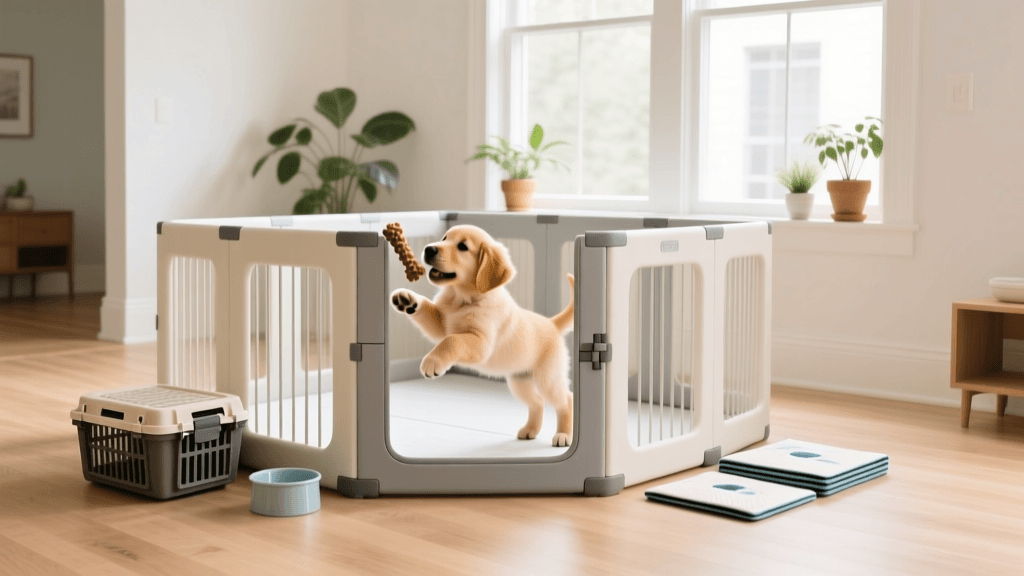
- Properly Sized Crate: MidWest Homes for Pets iCrate with Divider Panel (Approx. $60-$80). The crate should only be large enough for the puppy to stand up, turn around, and lie down. If it is too large, they will use one corner as a bathroom and sleep in the other. Use the included divider panel to expand the space as they grow.
- High-Value Training Treats: Zuke’s Mini Naturals (Approx. $6). You need treats that are small (under 3 calories each), soft, and highly smelly to create a massive "reward party" the second they finish going potty outside.
- Potty Bells: Potty Train’em Dog Doorbells (Approx. $10). A physical communication tool to bridge the gap between your puppy’s need to go and your awareness.
The "After" Phase: Implementing the Proactive Schedule
The core of the transformation lies in shifting from reactive to proactive. You must take the puppy out before they have the urge to go. The Humane Society of the United States emphasizes that taking your puppy out frequently and rewarding them immediately is the cornerstone of reliable house training.
Below is a comparison chart showing how a typical day shifts from the chaotic "before" to the structured "after."
| Time of Day | The "Before" (Chaotic) Approach | The "After" (Transformed) Routine |
|---|---|---|
| Early Morning | Waking up to a wet crate; rushing outside in a panic while the puppy cries. | Alarm set for 6:30 AM; immediate leash walk to the designated potty spot before the puppy fully wakes up. |
| Post-Meal | Letting puppy roam free after eating; finding a puddle 20 minutes later. | Puppy is leashed and taken out exactly 15 minutes after finishing kibble. Tethered to owner inside if not outside. |
| Playtime | Assuming puppy will "ask" to go out while chewing a toy or running around. | Implementing a strict 15-minute timer during high-activity play sessions to preempt excitement-urination. |
| Bedtime | Free access to water until 9:30 PM; multiple midnight wake-ups and accidents. | Water bowl removed at 7:00 PM; final "dream pee" outing at 11:00 PM before crating for the night. |
The Umbilical Cord Method
During the first four weeks of your transformation, utilize the "umbilical cord" method whenever the puppy is not in their crate. Attach a 4-foot lightweight leash to your puppy’s harness, and loop the other end around your waist or belt. This ensures the puppy is physically incapable of wandering into the dining room to have a secret accident. If they are attached to you, you will instantly notice the sniffing, circling, or sudden stillness that precedes a potty break.
Nighttime Transformations: Sleeping Through the Night
Nighttime accidents are often the most demoralizing part of the "before" phase. To transform your nights, you must manage their intake and output. Stop offering free-choice water two hours before bedtime. If bedtime is 9:00 PM, pick up the water bowl at 7:00 PM. Take them out for a final, boring, business-only potty break right before you go to sleep.
For the first few weeks, set a silent vibrating alarm on your smartwatch or phone for 3:00 AM. Wake up, carry or leash the puppy outside, let them eliminate, offer a quiet treat, and immediately put them back in the crate. By proactively waking them up, you prevent the 4:00 AM accident and the subsequent crying. As their bladder matures (usually around 12 to 16 weeks of age), you can push this alarm to 4:00 AM, then 5:00 AM, until they are sleeping a solid 7 to 8 hours.
Teaching the "Ask": Bell Training
The ultimate hallmark of the "after" phase is a dog that tells you they need to go. Bell training is highly effective for this.
- Mount the Bells: Hang the potty bells on the doorknob you use most frequently for potty breaks.
- Pairing the Action: Every single time you take the puppy out, gently guide their nose or paw to ring the bells before opening the door. Say a consistent cue word like "Touch" or "Outside."
- The Reward: The reward for ringing the bell is not a treat; the reward is the door opening. However, once they are outside and eliminate, you throw a massive treat party.
- Fading the Prompt: After two weeks of guiding their paw, stand by the door and wait. The puppy will eventually nudge the bells out of habit. The moment they ring it themselves, immediately open the door and praise enthusiastically.
Handling Setbacks and Regression
It is vital to understand that potty training is not a straight line. You will experience regression, particularly around the 4-month and 6-month marks, often coinciding with teething or fear periods. When accidents happen, do not revert to punishment. Simply interrupt the act with a neutral "Oops!" or a clap, scoop the puppy up, and carry them outside to finish. Clean the indoor spot thoroughly with your enzymatic cleaner. Re-evaluate your schedule: are you waiting too long between trips? Are you giving them too much unsupervised freedom?
Conclusion: Enjoying the "After"
Transforming your puppy’s potty habits requires intense vigilance for the first 4 to 6 months. It feels like a part-time job, but the investment pays off with a lifetime of clean carpets and peaceful nights. By relying on proactive scheduling, proper confinement, enzymatic cleaning, and positive reinforcement, you will successfully guide your puppy from the chaotic trenches of early ownership to the rewarding harmony of a fully house-trained companion.
anouk-beaumont
All our authors care for dogs every day — read more of their work on the authors page.