Puppy Potty Training: Answers to Google's Top Questions
Discover answers to Google's most-asked puppy potty training questions. Learn schedules, crate tips, and timelines to housebreak your pup fast.
Introduction to the Potty Training Journey
Bringing a new puppy home is one of the most exciting experiences in life, but it quickly becomes clear that those adorable paws come with a lot of responsibility. Among the many hurdles new dog owners face, housebreaking remains the most daunting. If you have found yourself typing frantic searches into your search engine at two in the morning, you are not alone. We have analyzed Google's 'People Also Ask' section and top search queries to bring you the ultimate guide to puppy potty training. From bladder capacity charts to the best enzymatic cleaners on the market, this comprehensive guide addresses the internet's most pressing potty training questions with actionable, expert-backed advice.
1. What Age Should You Start Potty Training a Puppy?
According to the American Kennel Club, you should begin potty training the moment your puppy crosses the threshold of your home, which is typically around 8 weeks of age. However, it is crucial to understand the biological limitations of a young dog. Puppies under 12 weeks old have very little sphincter muscle control. They physically cannot 'hold it' for long periods. Therefore, early training is less about strict obedience and more about establishing a routine, recognizing your puppy's physical cues (like sniffing, circling, or whining), and heavily rewarding successful outdoor eliminations. Patience is your most valuable tool during these early weeks.
2. How Long Does Puppy Potty Training Take?
Google users frequently ask for a definitive timeline, but the truth is that every dog is different. Generally, most puppies are reliably housebroken between 4 to 6 months of age. However, smaller breeds with tiny bladders and higher metabolisms may take up to a year to be fully reliable. The ASPCA notes that consistency is the primary factor in how quickly a puppy learns. If you take your puppy out at the same times every day, use the same verbal cues (like 'go potty'), and reward them immediately with high-value treats, you will drastically shorten the learning curve. Expect occasional setbacks, especially during periods of environmental stress or illness.
3. How Often Should I Take My Puppy Outside?
A common rule of thumb favored by veterinarians and trainers is the 'Month-Plus-One' rule. This means a puppy can generally hold their bladder for one hour per month of age, plus one extra hour. For example, a 3-month-old puppy can theoretically hold it for 4 hours. However, this is a maximum limit for overnight crating, not a recommended daytime schedule. During the day, active puppies need much more frequent breaks.
| Puppy Age | Max Hours to Hold (Overnight) | Recommended Daytime Potty Breaks | Key Developmental Milestone |
|---|---|---|---|
| 2 Months | 2 - 3 Hours | Every 1 - 2 Hours | Begin basic routine; high accident risk |
| 3 Months | 3 - 4 Hours | Every 2 Hours | Sphincter control improving; receptive to cues |
| 4 Months | 4 - 5 Hours | Every 3 - 4 Hours | Starting to signal to go out; fewer accidents |
| 6 Months | 6 - 7 Hours | Every 4 - 6 Hours | Mostly reliable; entering adolescent phase |
4. Crate Training vs. Pee Pads: Which is Better?
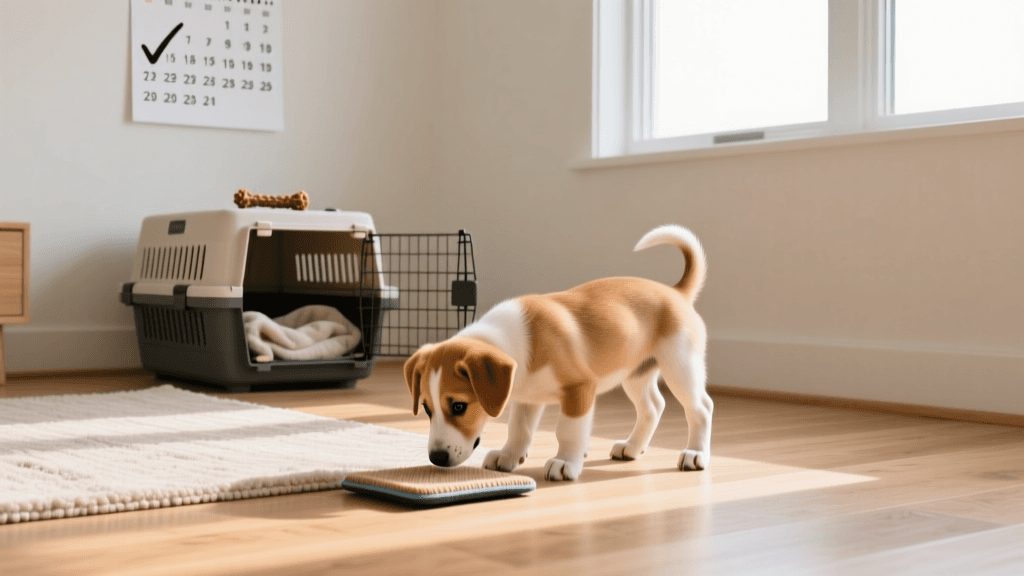
This is one of the most hotly debated topics in dog ownership. While pee pads seem like a convenient indoor solution, they often confuse puppies by teaching them that it is acceptable to eliminate inside the house. The Humane Society of the United States strongly advocates for crate training as the most effective method for housebreaking. Dogs possess a natural den instinct and will avoid soiling their sleeping area if the crate is sized correctly.
Comparison: Crate Training vs. Pee Pads
- Crate Training: Leverages natural den instincts. Teaches the puppy to hold their bladder until taken outside. Highly effective for long-term housebreaking. Cost: $40 - $80 for a wire crate with a divider panel.
- Pee Pads: Convenient for high-rise apartment dwellers or extreme weather. However, it creates a 'surface preference' where the dog may later confuse rugs or towels for pee pads. Cost: $20 - $30 per month for disposable pads.
- The Verdict: Unless you live in a high-rise without immediate yard access or plan to permanently train your dog to use an indoor litter box system, crate training combined with outdoor elimination is the gold standard.
5. What Are the Best Potty Training Treats and Products?
Success in potty training relies heavily on positive reinforcement. You need high-value, low-calorie treats that your puppy loves, as well as the right cleaning supplies to handle inevitable accidents.
- Zuke's Mini Naturals Training Treats ($6 - $8): These are tiny, highly palatable, and contain only 3 calories each, meaning you can reward your puppy every single time they go outside without risking obesity.
- Nature's Miracle Advanced Stain and Odor Eliminator ($12 - $15): This is a non-negotiable product. You must use an enzymatic cleaner to break down uric acid crystals. Standard household cleaners, especially those containing ammonia, smell like urine to a dog and will actually encourage them to remark the same spot.
- Potty Training Bells ($10 - $15): Hanging a set of jingle bells on your door handle is a fantastic way to give your puppy a voice. Teach them to nose or paw the bells right before you open the door to go outside.
- Wire Crate with Divider Panel ($50 - $90): The divider is crucial. If a crate is too large, a puppy will designate one corner as a bathroom and the other for sleeping. Adjust the divider as your puppy grows to ensure the space is only large enough for them to stand up, turn around, and lie down.
6. How Do I Stop My Puppy From Having Accidents Inside?
Accidents are a normal part of the process, but how you react dictates how quickly your puppy learns. Never rub a puppy's nose in their mess or yell at them after the fact. Dogs do not possess the cognitive ability to connect a past action with a present punishment; they will only learn to fear you and will start hiding behind furniture to eliminate.
If you catch your puppy in the act, interrupt them with a sharp, neutral sound like 'Oops!' or a quick clap, immediately scoop them up or leash them, and carry them outside to finish. When they finish outside, throw a massive reward party with treats and praise. If you find an accident after the fact, silently clean it up with your enzymatic cleaner. To prevent future accidents, increase your supervision. If you cannot watch your puppy with 100% focus, they must be in their crate or a securely gated puppy-proofed pen.
A Sample Potty Training Daily Schedule
Structure is the enemy of accidents. Here is a sample schedule for a 3-month-old puppy:
- 7:00 AM: Wake up, immediately carry or leash the puppy outside. Praise and treat for elimination.
- 7:30 AM: Breakfast time.
- 8:00 AM: Potty break (puppies usually need to go 15-30 minutes after eating).
- 9:00 AM: Potty break after morning play session.
- 10:00 AM: Nap time in the crate.
- 12:00 PM: Wake up, immediate potty break.
- 12:30 PM: Lunch.
- 1:00 PM: Potty break.
- 3:00 PM: Potty break after afternoon nap and play.
- 5:30 PM: Dinner.
- 6:00 PM: Potty break.
- 8:00 PM: Final evening play and potty break.
- 10:30 PM: Last call potty break, then into the crate for the night.
Conclusion
Potty training a puppy requires a blend of biological understanding, rigorous consistency, and endless patience. By leaning on proven methods like crate training, utilizing enzymatic cleaners, and adhering to a strict daily schedule, you will navigate this messy phase successfully. Remember that every trip outside is an opportunity to build trust and communication with your new best friend. Stick to the routine, celebrate the small victories, and soon enough, those frantic internet searches will be a thing of the past.
hannah-wickes
All our authors care for dogs every day — read more of their work on the authors page.