Moving With a Puppy in 2026: Stress-Free Home Transition Guide
Discover our 2026 guide to moving with a puppy. Learn stress-free transition tips, smart home setups, and potty training resets for your new house.
Navigating the Big Move With Your Growing Puppy
Moving to a new home is consistently ranked as one of life's most stressful events, and when you add a puppy to the mix, the complexity multiplies. Puppies are highly sensitive to environmental changes, and disrupting their routine during their critical first year can lead to behavioral regression, anxiety, and potty training setbacks. However, with the right strategy, moving can actually be a fantastic socialization and confidence-building exercise for your young dog.
In 2026, pet parents have access to better tools than ever before, from AI-driven anxiety-detection pet cameras to advanced calming supplements. Yet, the core principles of canine behavioral science remain the same: predictability, scent familiarity, and positive reinforcement are your best allies. According to the ASPCA, maintaining your pet's daily routine as much as possible before, during, and after the move is the single most effective way to mitigate stress. This comprehensive guide will walk you through a stress-free home transition with your puppy, ensuring your new house feels like home from day one.
Phase 1: Pre-Move Preparation and Packing
The weeks leading up to a move are chaotic. Cardboard boxes pile up, furniture gets disassembled, and the familiar layout of your home changes daily. For a puppy, this can be deeply unsettling. To counteract this, you must establish a 'puppy safe zone' early in the packing process.
Creating a Packing-Free Safe Zone
Designate one room or a large playpen area as the absolute safe zone. This area should remain completely free of moving boxes and packing materials. Keep your puppy's bed, favorite chew toys, water bowl, and puzzle feeders in this space. When the rest of the house looks foreign and chaotic, this zone provides a vital anchor of normalcy.
The 'Do Not Pack' Go-Bag
Pack a specific travel bag for your puppy that will stay with you in your car, not in the moving truck. This bag should include:
- Three to five days' worth of their current food and treats to avoid gastrointestinal upset from sudden diet changes or lost luggage.
- Collapsible silicone travel bowls.
- An extra leash and a well-fitted, escape-proof harness.
- Enzymatic cleaner and poop bags for immediate accident management.
- Their favorite comfort item, such as a blanket that smells like their littermates or your old home.
Phase 2: Moving Day Logistics
Moving day is loud, busy, and potentially dangerous for a curious puppy. Doors will be propped open, and strangers will be carrying heavy items in and out. According to the Humane Society, pets should be kept in a secure, quiet environment away from the hustle and bustle of moving day to prevent escape attempts or injury.
Safe Transit Options
If you are moving locally, consider boarding your puppy for the day or hiring a specialized pet sitter to keep them in a quiet, familiar environment while the heavy lifting happens. If they must be present, keep them secured in a crash-tested travel crate in a closed room or your vehicle. For long-distance moves in 2026, ensure your travel crate meets the latest safety standards and is equipped with a clip-on, spill-proof water bottle.
Managing Travel Anxiety
If your puppy is prone to car sickness or travel anxiety, consult your veterinarian a few weeks before the move. Modern 2026 veterinary guidelines often recommend a combination of short, positive car-riding practice sessions and, if necessary, prescription anti-nausea medications or natural calming chews containing L-theanine and hemp-derived CBD.
Phase 3: Setting Up the 'Puppy Basecamp'
When you arrive at your new home, resist the urge to let your puppy roam freely. A new environment is overwhelming, and giving a puppy full access to an entire house immediately can lead to overstimulation, fear-based hiding, and immediate potty accidents.
The Basecamp Method
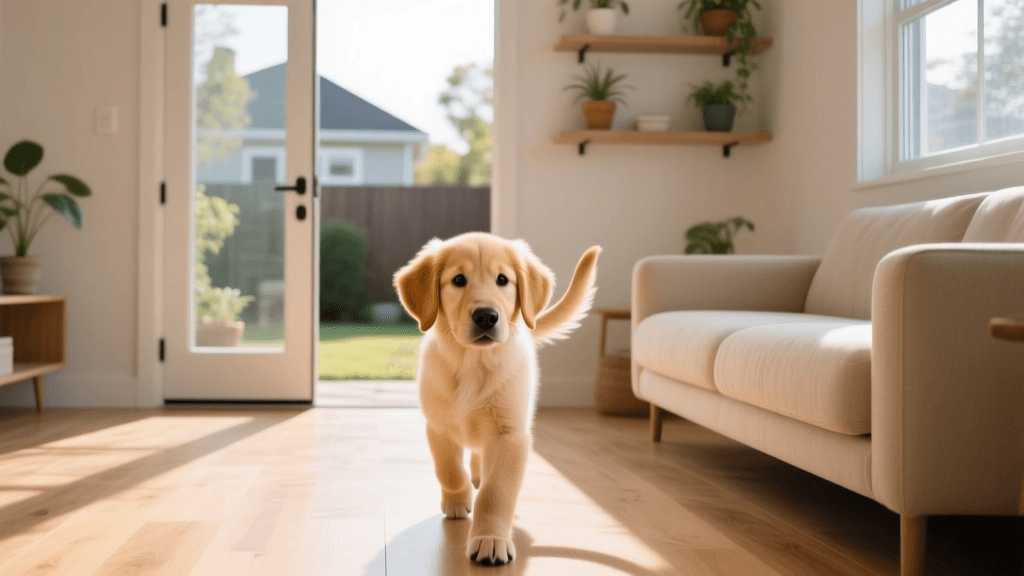
Set up a 'Basecamp' in a single, easily cleanable room (like a kitchen or a spare bedroom with hard floors). Set up their crate, bed, water, and toys exactly as they were in your old home. Allow your puppy to decompress in this single room for the first 24 to 48 hours. This controlled environment allows them to process the new scents and sounds without feeling overwhelmed by the sheer square footage of the new house.
Puppy-Proofing the 2026 Smart Home
Modern homes are filled with technology that can pose unique hazards to teething puppies. Before letting your puppy explore, ensure the following:
- Smart Outlets and Cords: Use cord concealers and ensure smart plugs are pushed firmly into the wall. Puppies love chewing on the textured plastic of charging cables.
- Robot Vacuums: The latest 2026 robot vacuums have advanced mapping, but they can still terrify a puppy or spread a potty accident across your entire living room. Keep the vacuum docked in a closed room until your puppy is fully potty trained and desensitized to the noise.
- Smart Pet Doors: If your new home has an electronic pet door, ensure the collar key is properly synced and the door is locked until your puppy understands the boundaries of the new yard.
The Puppy Moving Timeline
Use this structured checklist to keep your transition organized and your puppy grounded.
| Timeline | Action Item | Puppy Focus |
|---|---|---|
| 4 Weeks Out | Begin packing non-essentials. | Establish the 'Safe Zone' and maintain strict feeding/walking schedules. |
| 2 Weeks Out | Update address with vet and microchip registry. | Introduce the travel crate as a positive, treat-filled space. |
| Moving Day | Secure transit and heavy lifting. | Keep puppy with a sitter or in a secure, quiet crate away from movers. |
| Day 1 in New Home | Set up the 'Puppy Basecamp'. | Allow decompression; limit exploration to one room. Use calming pheromone diffusers. |
| Week 1 | Gradually open up the house. | Begin supervised exploration of new rooms. Restart potty training basics. |
Phase 4: The Potty Training Reset
One of the most common issues puppy owners face after a move is sudden potty regression. Your puppy has not forgotten their training; rather, they do not yet understand the 'scent map' of the new house. In your old home, they knew exactly where the door to the outside was and what the yard smelled like. In the new house, everything smells like strangers, cleaning chemicals, and previous pets.
Scent Transfer Technique
To bridge this gap, use the scent transfer technique. Take a used potty pad or a small piece of soiled paper towel from your old home (or from the first accident in the new home) and place it in the designated potty area of your new yard. This signals to your puppy that this is the correct bathroom zone.
Treating It Like Day One
For the first two weeks in the new house, treat your puppy as if they are completely untrained. Take them out on a leash every two hours, immediately after meals, and after every nap. Use high-value treats (like freeze-dried liver or boiled chicken) to reward outdoor elimination heavily. Supervise them 100% of the time they are indoors, or keep them in their crate or playpen when you cannot watch them. This prevents indoor accidents that would further confuse their new scent map.
Phase 5: Updating Identification and Tech
A lost puppy is a nightmare scenario, and moving day presents the highest risk for escape. Before the moving truck even arrives, ensure your puppy's identification is fully updated for 2026 standards.
- Microchip Registry: Log into your microchip provider's portal and update your new address and phone number. A microchip is useless if the contact info leads to an empty house.
- GPS Smart Collars: If you use a GPS-enabled smart collar, ensure the battery is fully charged and the safe-zone geofences are updated to reflect the boundaries of your new property.
- Physical Tags: Order a new collar tag with your new address or a current cell phone number, and attach it to the harness your puppy will be wearing during transit.
Managing Separation Anxiety During Unpacking
Unpacking takes weeks, and during this time, you will be distracted, lifting boxes, and ignoring your puppy. This sudden lack of attention can trigger separation anxiety or destructive chewing behaviors. To combat this, lean heavily on interactive enrichment toys. Freeze a Kong stuffed with puppy-safe peanut butter and plain yogurt, or use a lick mat smeared with wet food. Giving your puppy a 'job' to do in their playpen while you unpack the kitchen keeps their brain engaged and prevents them from deciding that your baseboards are a fun alternative chew toy.
Conclusion: Patience is Key
Transitioning to a new home is a major life event for both you and your puppy. Expect some regression in training, a few sleepless nights, and a period of adjustment. By utilizing the basecamp method, resetting your potty training expectations, and leveraging modern pet safety tools, you can guide your puppy through this transition with confidence. Remember, every new room you explore together and every successful outdoor potty break in the new yard is a bonding experience that builds a more resilient, adaptable, and happy dog.
beth-carrasco
All our authors care for dogs every day — read more of their work on the authors page.