Moving With a Puppy in 2026: Stress-Free Home Transitions
Moving with a puppy in 2026? Discover expert tips on the 3-3-3 decompression rule, maintaining potty training, and setting up a stress-free new home.
Navigating Life Transitions: Moving With a Puppy in 2026
Moving to a new home is consistently ranked as one of life’s most stressful events, and that stress is exponentially magnified when you share your life with a puppy. The first year of a dog’s life is a critical window for development, encompassing vital milestones like potty training, teething, crate training, and early socialization. Uprooting your puppy from the only environment they have ever known can trigger regression in training, separation anxiety, and destructive behaviors. However, with the right preparation and an understanding of canine psychology, you can turn this major life transition into a seamless adventure. In this comprehensive 2026 guide, we will explore how to manage your puppy’s decompression, maintain their potty training schedule, and utilize the latest smart home technology to monitor their adjustment.
The Developmental Impact of Moving on Puppies
Puppies experience several “fear periods” during their first year, most notably between 8 to 11 weeks and again around 6 to 14 months. If your move coincides with one of these sensitive developmental windows, your puppy may become hyper-vigilant, startled by normal household noises, or hesitant to explore the new yard. According to the American Kennel Club (AKC), maintaining a predictable routine and providing positive reinforcement during these fear periods is essential to prevent long-term behavioral issues. Moving disrupts the spatial predictability your puppy relies on for comfort, meaning your primary goal during the first few weeks in a new house is to rebuild that sense of security through scent, routine, and controlled exposure.
Pre-Move Preparation: The "Do Not Pack" Box
The chaos of packing boxes, rolling tape, and moving furniture can easily overwhelm a young dog. To mitigate this, create a dedicated "Do Not Pack" box or suitcase at least a week before the move. This kit should include:
- Their current bed and blankets: Do not wash these items before the move. The familiar scent of your old home will serve as an olfactory anchor in the new environment.
- An unwashed t-shirt: Sleep in an old t-shirt for two nights and place it in their crate. Your scent is the ultimate calming agent.
- Enzymatic cleaner and potty pads: Accidents are guaranteed during a move. Having your trusted cleaning supplies immediately accessible prevents you from using harsh chemicals that might confuse their scent-marking instincts.
- High-value treats and puzzle toys: Keep a stash of frozen Kongs or lick mats to keep them occupied on the actual moving day.
The 3-3-3 Rule of Puppy Decompression
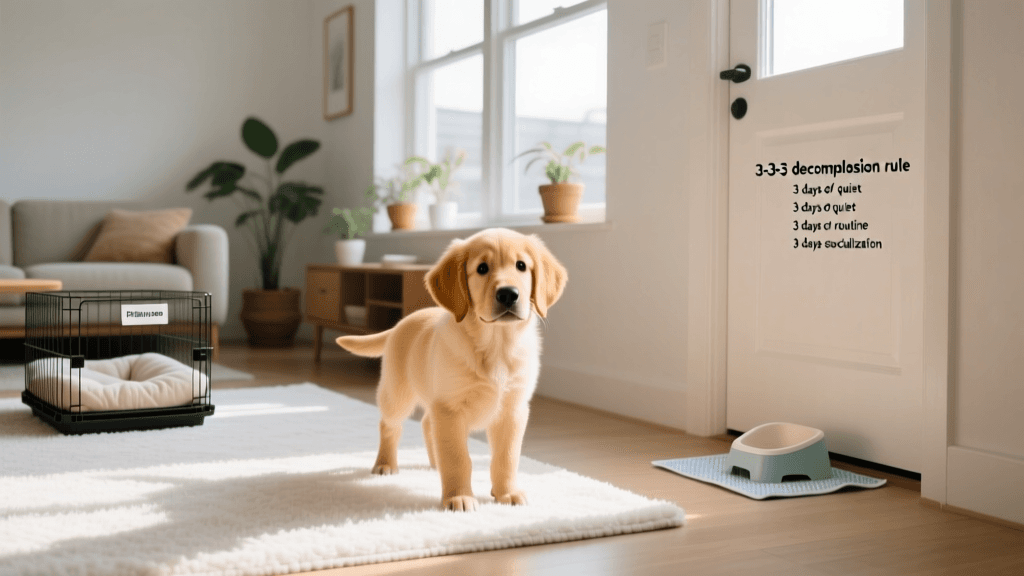
When transitioning to a new home, animal behaviorists widely recommend the 3-3-3 rule to set realistic expectations for your puppy’s adjustment period.
The First 3 Days: Overwhelm and Shutdown
During the first 72 hours, your puppy may seem overly tired, hide in their crate, refuse to eat, or exhibit minor potty accidents. They are processing an immense amount of new sensory data. Keep the environment quiet, limit visitors, and stick strictly to a basic schedule of feeding, potty breaks, and sleep.
The First 3 Weeks: Settling and Testing
By week two, your puppy will start to feel more comfortable. Their true personality will emerge, and they may begin testing boundaries. This is the time to reinforce house rules, establish the new potty perimeter, and begin short, positive socialization walks around the new neighborhood.
The First 3 Months: Bonding and Routine
After three months, your puppy should feel entirely secure in their new home. Trust and attachment are deeply established, and they will view the new house as their definitive territory. This is the ideal time to introduce more complex training commands and host small gatherings to socialize them in their new space.
Maintaining Potty Training During the Transition
Potty training regression is the most common complaint from pet parents who move. A new yard means new smells, new grass textures, and the lingering scent of previous pets. Your puppy will not automatically know where the "bathroom" is in the new house. You must essentially reset their potty training to day one, utilizing a structured transition plan.
| Time of Day | Old Home Routine | New Home Transition (First 2 Weeks) |
|---|---|---|
| Morning (7:00 AM) | Let out to fenced yard independently | Leashed walk to a designated "potty spot" in the new yard. Use a specific cue word and reward heavily. |
| Mid-Day (12:00 PM) | Doggy door access | No doggy door access. Take out on a leash to the exact same designated spot. |
| Evening (5:30 PM) | Playtime in yard, potty as needed | Structured play session followed by a leashed potty break at the designated spot. |
| Night (10:00 PM) | Final let out, sleep in crate | Leashed final potty break. Sleep in crate placed in the owner's bedroom for added security. |
By restricting off-leash yard access for the first two weeks, you prevent the puppy from wandering, getting distracted by new wildlife, and forgetting to eliminate. Once they are consistently using the designated spot on a leash, you can gradually grant them more freedom.
Managing Teething and Stress-Induced Chewing
If your puppy is between 4 and 6 months old, they are likely in the peak of their teething phase. The physical discomfort of losing baby teeth, combined with the psychological stress of moving, creates a perfect storm for destructive chewing. Baseboards, door frames, and moving boxes are prime targets. To protect your new home and your puppy’s teeth, provide appropriate outlets. In 2026, veterinary behaviorists recommend durable, freezable chew toys like the Kong Classic or Nylabone Power Chew. Soak a clean washcloth in low-sodium chicken broth, twist it into a rope, and freeze it solid. The cold numbs their aching gums while the familiar scent provides comfort. Furthermore, utilize bitter apple sprays on the corners of your new furniture and baseboards to deter exploratory chewing during the 3-3-3 decompression phase.
2026 Smart Home Tech for Puppy Monitoring
Technology has vastly improved our ability to monitor puppies during life transitions. If you are returning to the office or leaving the puppy alone in the new house for the first time, smart home integration is invaluable. Look for Matter-compatible pet cameras that integrate seamlessly with your existing smart home ecosystem. Devices equipped with AI-driven bark detection and treat-tossing capabilities allow you to interrupt anxiety spirals before they escalate into destructive behavior. Additionally, smart pet doors with microchip recognition ensure that as your puppy grows and gains yard privileges, local wildlife or neighborhood cats cannot enter your new home. Setting up these devices before the move allows you to test the Wi-Fi bandwidth in your new house and ensure the camera angles cover the puppy’s primary safe zone.
Administrative Transitions: Vets, Microchips, and Insurance
The physical move is only half the battle; the administrative transition is equally critical for your puppy’s safety. The ASPCA strongly advises updating your pet’s microchip registry the moment you have a confirmed new address. Do not wait until the puppy is lost in an unfamiliar neighborhood to realize the chip is still linked to your old landlord’s address. Furthermore, the Humane Society of the United States recommends securing a new local veterinarian and transferring your puppy’s medical records, including their current vaccination schedule and heartworm prevention prescription, at least two weeks prior to moving day. If you have pet insurance, update your zip code, as premiums and coverage networks can vary significantly by region.
Conclusion: Patience is the Ultimate Tool
Transitioning to a new home during a puppy’s first year is a profound life event that requires patience, empathy, and meticulous planning. By respecting the 3-3-3 decompression rule, resetting your potty training expectations, and leveraging modern smart home technology, you can guide your puppy through this transition with confidence. Remember that setbacks are a normal part of the process. A forgotten potty break or a chewed shoe is not a sign of failure, but rather a signal that your puppy needs a little more guidance and reassurance. With consistent routines and a calm demeanor, your new house will quickly become your puppy’s forever home.
beth-carrasco
All our authors care for dogs every day — read more of their work on the authors page.