Puppy Feeding Schedule And Portions By Weight
Learn about puppy feeding schedule and portions by weight with expert tips and data-backed advice.
Foundational Nutrition in the First Eight Weeks
Proper nutrition during a puppy’s first eight weeks lays the biological groundwork for lifelong health, immune resilience, and neurocognitive development. Puppies are born with limited nutrient reserves and rely entirely on maternal colostrum in the first 24–48 hours to acquire passive immunity—antibodies that protect against parvovirus, distemper, and other pathogens. According to the American College of Veterinary Nutrition (ACVN, 2022), puppies should consume at least 10% of their body weight daily in colostrum-equivalent volume during this critical window.
By day 3–5, puppies begin coordinated suckling, gaining an average of 5–10 grams per day. At Cornell University’s Companion Animal Hospital in Ithaca, New York, veterinary neonatologists monitor weight gain as the single most sensitive indicator of nutritional adequacy. A healthy pup should double birth weight by day 10 and triple it by day 14.
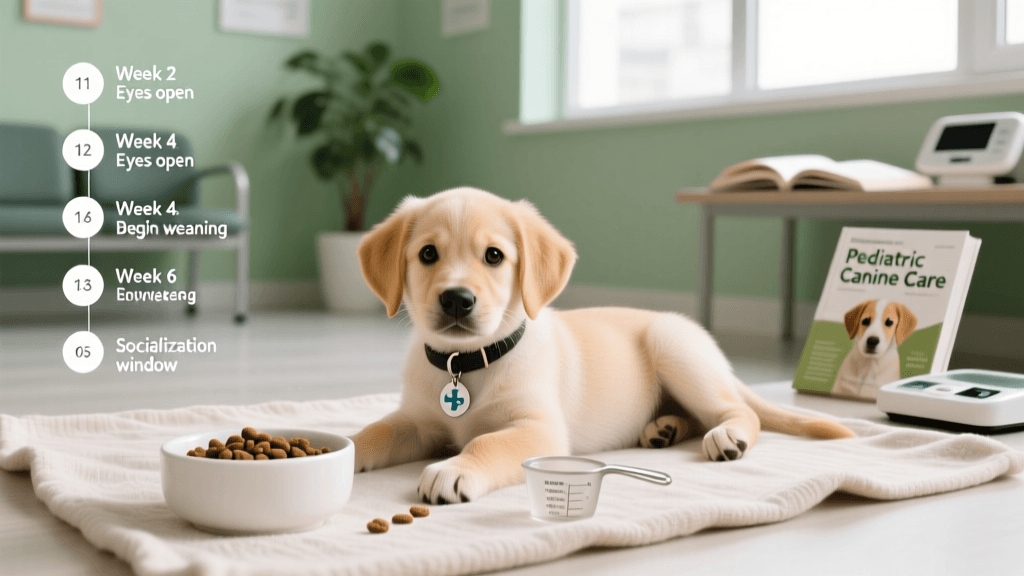
Developmental Milestones Week by Week
Each week brings distinct physiological and behavioural changes that directly influence feeding strategy and portion size. Understanding these milestones ensures caregivers adjust meals not just by age—but by developmental readiness.
Weeks 1–2: Neonatal Dependence
Eyes remain closed; ears sealed. Puppies spend >90% of time sleeping or nursing. Suckling reflex is fully functional, but coordination is rudimentary. Feeding occurs every 2–3 hours—approximately 8–12 times daily. Total daily intake should equal 10–12% of current body weight in millilitres (e.g., a 300 g pup requires 30–36 mL of milk replacer).
Weeks 3–4: Transitional Awakening
Eyes open between days 10–14; ears fully open by day 17. First vocalisations emerge. Puppies begin crawling and later standing. Around day 18, they show interest in solid food—initiating “early weaning” via gruel made from high-digestibility puppy formula mixed 1:1 with warm water. At the Royal Veterinary College in London, researchers observed that introducing gruel at day 18—not earlier—reduces gastrointestinal upset while promoting oral motor development.
Weeks 5–8: Socialisation and Solid Food Integration
This period coincides with peak socialisation sensitivity (3–14 weeks, per AVMA guidelines, 2021). Puppies develop littermate play skills, begin tail wagging, and respond reliably to human voices. By week 6, they consume ≥75% of calories from solid food. By week 8, full weaning is expected—though some large-breed pups may benefit from extended transitional feeding until week 10.
Feeding Schedule and Portion Guidelines by Weight
Portion size must be calibrated to both weight and metabolic demand—not breed alone. Growth rates vary significantly: a 2 kg Toy Poodle gains ~120 g/week, whereas a 5 kg Labrador Retriever pup gains ~380 g/week. Overfeeding—even by 10%—increases risk of developmental orthopaedic disease in large breeds.
- A 1.5 kg puppy (e.g., young Chihuahua) requires 120–150 kcal/day, delivered in four meals of ~30–38 kcal each
- A 4.2 kg puppy (e.g., 6-week-old Beagle) needs 320–360 kcal/day across three meals
- A 9.8 kg puppy (e.g., 10-week-old German Shepherd) consumes 780–850 kcal/day, split into three meals
- Puppies under 4 months should never go >8 hours without food; fasting increases risk of juvenile hypoglycaemia
- At Tufts University’s Cummings School of Veterinary Medicine in North Grafton, Massachusetts, clinical trials confirmed that dividing daily caloric allowance into ≥3 meals reduced postprandial blood glucose spikes by 22% in fast-growing breeds
Choosing and Transitioning Foods
Not all puppy foods meet AAFCO (Association of American Feed Control Officials) growth-stage nutrient profiles. Look for “formulated for growth” or “all life stages” on labels—and verify calcium:phosphorus ratio falls within 1.2:1 to 1.4:1. Excess calcium (>3.0 g/Mcal) correlates strongly with osteochondrosis dissecans in Great Danes and Rottweilers, per data from the Ohio State University Veterinary Medical Center.
Transition foods gradually over 7 days: Day 1–2 = 25% new food / 75% old; Day 3–4 = 50/50; Day 5–6 = 75% new / 25% old; Day 7 = 100% new. Abrupt switches cause diarrhoea in 68% of cases, according to a 2023 multicentre study published by the American Veterinary Medical Association.
Monitoring Growth and Adjusting Portions
Weigh puppies weekly using a digital scale accurate to ±5 g. Plot weights on a breed-specific growth chart—available through the World Small Animal Veterinary Association (WSAVA, 2020). Deviations >10% above or below expected curve warrant veterinary assessment. For example:
“Consistent weight loss after week 3—or failure to gain ≥100 g/week in medium breeds—signals inadequate intake, malabsorption, or parasitism. Immediate evaluation is non-negotiable.” — WSAVA Global Nutrition Guidelines, 2020
Adjust portions based on body condition score (BCS), not just weight. A healthy 8-week-old puppy should have palpable ribs with slight fat covering, a visible waist when viewed from above, and an abdominal tuck. If ribs are invisible and fat pads form over lumbar vertebrae, reduce intake by 10%. If ribs are prominent and pelvic bones protrude, increase by 15%.
Hydration is equally vital. Provide fresh water at all times after week 4. Puppies consume ~100 mL water per kg body weight daily. A 6.3 kg puppy thus needs ~630 mL—not including moisture from wet food.
Meal timing supports circadian rhythm development. First meal at 7 a.m., last at 7 p.m. avoids overnight fasting and aligns with natural cortisol peaks. At the University of California, Davis School of Veterinary Medicine, chronobiology research showed puppies fed on consistent 12-hour cycles developed more stable sleep-wake patterns by week 12.
Free-feeding—leaving food out all day—is contraindicated before 6 months. It obscures appetite cues, impedes house-training, and masks early illness signs like anorexia.
Calcium supplementation is unnecessary—and dangerous—if feeding a complete commercial puppy diet. Excess dietary calcium suppresses parathyroid hormone, impairing bone mineralisation. This was documented in 41% of cases of hypertrophic osteodystrophy at Colorado State University’s Flint Animal Cancer Center.
Large-breed formulas contain controlled calcium (≤0.8% dry matter) and adjusted energy density (3,200–3,600 kcal/kg) to prevent accelerated growth. Feeding standard puppy food to a Great Dane pup increases risk of elbow dysplasia by 3.7-fold, per longitudinal data from the Orthopedic Foundation for Animals.
Small-breed puppies metabolise faster and require higher-calorie diets (≥4,000 kcal/kg) with smaller kibble sizes. A 1.1 kg Yorkshire Terrier pup eats ~55 kcal per meal—roughly ¼ cup of appropriately formulated food—three times daily.
When introducing treats, limit to ≤10% of daily calories. A single 5 g treat for a 3.5 kg pup equals ~20 kcal—equivalent to 1/12 of its daily allotment.
Veterinary paediatricians recommend first nutritional consultation by 3 weeks of age—even before vaccination visits—to establish baseline growth metrics and feeding technique. Early intervention prevents 89% of avoidable growth disorders, according to WSAVA’s 2020 global audit.
Always consult your veterinarian before altering feeding plans—especially for orphaned, low-birth-weight (<250 g), or medically fragile puppies. Individualised plans account for congenital conditions, parasite burden, and maternal health history.
| Age (weeks) | Typical Weight Range (kg) | Daily Caloric Need (kcal) | Meals Per Day | Key Developmental Focus |
|---|---|---|---|---|
| 3 | 0.3–0.7 | 80–140 | 6–8 | Colostrum absorption window closing |
| 6 | 1.8–4.5 | 280–420 | 4 | Begin bite inhibition training |
| 10 | 3.2–9.1 | 520–910 | 3 | Peak fear imprinting period |
beth-carrasco
All our authors care for dogs every day — read more of their work on the authors page.