Managing Puppy Fear Periods & Reactivity in 2026
Learn how to manage your puppy's 8-11 week fear period and prevent early leash reactivity using 2026's top calming gear and positive reinforcement.
The Neurological Reality of the 8-11 Week Fear Period
Bringing a new puppy home is an exciting milestone, but it often coincides with one of the most critical developmental windows in a dog's life: the first fear period. Occurring roughly between 8 and 11 weeks of age, this evolutionary survival mechanism makes puppies hyper-vigilant and deeply susceptible to forming lifelong negative associations. In 2026, modern veterinary behaviorists emphasize that how you manage this window dictates whether your puppy grows into a confident adult or a reactive, anxious dog.
During this phase, a puppy's amygdala—the brain's fear center—is highly active, while the prefrontal cortex, responsible for emotional regulation, is still underdeveloped. A traumatic or overly stressful experience during these weeks, such as a harsh correction, an aggressive dog encounter, or forced interaction with a terrifying stimulus, can literally wire the brain for lifelong reactivity. According to the American Kennel Club (AKC), recognizing and respecting these fear stages is the cornerstone of modern, science-based puppy socialization.
As a puppy owner, your primary goal during this period is not to force your puppy to 'get over it,' but to act as an advocate and emotional anchor. This means avoiding overwhelming environments like crowded dog parks or busy street festivals, and instead focusing on controlled, positive exposures that build resilience without triggering the fear response.
Identifying Early Reactivity: Beyond the Bark
Many owners mistakenly believe that reactivity only looks like lunging, barking, and snapping. However, early signs of anxiety and reactivity in puppies are often subtle and easily missed until they escalate. By the time a puppy is barking at the end of a leash, they have already been silently screaming for help through their body language for weeks.
The Humane Society of the United States outlines several critical calming signals and stress indicators that precede reactive outbursts. Watch closely for the following early warning signs during walks or socialization outings:
- Whale Eye: The puppy turns their head away from a trigger but keeps their eyes fixed on it, exposing the whites of their eyes.
- Lip Licking and Yawning: When not related to food or waking up, these are classic displacement behaviors indicating internal conflict and stress.
- Freezing: The puppy stops moving entirely, stiffening their body. This is often the last step before a 'fight or flight' reaction.
- Leash Biting and Scratching: Redirected frustration and anxiety often manifest as a puppy attacking their own leash or scratching frantically at their harness.
- Pinned Ears and Tucked Tail: The most visible signs of acute fear and submission.
If you notice any of these signs, your puppy is over threshold. The immediate protocol is to increase distance from the trigger and offer a high-value reward to create a positive emotional response, rather than forcing the puppy to endure the interaction.
2026's Top Calming Arsenal for Anxious Puppies
Managing a reactive or anxious puppy requires more than just patience; it requires the right tools. The pet care industry has seen significant advancements in fear-free gear over the last few years. Here is a comparison of the most effective, veterinarian-recommended calming tools available in 2026 to help your puppy navigate their fear periods and early reactivity.
| Calming Tool | Best Used For | 2026 Average Price | Mechanism of Action |
|---|---|---|---|
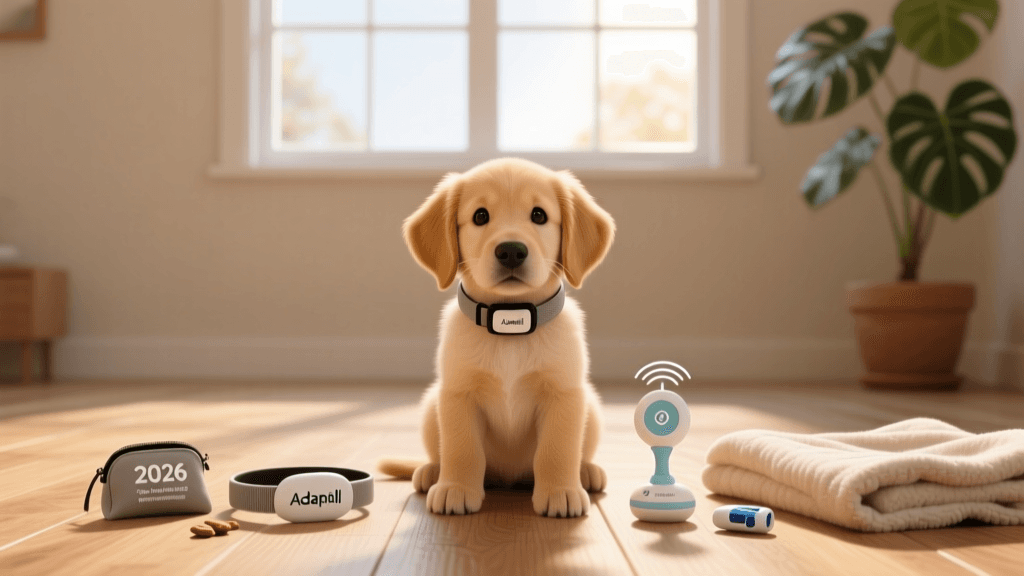
| Adaptil Junior Calming Collar | General anxiety, fear periods, vet visits | $28 - $34 | Releases synthetic dog-appeasing pheromones (DAP) that mimic a nursing mother. |
| ThunderShirt Puppy | Storm phobia, separation anxiety, travel | $45 - $55 | Provides gentle, constant pressure that stimulates the parasympathetic nervous system. |
| LickiMat Soother (Silicone) | Decompression, crate training, grooming | $12 - $18 | Repetitive licking releases endorphins and lowers cortisol levels in the brain. |
| Snuffle Mat (Fleece) | Pre-walk decompression, mental fatigue | $25 - $40 | Engages the olfactory system, which naturally slows heart rate and reduces arousal. |
| Ziwi Peak Air-Dried Venison | High-stress training, counter-conditioning | $40 - $50 (lb) | Ultra-high value protein that overrides mild fear responses during threshold work. |
When using tools like the Adaptil Junior collar, ensure it is fitted snugly against the skin for maximum pheromone absorption. For the LickiMat, freeze it with a mixture of plain Greek yogurt and bone broth for 30 minutes before a stressful event (like a nail trim) to prolong the soothing licking behavior.
The Engage-Disengage Protocol for Leash Reactivity
If your puppy is already showing early signs of leash reactivity—such as barking at other dogs or lunging at strangers—the most effective behavioral modification technique is the Engage-Disengage game, heavily popularized by Leslie McDevitt's 'Control Unleashed' program. This protocol rewires the puppy's emotional response to triggers from 'threat' to 'predictor of good things.'
Step 1: Find the Sub-Threshold Distance
Identify the distance at which your puppy notices a trigger (e.g., another dog) but does not react. This might be 30 feet, or it might be 100 feet. If your puppy is barking, you are too close. You must work entirely under their fear threshold.
Step 2: Engage (Mark the Look)
When your puppy looks at the trigger, immediately mark the behavior with a clicker or a verbal marker like 'Yes!' The exact moment they look at the trigger, they get marked. This teaches them that noticing a trigger is a cue to check in with you.
Step 3: Disengage (Reward the Turn)
After the mark, wait for the puppy to turn their head back toward you to get the treat. Deliver a high-value reward (like air-dried venison or boiled chicken) directly at your side, away from the trigger. This physically moves them out of the confrontational posture.
Step 4: Repeat and Decrease Distance
Over multiple sessions spanning several weeks, gradually decrease the distance to the trigger by just 1 to 2 feet at a time. If the puppy reacts, you have moved too fast. Increase the distance and start again. According to the ASPCA, consistent counter-conditioning is the gold standard for treating fear-based reactivity without the use of aversive punishment.
Decompression Walks: The Sniffari Method
For an anxious or reactive puppy, a traditional neighborhood walk can be an overwhelming sensory assault. Concrete sidewalks, passing cars, and unpredictable pedestrians keep the puppy's nervous system in a state of high arousal. In 2026, canine behaviorists strongly advocate for 'Decompression Walks,' often referred to as Sniffaris.
A Sniffari involves taking your puppy to a quiet, low-traffic natural area (like a wooded trail or an empty field) on a long line (15 to 30 feet). The goal of this walk is not physical exercise or heel training; the sole objective is to allow the puppy to sniff at their own pace. Sniffing is a deeply enriching cognitive exercise for dogs. Studies show that sustained sniffing lowers a dog's heart rate and engages the parasympathetic nervous system, effectively acting as a natural sedative.
Allow your puppy to investigate a single bush for five minutes if they wish. Do not rush them, do not correct them for pulling on the long line, and do not demand eye contact. For a highly reactive puppy, a 20-minute Sniffari in a quiet field is far more mentally exhausting and emotionally regulating than a two-mile march down a busy city street.
The Danger of Flooding and Outdated Alpha Theories
Despite the overwhelming scientific consensus supporting positive reinforcement and fear-free handling, outdated dominance-based training methods still circulate on social media. Techniques such as 'flooding' (forcing a dog to confront their fear until they stop reacting), alpha rolls, and the use of prong or shock collars on puppies are not only ineffective but deeply damaging.
Flooding a fearful puppy does not teach them that the trigger is safe; it teaches them 'learned helplessness.' The puppy may stop barking or lunging, but their internal cortisol levels remain dangerously high. They have simply shut down because fighting back didn't work. This suppressed anxiety almost always resurfaces later in life as severe, unpredictable aggression.
Furthermore, applying pain or physical intimidation to a puppy experiencing a fear period destroys the foundational trust between dog and owner. If a puppy learns that looking at another dog results in a painful leash correction, they will quickly associate the sight of other dogs with pain, thereby worsening their reactivity. Modern 2026 veterinary guidelines strictly advise against the use of aversive tools on puppies, emphasizing that patience, distance management, and high-value counter-conditioning are the only safe pathways to a confident, well-adjusted adult dog.
Conclusion: Patience is Your Greatest Tool
Managing a reactive or anxious puppy during their critical fear periods requires a shift in perspective. You are not fighting your puppy; you are helping them navigate a world that feels overwhelmingly loud and unpredictable. By utilizing modern calming gear like the Adaptil Junior collar, implementing structured Engage-Disengage protocols, and prioritizing mental decompression through Sniffaris, you can successfully guide your puppy through the 8-11 week fear period. Remember, socialization is about the quality of positive experiences, not the quantity of exposures. Protect your puppy's emotional well-being, advocate for their boundaries, and watch them blossom into a resilient, confident companion.
jonas-cole
All our authors care for dogs every day — read more of their work on the authors page.