Puppy Calming Signals Guide 2026: Decode Early Stress
Learn to decode puppy calming signals like lip licking and yawning in 2026. Master early stress recognition for better socialization and training.
The Evolution of Puppy Communication in 2026
As we raise puppies in 2026, our understanding of canine cognition and emotional welfare has reached unprecedented heights. Gone are the days of dominance-based training theories and misunderstood behavioral quirks. Today, modern veterinary behaviorists and certified professional dog trainers emphasize a force-free, fear-free approach to puppy rearing. At the absolute core of this modern paradigm is the ability to read and respect canine communication, specifically 'calming signals.' These subtle, often fleeting body language cues are your puppy's primary method of de-escalating tension, self-soothing, and communicating discomfort before a situation escalates to fear or aggression.
Understanding these signals during your puppy's first year is not just a neat trick; it is a fundamental requirement for ethical ownership. Misinterpreting a stress signal as 'stubbornness' or 'guilt' can lead to unintended behavioral fallout, damaging the trust between you and your dog. According to the American Kennel Club, recognizing early signs of canine stress is the most critical skill a new owner can develop to ensure a well-adjusted, confident adult dog.
The Science Behind Canine Calming Signals
The concept of calming signals was popularized by Norwegian canine behaviorist Turid Rugaas, who identified over thirty distinct behaviors dogs use to communicate peaceful intentions. In the wild and in domestic settings, dogs are inherently social animals that rely on cooperation for survival. Overt aggression is costly and dangerous, so dogs evolved a sophisticated repertoire of micro-expressions and body postures to prevent conflict. When your puppy encounters a stressful stimulus—be it a loud noise, an overly enthusiastic toddler, or an unfamiliar dog—they will deploy these signals to say, 'I mean no harm, and I am feeling overwhelmed.' In 2026, the Fear Free Pets initiative has made the recognition of these signals a mandatory standard for certified veterinary professionals, highlighting their importance in preventing veterinary visit trauma.
7 Essential Puppy Calming Signals You Must Recognize
1. Lip Licking and Nose Flicking
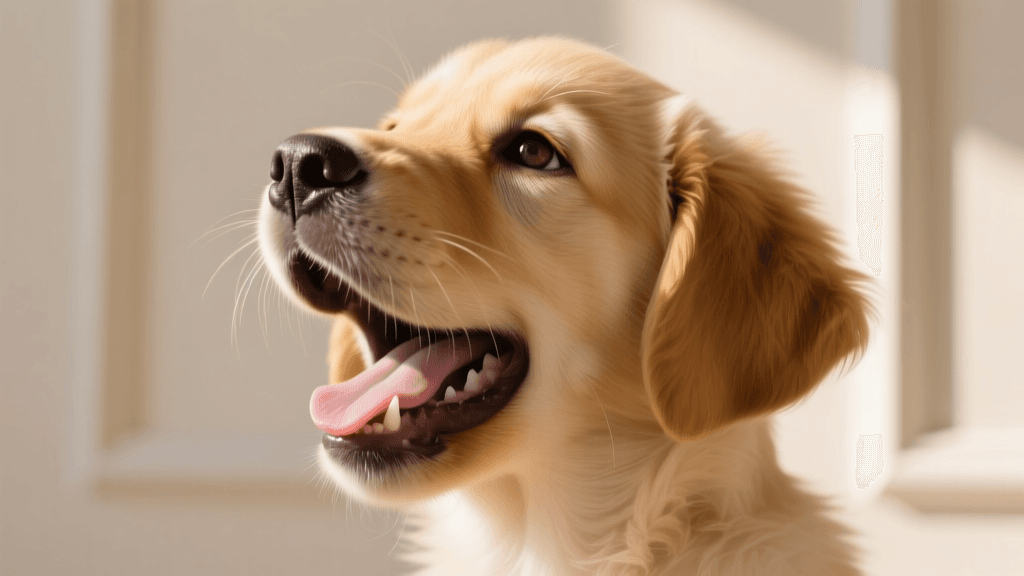
While puppies lick their lips after eating a delicious treat, rapid, repetitive lip licking or 'nose flicking' in the absence of food is a classic displacement behavior. You will often see this when a stranger leans over your puppy, when you scold them, or when they are placed in a restrictive harness. It is a clear indicator of mild to moderate anxiety. If your puppy is lip-licking during a training session, they are likely confused or frustrated, and it is time to take a break.
2. The Displacement Yawn
Puppies yawn when they wake up, but a 'displacement yawn' occurs in highly stimulating or stressful environments. If you are at a busy outdoor cafe or the veterinary waiting room and your puppy lets out a long, drawn-out yawn despite having just slept, they are attempting to self-soothe and lower their heart rate. It is a plea for a calmer environment.
3. Head Turning and Averting Eyes
In human culture, direct eye contact is a sign of attention and respect. In canine culture, prolonged direct eye contact is a threat. If you point a camera at your puppy or approach them head-on, they will likely turn their head away or avert their gaze. This is not them ignoring you; it is them politely asking you to lower the social pressure. Respecting this signal prevents defensive biting.
4. Intense Ground Sniffing
Sniffing is a natural investigative behavior, but sudden, intense ground sniffing when another dog approaches or when called by an angry owner is a calming signal. By pretending to be deeply engrossed in a blade of grass, the puppy is signaling to the approaching entity that they are not a threat and wish to be left alone. Forcing a puppy to stop sniffing and 'look at you' in these moments invalidates their coping mechanism.
5. Freezing and Moving Slowly
When a puppy feels entirely trapped or overwhelmed, they may freeze completely, becoming stiff as a board. Alternatively, they might move in slow motion. This is often misinterpreted by owners as the puppy being 'lazy' or 'stubborn' during a walk. In reality, the puppy's nervous system is entering a state of dorsal vagal shutdown—a freeze response. Moving slowly is also a signal used to project non-threatening intentions to a larger, more intimidating dog.
6. The Curved Approach
Watch how well-socialized adult dogs greet one another; they rarely walk in a straight line. A straight-line approach is inherently confrontational. Puppies will naturally try to curve their bodies or approach in an arc when meeting new people or dogs. If you are walking your puppy toward a new friend, allow them to take a curved path rather than forcing a direct, head-on collision.
7. The 'Shake Off'
You have likely seen your puppy shake vigorously from nose to tail as if they are wet, even when completely dry. This 'shake off' is a physiological reset button. It occurs immediately after a stressful encounter, a rough play session, or a veterinary exam. The physical shaking helps discharge built-up adrenaline and cortisol from the nervous system. Allow your puppy to complete the shake without interruption.
Signal Interpretation Chart for Puppy Owners
| Calming Signal | Common Misinterpretation | What Your Puppy is Saying | Recommended Owner Action |
|---|---|---|---|
| Lip Licking | Hungry or tasting the air | I feel pressured or anxious | Increase distance from the stressor |
| Yawning | Boredom or sleepiness | I am overstimulated and stressed | Move to a quieter, less chaotic area |
| Looking Away | Ignoring commands or being defiant | Your direct eye contact is intimidating | Turn your body sideways and soften your gaze |
| Ground Sniffing | Distracted or disobedient | I need space from the approaching dog/person | Advocate for your puppy and ask others to back up |
| Freezing | Stubbornness on the leash | I am terrified and feel trapped | Do not pull the leash; lure with high-value treats |
Integrating Signal Recognition into 2026 Socialization Protocols
Socialization is the most critical developmental milestone in a puppy's first year. However, the 2026 consensus among veterinary behaviorists is that 'socialization' does not mean forcing your puppy to interact with every dog, person, and object they encounter. True socialization is about teaching your puppy how to feel neutral and safe in the presence of novel stimuli. The Humane Society of the United States emphasizes that forcing interactions when a puppy is displaying calming signals can lead to 'flooding'—a psychological trauma response that creates lifelong phobias.
When attending puppy kindergarten classes, your primary job is to be your puppy's advocate. If another puppy is playing too roughly and your dog turns their head away, licks their lips, and tucks their tail, they are asking for help. It is your responsibility to step in, call your puppy away, and provide a safe decompression zone. Reward your puppy for offering a calming signal by giving them space and a high-value treat, reinforcing that their communication is heard and respected.
How to Respond to Your Puppy's Stress Signals
Recognizing the signal is only half the battle; knowing how to respond is where the true bond is forged. Here is a practical, actionable protocol for when your puppy exhibits stress:
- Step 1: Identify the Trigger. Look at the environment. Is a loud truck passing by? Is a stranger looming over them? Is another dog staring?
- Step 2: Increase Distance. The most effective way to lower a puppy's cortisol levels is to increase the physical distance between them and the trigger. Calmly walk away without yanking the leash.
- Step 3: Offer a Decompression Activity. Once at a safe distance, engage your puppy in a sniffing game or scatter a handful of treats in the grass. Sniffing naturally lowers a dog's heart rate and engages the parasympathetic nervous system.
- Step 4: Reassess and Adjust. Before attempting to re-introduce the trigger, evaluate if the puppy is truly ready. If they are still yawning or lip-licking, end the session for the day. Pushing through stress never yields positive training results.
The Danger of Punishing Calming Signals
One of the most detrimental mistakes an owner can make is punishing a puppy for growling or freezing. While growling is a distance-increasing warning rather than a calming signal, it belongs to the same continuum of canine communication. If you scold a puppy for giving subtle signals like lip-licking or freezing, they will learn that communicating discomfort results in punishment. Consequently, they will suppress these early warning signs and jump straight to biting without warning. By fostering an environment where your puppy feels safe expressing their boundaries, you are actively bite-proofing your dog for the future.
Conclusion: Building a Lifelong Bond Through Empathy
Raising a puppy in 2026 offers us the incredible advantage of decades of behavioral science at our fingertips. By learning to decode your puppy's calming signals—the subtle lip licks, the displacement yawns, the averted gazes—you are doing far more than just preventing behavioral issues. You are telling your puppy, in their own native language, that you understand them, that you will protect them, and that their feelings matter. This profound level of empathy and communication is the true foundation of a lifelong, unbreakable bond between human and dog. Observe closely, respect their boundaries, and watch your puppy blossom into a confident, resilient adult dog.
priya-sutaria
All our authors care for dogs every day — read more of their work on the authors page.