Puppy Biting And Kids: A Safe Family Survival Guide
Learn how to manage puppy biting and teething around young children. Discover safe zones, bite inhibition tips, and family rules for a harmonious home.

The Reality of Puppy Teeth and Toddler Skin
Bringing a new puppy into a home with young children is a magical experience, filled with cuddles, laughter, and unforgettable firsts. However, the honeymoon phase can quickly come to a screeching halt when those razor-sharp puppy teeth make contact with delicate toddler skin. For families navigating the chaotic intersection of early childhood and early puppyhood, managing biting and teething is often the most pressing challenge. Puppies do not bite out of malice; they bite to explore, to play, and to soothe their aching gums. Yet, when young children are involved, even playful nips can lead to tears, fear, and a stressful household environment. This comprehensive survival guide is designed specifically for families, providing actionable, step-by-step strategies to manage puppy biting, establish safe physical boundaries, and teach children how to interact confidently and safely with their new furry sibling.
Understanding Why Puppies Bite
Before implementing training strategies, it is crucial for both parents and children to understand the developmental reasons behind puppy biting. Puppies use their mouths the same way human toddlers use their hands—to investigate textures, tastes, and the world around them. Furthermore, between the ages of 12 and 16 weeks, puppies begin to lose their baby teeth and grow their adult teeth. This teething phase can cause significant oral discomfort, leading them to chew and bite on anything that provides relief, including baseboards, shoes, and unfortunately, children's hands and ankles.
Play is another major driver. In a litter, puppies learn 'bite inhibition' from their siblings; if one puppy bites too hard, the other will yelp and stop playing. When a puppy enters a human home, they must learn that human skin is entirely off-limits. The American Kennel Club emphasizes that early socialization and consistent, gentle redirection are vital during these formative months to ensure the puppy develops a soft mouth and appropriate play behaviors.
Setting Up Physical Boundaries: Safe Zones and Gates
The most effective way to prevent a puppy from biting a child is to manage the environment so that unsupervised or overly rambunctious interactions simply cannot happen. Relying solely on verbal commands will fail when a toddler is running and a puppy is overstimulated. You must create physical 'Safe Zones' for both the child and the puppy.
Invest in Quality Baby Gates
Do not rely on flimsy, pressure-mounted gates for doorways. Invest in hardware-mounted gates that can withstand a jumping puppy and a leaning toddler. The Carlson Pet Products Extra Wide Walk-Thru Gate with Pet Door (Cost: approximately $60 to $80) is an excellent choice. It features a small pet door at the bottom, allowing the puppy to pass through while keeping toddlers contained, or vice versa, depending on your room setup. Install these gates at the entrance to the kitchen, the nursery, and the main living area to create distinct zones.
Create a Puppy Playpen Sanctuary
A playpen provides a safe enclosure where the puppy can relax, chew on appropriate toys, and sleep without being ambushed by a well-meaning but overwhelming toddler. For small to medium breeds, a 4x4 foot playpen is sufficient, while large breeds require at least a 4x6 foot footprint. The Iris USA 4-Panel Pet Playpen (Cost: approximately $45 to $60) is highly durable and easily configurable. Place the playpen in a low-traffic area of the living room. Inside, include a comfortable bed, a water bowl, and a designated chew zone. Teach your children that the playpen is the puppy's 'bedroom' and that they must never reach inside or climb over the panels when the puppy is resting.
Teaching Children How to Interact Safely
According to the Centers for Disease Control and Prevention (CDC), children are the most common victims of dog bites, often occurring during ordinary, everyday interactions. Teaching your children how to behave around the puppy is just as important as training the puppy itself.
The 'Be a Tree' Method
Puppies are naturally triggered by high-pitched squeals, running, and erratic movements. When a child runs, the puppy's prey drive is activated, resulting in chasing and nipping at the child's heels. Teach your children the 'Be a Tree' method. If the puppy becomes overly excited or starts nipping, the child must immediately stop moving, fold their arms across their chest like branches, and look down at their feet like roots. By becoming boring and still, the puppy will quickly lose interest and look for a toy instead. Practice this method as a fun game when the puppy is calm, rewarding the child with a sticker or praise for holding their 'tree' pose perfectly still.
Establish Strict Interaction Rules
Implement and enforce the following household rules for all children and their friends:
- No hugging: While humans show affection through hugging, dogs often perceive wrapping arms around their neck as a threatening or restraining gesture, which can lead to a defensive bite.
- No reaching into the crate or playpen: The puppy's enclosure is their sanctuary. Children must be taught to wait for the puppy to come out before initiating play.
- Pet the back, not the head: Toddlers tend to pat dogs heavily on the top of the head or grab their ears. Teach children to gently stroke the puppy's back or chest with an open, flat hand.
- Never disturb a sleeping puppy: A startled puppy may snap reflexively. If the puppy is asleep, let them sleep.
Bite Inhibition and Redirection Techniques
When the puppy does bite, the family must respond consistently. Avoid yelling or physical punishment, as this will only increase the puppy's anxiety and arousal levels, leading to more biting. Instead, use the 'Redirect and Reward' method.
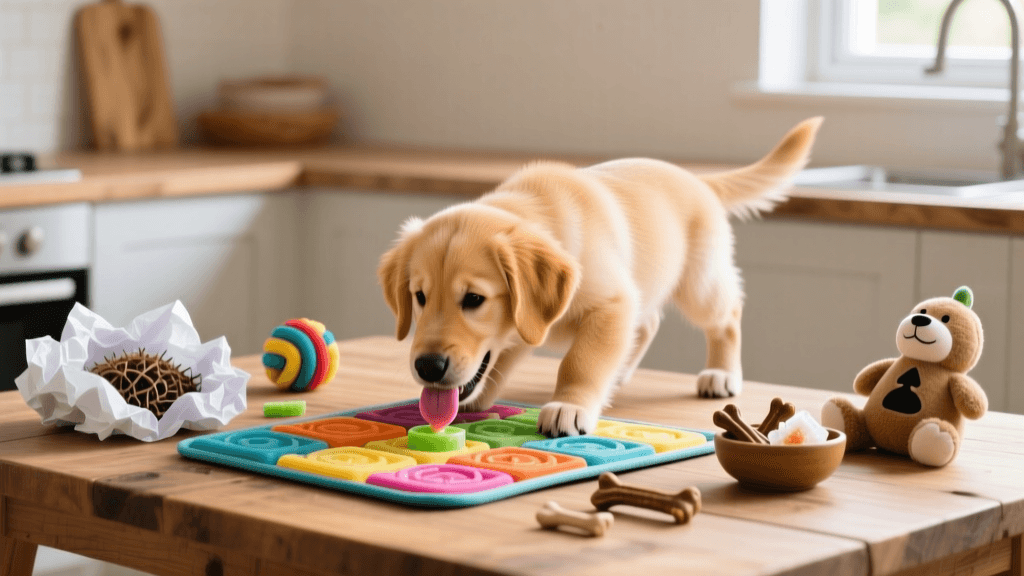
Keep a stash of appropriate chew toys in every room. The KONG Classic Puppy Toy (Cost: approximately $10 to $15) is an indispensable tool for families. To make it highly enticing and soothing for teething gums, prepare a batch of frozen KONGs. Plug the small hole with a dab of dog-safe peanut butter, fill the cavity with plain, unsweetened Greek yogurt mixed with mashed bananas, and freeze it solid. When the puppy's teeth touch human skin, let out a calm, high-pitched 'Oops!' or 'Too bad!', immediately stand up, and walk away for 15 seconds. This mimics the behavior of a littermate ending the play session. Return with the frozen KONG and offer it to the puppy. When they bite the toy instead of your skin, offer calm verbal praise. This teaches the puppy that human skin equals the end of play, while chewing on toys earns attention and relief for their gums.
Puppy and Child Interaction Chart by Age
Managing expectations is vital for family harmony. A puppy's capacity for self-control and appropriate play changes rapidly during their first year. Use the following chart to guide your family's interactions and management strategies based on the puppy's developmental stage.
| Puppy Age | Developmental Stage | Kid Interaction Rules | Management Strategy |
|---|---|---|---|
| 8-12 Weeks | High sleep needs, exploring with mouth, very fragile. | Only gentle, seated petting. No picking up by children. | Strict playpen use. 10-minute supervised play sessions max. |
| 3-4 Months | Teething begins, high energy bursts, testing boundaries. | Practice 'Be a Tree'. No running games indoors. | Heavy use of frozen chew toys. Enforce mandatory mid-day naps in the crate. |
| 5-6 Months | Adult teeth coming in, increased independence, chewing phase. | Children can participate in treat-tossing and basic trick training. | Provide structured mental enrichment (snuffle mats, puzzle toys) to burn energy. |
| 7-12 Months | Adolescence, hormonal changes, testing rules again. | Supervised fetch and tug-of-war with strict 'drop it' rules. | Reinforce basic obedience. Maintain safe zones during high-arousal play. |
Managing Arousal Levels and Nap Times
One of the most common mistakes families make is assuming that a biting, hyperactive puppy needs more exercise. In reality, an overtired puppy is exactly like an overtired toddler: they become cranky, lose impulse control, and resort to biting. Puppies require between 18 and 20 hours of sleep per day to support their rapid physical and neurological growth. The American Academy of Pediatrics advises that children must be taught to recognize when an animal is tired and needs space, as sleep deprivation is a major trigger for irritable behavior and subsequent bites in pets.
Implement a strict nap schedule. For every hour the puppy is awake and playing, they should spend two to three hours sleeping in their crate or a quiet, darkened room. If your puppy turns into a 'land shark' in the evening, it is almost always a sign that they are overtired. Calmly pick them up or lure them with a treat into their crate, cover it with a breathable blanket, and turn on a white noise machine. You will likely find that after a 90-minute nap, the puppy wakes up as a completely different, calmer, and more manageable dog.
Conclusion
Raising a puppy alongside young children requires patience, vigilance, and a proactive approach to management. By understanding the developmental reasons behind puppy biting, investing in physical barriers like hardware-mounted gates and playpens, and teaching your children vital safety skills like the 'Be a Tree' method, you can drastically reduce the risk of tears and injuries. Remember that this challenging phase is temporary. With consistent redirection, ample frozen chew toys, and strictly enforced nap times, your puppy will soon outgrow their needle-like teeth, paving the way for a lifelong, gentle, and deeply rewarding bond between your child and their best friend.
aaron-whyte
All our authors care for dogs every day — read more of their work on the authors page.