2026 Puppy Sports Guide: Safe Agility Foundations For First Year
Discover safe 2026 puppy agility foundation games that build focus and body awareness without risking growth plate injuries in your first-year sports dog.
The Evolution of Puppy Sports Training in 2026
Welcome to the exciting world of canine sports! Whether you are dreaming of agility championships, obedience trials, or rally competitions, the foundation for a successful sports dog is built during their first year of life. In 2026, the veterinary and canine sports communities have reached a strong consensus: early training should focus entirely on cognitive development, body awareness, and environmental socialization, strictly avoiding high-impact physical maneuvers. The modern approach to puppy care for future athletes prioritizes longevity and joint health over early physical achievements.
Raising a puppy with the intent to compete requires a delicate balance. You must cultivate a high-drive, confident, and focused dog while simultaneously protecting their developing skeletal system. According to the ASPCA Puppy Care Guidelines, the first year of a dog's life is a critical window for socialization and basic learning, but their physical bodies are still highly vulnerable. This guide will walk you through the safest, most effective foundation games and conditioning exercises to prepare your puppy for the competition ring without compromising their long-term health.
Understanding Growth Plates and Physical Safety
The most critical concept for any prospective sports dog handler to understand is the biology of canine growth plates (physis). These are areas of active, new bone growth located near the ends of the long bones in a puppy's legs. Until these plates close and calcify—typically between 12 and 18 months of age, depending on the breed and size—they are soft and highly susceptible to injury.
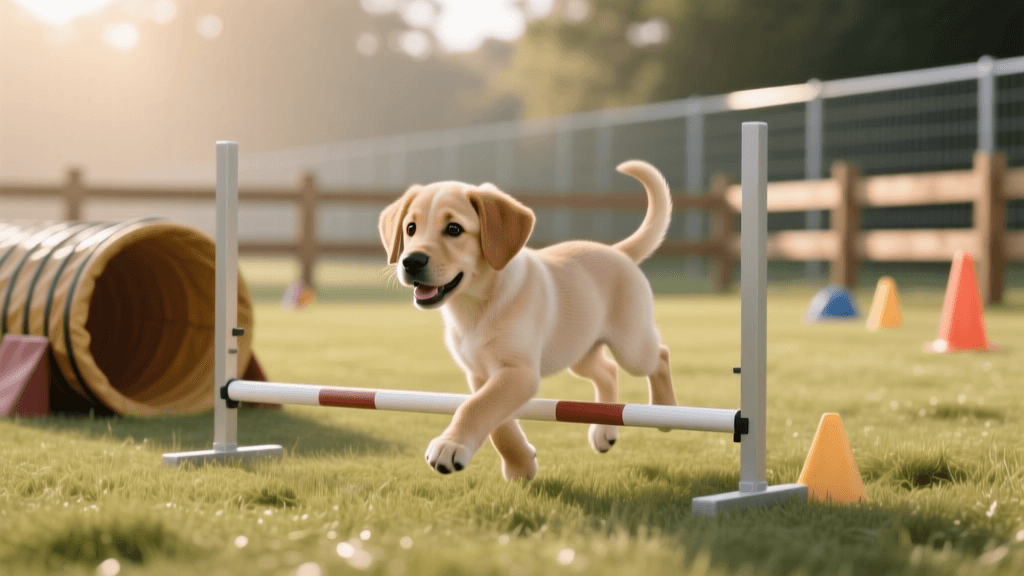
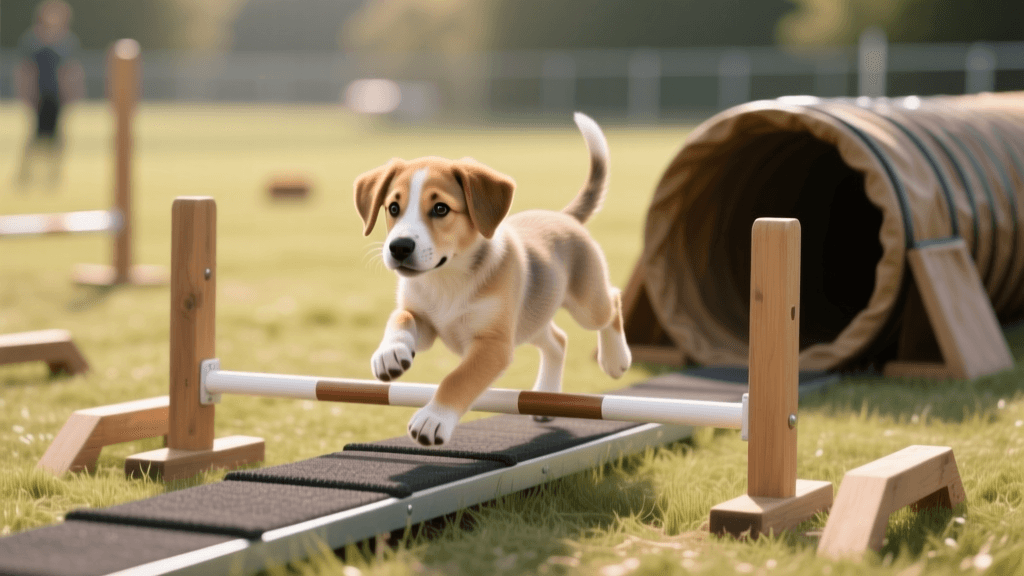
Repetitive high-impact activities, such as jumping over agility bars, leaping off high contacts, or twisting through weave poles, can cause micro-fractures or premature closure of these plates. This can lead to permanent structural deformities, early-onset osteoarthritis, and a shortened sports career. The 2026 veterinary sports medicine consensus strictly advises keeping all jumps under elbow height and completely avoiding weave poles until a puppy is fully mature. Instead, the American Kennel Club (AKC) Agility programs emphasize flat-work, tunnel exposure, and foundational handling skills for puppies under a year old.
Essential Foundation Games (No Jumping Required)
So, what can you safely do with a 4-month-old puppy to prepare them for the agility field? The answer lies in flat-work, proprioception, and engagement games.
1. Proprioception and Body Awareness
Proprioception is the dog's ability to know where their body parts are in space. A dog with excellent body awareness will be more coordinated, less prone to injury, and faster to learn complex physical skills later in life.
- The Pivot Bowl: Place your puppy's front paws on a low, stable disc or bowl. Using a food lure, encourage them to move their hind legs in a circle around the front paws. This builds core strength and hind-end awareness, which is crucial for future contact equipment like the dog walk and teeter.
- Cavaletti Poles: Set up lightweight PVC pipes or wooden poles on the ground, spaced appropriately for your puppy's natural stride. Encourage them to walk slowly over the poles. This teaches them to pick up their feet, articulate their joints, and focus on their footing without any jarring impact.
- Backing Up: Teaching a puppy to reverse in a straight line is a fantastic core-strengthening exercise that requires zero jumping. Use a narrow channel (like a hallway or two chairs) to guide them backward using a food lure and a verbal cue.
2. Target Training
Targeting is the cornerstone of modern agility training. It teaches the dog to seek out a specific object or location, which translates directly to contact zones and jump wraps.
- Nose Targets: Teach your puppy to touch a small piece of tape on your hand or a target stick with their nose. This is invaluable for teaching lead-outs, distance handling, and directing the dog's focus away from distractions.
- Paw Targets: Using a small, textured mat, train your puppy to place their front paws on the mat and hold the position. This is the exact foundational behavior used to train the '2-on, 2-off' contact position on the A-frame and dog walk.
3. Engagement and Drive Building
In the competition ring, you are the most important piece of equipment. Your puppy must learn that interacting with you is more rewarding than the environment. Practice 'tug-of-war' with clear rules (e.g., the dog must release the toy on cue) and use high-value food rewards delivered in rapid succession to build intense focus. Mental fatigue is just as effective as physical fatigue; a 10-minute intense shaping session will tire a puppy out just as much as a 30-minute walk.
Socializing for the Competition Environment
A common mistake handlers make is only socializing their puppies to other dogs and people. The Fédération Cynologique Internationale (FCI) Agility Regulations dictate that competition environments are loud, chaotic, and full of strange equipment. A successful sports dog must be neutral to these stimuli.
During your puppy's first year, actively expose them to:
- Strange Surfaces: Tarps, grates, wobble boards, and artificial turf. Reward heavily for voluntary exploration.
- Loud Noises: Clapping, whistles, announcers speaking over megaphones, and the sound of other dogs barking in high drive. Pair these sounds with high-value treats to build positive associations.
- Equipment Neutrality: Allow your puppy to sniff and walk around agility wings, tunnel bags, and jump stanchions without interacting with them. They must learn that these objects are part of the background until you give a specific cue.
2026 Recommended Foundation Gear
Investing in the right equipment early on can streamline your training process. Below is a comparison of the most highly recommended foundation gear for puppy sports conditioning in 2026.
| Equipment Name | Primary Purpose | Estimated 2026 Price | Safety Rating for Puppies |
|---|---|---|---|
| Klimb Training Platform | Paw targeting, sit-stands, hind-end awareness | $135 - $160 | Excellent (Low Impact) |
| Cavaletti Pole Set | Stride regulation, foot placement, joint articulation | $45 - $80 | Excellent (Walking Pace) |
| Canine Paw Pods | Stretching, balance, core stabilization | $50 - $75 | Very Good (Supervised) |
| Snuffle Mats / Lick Mats | Mental fatigue, calming, impulse control | $20 - $40 | Excellent (Passive) |
| Tug Toys with Bungee | Drive building, neck protection during play | $15 - $30 | Very Good (Proper Use) |
Sample Weekly Training Schedule for a 6-Month-Old Puppy
Keep sessions incredibly short. A good rule of thumb for puppies is no more than 1 to 2 minutes of active training per month of age, followed by a rest period.
- Monday: 3 minutes of Paw Targeting on a Klimb; 5 minutes of environmental walk (sniffing on a long line).
- Tuesday: 3 minutes of Cavaletti walking; 2 minutes of tug play and toy release mechanics.
- Wednesday: Rest day. Provide a frozen lick mat for mental enrichment and jaw relaxation.
- Thursday: 3 minutes of Pivot Bowl exercises; 5 minutes of socialization walk in a busy area (rewarding for neutrality to strangers).
- Friday: 3 minutes of Nose Targeting and recall games; 2 minutes of impulse control ('leave it' games with food).
- Weekend: Off-trail hiking in nature to build natural proprioception over uneven terrain, or complete rest.
Conclusion: Patience Pays Podiums
Raising a puppy for dog sports is a marathon, not a sprint. By dedicating your puppy's first year to safe body awareness, deep engagement, and environmental confidence, you are building a resilient athlete capable of competing well into their senior years. Embrace the 2026 standards of canine sports science, protect those precious growth plates, and enjoy the process of building an unbreakable bond with your future champion.
hannah-wickes
All our authors care for dogs every day — read more of their work on the authors page.