The Psychology of Leash Pulling: No-Pull Harness Guide 2026
Discover the canine psychology behind leash pulling and how front-clip no-pull harnesses biomechanically redirect your dog's behavior in 2026.
The Canine Psychology Behind Leash Pulling
To truly understand why your dog drags you down the street, we must first look past the idea of 'stubbornness' and examine canine psychology and evolutionary biology. Leash pulling is rarely an act of defiance; it is a natural byproduct of how dogs interact with their environment and how their bodies respond to physical pressure. As we navigate the dog care landscape in 2026, veterinary behaviorists emphasize that addressing the root psychological triggers of pulling is far more effective than simply relying on restrictive gear.
There are three primary psychological and instinctual drivers behind leash pulling: the opposition reflex, prey drive, and environmental overstimulation. Understanding these triggers is the first step toward selecting the right no-pull dog harness and implementing a successful behavioral modification plan.
The Opposition Reflex (Thigmotaxis)
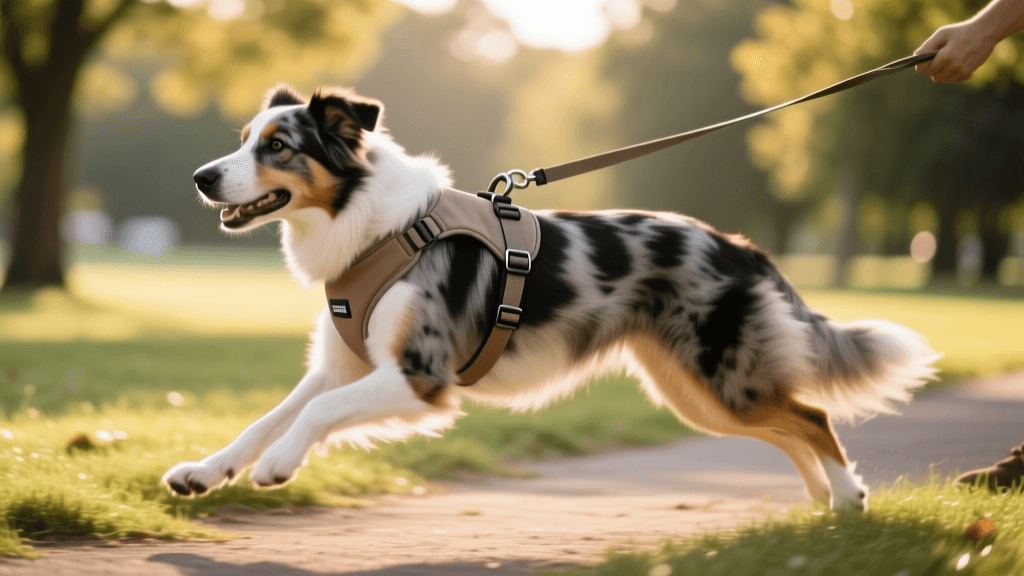
Dogs possess a hardwired physiological response known as the opposition reflex, or thigmotaxis. When a dog feels pressure against its body, its instinctual reaction is to push against that pressure. This is the same instinct that allows sled dogs to pull heavy loads across the snow. When you use a traditional back-clip harness or a collar, the pressure is applied to the dog's chest or neck from behind. Biomechanically, the dog's brain interprets this backward pull as a signal to lean forward and push harder. You are inadvertently triggering an ancient working instinct, turning your daily walk into a tug-of-war that your dog is biologically programmed to win.
Prey Drive and Environmental Overstimulation
A dog's olfactory and visual senses are vastly superior to ours. A walk is not just exercise; it is a complex sensory experience. When a dog spots a squirrel, smells an intriguing scent, or sees another dog, their prey drive or social curiosity spikes. In this state of high arousal, the dog's threshold for physical discomfort increases dramatically. A dog highly motivated to reach a stimulus will pull through the discomfort of a choking collar or a restrictive back-clip harness because the psychological reward of reaching the target outweighs the physical consequence.
How Front-Clip No-Pull Harnesses Interrupt the Pulling Cycle
A front-clip no-pull harness fundamentally changes the physics and psychology of the walk. By placing the leash attachment point on a reinforced ring located at the center of the dog's chest (the sternum), you alter the dog's center of gravity.
When the dog surges forward and hits the end of the leash, the front-clip redirects the tension. Instead of pulling backward against the dog's forward momentum (which triggers the opposition reflex), the front-clip gently pivots the dog's chest and shoulders sideways, turning them back toward the handler. This biomechanical interruption breaks the dog's forward focus, resets their physical alignment, and provides a crucial split-second window for the handler to reward engagement and reinforce loose leash walking techniques.
Crucially, a well-designed front-clip harness does not cause pain or restrict breathing. It relies on spatial redirection rather than aversive punishment, aligning perfectly with the modern, force-free training methodologies that dominate the canine behavioral science community in 2026.
2026 No-Pull Harness Market: Behavioral Suitability
Not all harnesses are created equal. The market has evolved significantly, with manufacturers focusing on canine ergonomics and behavioral feedback. Below is a comparison of the top front-clip harnesses available in 2026, evaluated specifically on their ability to aid in behavioral redirection without compromising physical health.
| Harness Brand & Model | Clip Configuration | Behavioral Suitability | 2026 Est. Price |
|---|---|---|---|
| Ruffwear Front Range | Dual (Front & Back) | Excellent for transitioning from pulling to heel work. Padded chest prevents chafing during redirection. | $44.95 |
| Kurgo Tru-Fit Smart | Dual (Front V-Ring) | Ideal for escape artists and high-arousal pullers. The V-ring design offers superior steering control. | $39.99 |
| Rabbitgoo No-Pull | Dual (Front & Back) | Great budget option for mild pullers. Wide chest plate distributes pressure evenly during sudden stops. | $21.99 |
| Blue-9 Balance Harness | Dual (Front & Back) | Top tier for behavioral rehab. Customizable fit ensures zero shoulder restriction, keeping the dog relaxed. | $58.00 |
The Importance of Gait and Y-Shaped Designs
When selecting a no-pull harness, understanding your dog's physical biomechanics is just as important as understanding their psychology. In recent years, veterinary orthopedic specialists have heavily criticized harnesses that feature a horizontal strap across the dog's chest and shoulders. These restrictive designs limit the natural forward extension of the shoulder blades (scapulae), forcing the dog to alter their natural gait.
Over time, a restricted gait leads to joint strain, muscle atrophy, and chronic pain. A dog experiencing physical discomfort will often exhibit behavioral issues, including increased pulling, reactivity, or a refusal to walk. In 2026, the gold standard recommended by veterinary behaviorists is the 'Y-shaped' harness. A Y-shaped harness features a front strap that drops down between the dog's front legs, leaving the shoulder joints completely free to move through their full range of motion. When evaluating the harnesses listed above, always ensure the front profile forms a 'Y' rather than a 'T' to protect your dog's long-term musculoskeletal health while you work on safe and enjoyable walking habits.
Reading Body Language: Stress vs. Engagement
A harness is a communication tool, but it is up to you to read your dog's responses. While using a front-clip no-pull harness, pay close attention to your dog's body language to gauge their emotional state.
- Signs of Stress or Frustration: 'Whale eye' (showing the whites of the eyes), excessive lip licking, yawning when not tired, pinned ears, or a stiff, high-carried tail. If you see these signs, the environment may be too overstimulating, and you should increase the distance from the trigger.
- Signs of Relaxation and Engagement: A softly wagging tail at mid-level, relaxed facial muscles, a slightly open mouth ('soft smile'), and voluntary 'check-ins' where the dog looks back at you for guidance.
If your dog is constantly hitting the end of the leash and getting spun around by the front-clip, they are not learning; they are merely being managed. The goal is to use the gentle redirection of the harness to encourage voluntary check-ins, rewarding the dog with high-value treats when they choose to look at you instead of pulling toward a distraction.
Pairing the Harness with Behavioral Training
The most critical concept to internalize is that a no-pull harness is a training aid, not a permanent cure. It manages the physical symptom (pulling) while you address the psychological root (lack of engagement and impulse control).
To achieve a reliable loose-leash walk in 2026, pair your front-clip harness with the following behavioral protocols:
- The 'Stop and Reset' Method: The moment you feel tension on the leash, stop walking immediately. Do not jerk the leash or yell. Simply become a tree. Wait for your dog to release the tension by taking a step back or looking at you. The moment the leash is slack, mark the behavior with a 'Yes!' and resume walking.
- The Direction Change: If your dog is locked onto a distraction and pulling, use the front-clip to gently guide them into a 180-degree turn away from the trigger. Walk briskly in the opposite direction for a few steps, then reward them heavily when they catch up to you and offer eye contact.
- Proactive Rewarding: Do not wait for your dog to pull to react. Reward them for walking in the 'heel' zone (near your knee) before they even think about surging forward. This builds a psychological preference for staying close to you rather than rushing to the end of the leash.
By combining the biomechanical advantages of a modern, Y-shaped front-clip no-pull harness with a deep understanding of your dog's opposition reflex and environmental triggers, you transform the daily walk from a stressful battle into an enriching, cooperative experience. Understanding your dog's mind is the ultimate key to a lifetime of joyful, pull-free adventures.
marcus-aldridge
All our authors care for dogs every day — read more of their work on the authors page.