Outward Hound Casino vs Nina Ottosson Brick 2026 Review
Compare the Outward Hound Dog Casino and Nina Ottosson Dog Brick puzzle toys in 2026. Discover which mental enrichment game best suits your dog's needs.
The Rise of Canine Cognitive Enrichment in 2026
As we navigate through 2026, the veterinary and canine behavior communities have reached a unified consensus: physical exercise alone is no longer sufficient for a well-balanced dog. Mental enrichment and puzzle games have moved from niche training tools to essential components of daily canine healthcare. According to ASPCA's comprehensive dog care guidelines, providing structured cognitive challenges can significantly reduce anxiety, curb destructive behaviors, and slow the onset of age-related cognitive decline in senior dogs.
When it comes to interactive puzzle feeders, two titans dominate the market: the Outward Hound Dog Casino and the Nina Ottosson Dog Brick. Both offer unique mechanical challenges designed to tap into a dog's natural foraging instincts and problem-solving capabilities. But which one is the right fit for your specific dog's cognitive profile? In this comprehensive 2026 review, we break down the mechanics, durability, and training applications of both puzzle games to help you make an informed decision for your dog's mental wellbeing.
Understanding Canine Cognition and Puzzle Play
Before diving into the product comparison, it is vital to understand why puzzle toys work. Research into canine cognitive abilities and intelligence shows that a dog's brain is wired to seek out food through scavenging and problem-solving. In the wild, canines spend up to 80% of their waking hours foraging. Modern domestic dogs, fed from a bowl in seconds, often suffer from 'leisure boredom,' which manifests as excessive barking, chewing, or hyperactivity.
Puzzle toys simulate the foraging process. They require the dog to use their olfactory senses, paw-eye coordination, and spatial reasoning to access high-value treats. The dopamine release triggered by successfully solving a puzzle provides a profound sense of mental fatigue—often equivalent to an hour-long physical walk.
Outward Hound Dog Casino: The Drawer and Bone Challenge
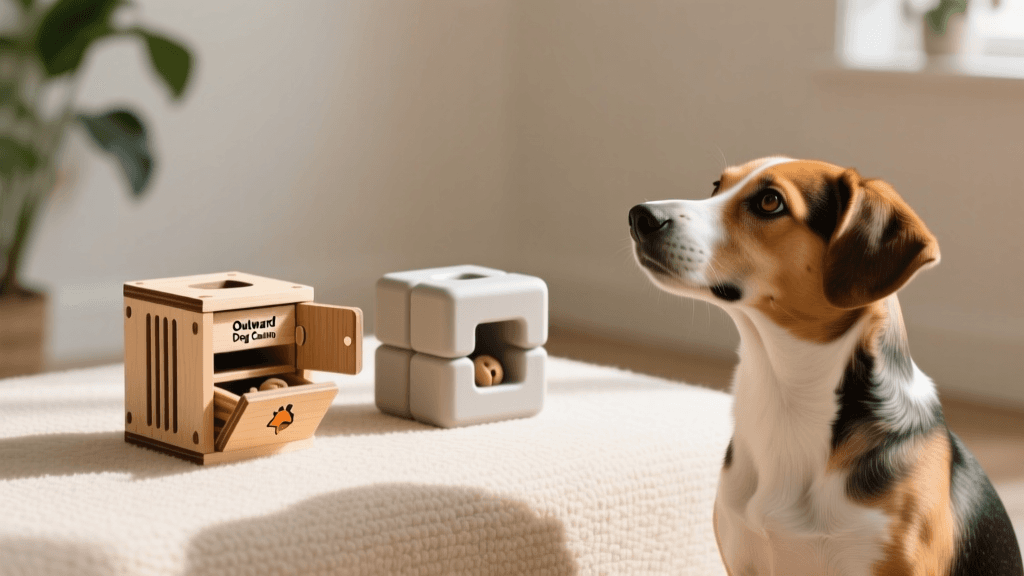
The Outward Hound Dog Casino (often referred to as the Dog Casino Advanced) is a multi-level puzzle that relies on a combination of lifting, pulling, and unlocking mechanisms. Priced around $24.99 in 2026, it is constructed from durable, BPA-free, phthalate-free composite plastics.
Key Features and Mechanics
- The Bone Covers: The top of the Casino features six removable bone-shaped pegs. Dogs must learn to lift these pegs out of their slots to reveal hidden treat compartments beneath.
- The Drawer System: This is where the Casino shines. It features four pull-out drawers located on the sides of the base. However, these drawers are locked by the bone pegs. The dog must first remove the bones from the top to unlock the drawers, allowing them to slide out and access the treats inside.
- Adjustable Difficulty: You can easily adjust the difficulty by leaving some bones in (locking the drawers) or taking them out, allowing the dog to focus solely on pulling the drawers.
Pros and Cons
The primary advantage of the Dog Casino is its sequential problem-solving requirement. It teaches dogs impulse control and multi-step logic. However, the removable bone pegs can be a choking hazard for aggressive chewers who might try to bite the plastic rather than manipulate it with their paws and nose. It is strictly a supervised enrichment tool.
Nina Ottosson Dog Brick: The Sliding and Flipping Classic
Nina Ottosson is a pioneer in canine puzzle games, and the Dog Brick remains one of their most popular intermediate-level puzzles in 2026. Retailing for approximately $19.99, the Dog Brick focuses on lateral movement and flipping actions rather than pulling and unlocking.
Key Features and Mechanics
- Flipping Lids: The board features several circular compartments covered by hinged lids that the dog must flip open using their nose or paws.
- Sliding Bricks: Interspersed among the flipping lids are bone-shaped sliding blocks. The dog must push these blocks laterally along a track to reveal treats hidden underneath.
- Removable White Bone Covers: To increase the difficulty, the Dog Brick includes white bone-shaped covers that can be placed over the flipping lids, requiring the dog to remove the cover before they can flip the lid.
- Non-Slip Rubber Feet: Unlike many cheaper alternatives, the Dog Brick features sturdy rubber feet that prevent the toy from sliding across hardwood floors, which is crucial for maintaining the dog's focus and preventing physical frustration.
Pros and Cons
The Dog Brick is incredibly intuitive for beginners and intermediate players. The sliding mechanism encourages paw targeting, a valuable skill in canine trick training. The main drawback is that highly food-motivated, powerful dogs can sometimes force the sliding tracks or flip the entire board over if the treats are too large, though the 2026 reinforced track design has mitigated this issue significantly compared to older models.
Head-to-Head Comparison Chart
| Feature | Outward Hound Dog Casino | Nina Ottosson Dog Brick |
|---|---|---|
| Primary Mechanic | Lifting pegs, pulling drawers | Sliding blocks, flipping lids |
| Difficulty Level | Advanced (Multi-step logic) | Intermediate (Lateral movement) |
| 2026 Average Price | $24.99 | $19.99 |
| Material | Composite Plastic | Composite Plastic |
| Non-Slip Base | No | Yes (Rubber feet) |
| Dishwasher Safe | Hand wash recommended | Hand wash recommended |
| Best For | Methodical thinkers, paw-users | Nose-workers, fast learners |
Step-by-Step Guide to Introducing Puzzle Toys
A common mistake pet owners make is presenting a fully loaded, maximum-difficulty puzzle to a novice dog. This leads to frustration, barking, and the dog abandoning the toy. The American Kennel Club's expert training resources emphasize the importance of 'shaping' the behavior and setting the dog up for success.
Phase 1: The Open Book (Days 1-3)
Remove all obstacles. For the Dog Brick, leave the sliding blocks pushed back and the lids open. For the Casino, remove all bone pegs and pull the drawers completely out. Place high-value, smelly treats (like freeze-dried liver or small pieces of boiled chicken) directly in the open compartments. Let the dog eat freely. This builds a positive association with the toy.
Phase 2: The Minor Obstacle (Days 4-7)
Introduce one level of difficulty. Leave the drawers open but place one bone peg on top of the Casino. Or, close just one flipping lid on the Dog Brick. Demonstrate how to move the piece with your hand if the dog seems confused. Praise heavily when they interact with the obstacle.
Phase 3: The Full Challenge (Week 2 and Beyond)
Gradually increase the difficulty by adding more sliding blocks, closing more lids, or locking the Casino drawers. Always supervise. If the dog begins to chew the plastic rather than manipulate it, the puzzle is too difficult, or the dog is over-aroused. Remove the toy, calm the dog, and revert to an easier phase.
Pro Tip for 2026: Use a portion of your dog's daily kibble allotment for puzzle play rather than adding extra treats on top. This prevents obesity while ensuring the dog remains motivated to 'work' for their meals.
Expanding the Enrichment: DIY Scent Work and Snuffle Mats
While mechanical puzzles like the Casino and Dog Brick are fantastic for spatial reasoning, they should be part of a broader mental enrichment routine. Scent work is arguably the most tiring cognitive exercise you can offer a dog, as the olfactory lobe in a canine brain is proportionally 40 times larger than in humans.
Consider pairing your puzzle toys with a DIY Snuffle Mat. You can create one using a rubber sink mat and strips of fleece fabric tied through the holes. Scatter kibble or small training treats deep within the fleece strips. This mimics the natural behavior of rooting through underbrush and grass. Alternating between mechanical puzzles (which require visual and tactile problem solving) and snuffle mats (which require deep olfactory focus) provides a well-rounded cognitive workout that addresses different neural pathways.
Safety, Cleaning, and Maintenance
Hygiene is a critical, often overlooked aspect of puzzle toys. Saliva, treat residue, and environmental dust can accumulate in the sliding tracks and drawer compartments, leading to bacterial growth. In 2026, most veterinary professionals recommend washing puzzle toys weekly.
Neither the Outward Hound Casino nor the Nina Ottosson Dog Brick are officially top-rack dishwasher safe, as the high heat can warp the composite plastics and ruin the precise tolerances of the sliding tracks. Instead, use a warm water soak with a pet-safe, enzymatic cleaner or mild dish soap. Use an old toothbrush to scrub the tracks and hinges. Always rinse thoroughly and air dry completely before the next use to prevent mold growth in the crevices.
Furthermore, inspect the toys regularly for micro-fractures or chewed edges. If a dog manages to bite off a piece of the sliding block or a bone peg, the toy must be immediately retired to prevent gastrointestinal blockages.
Final Verdict: Which Puzzle Game Wins?
Choosing between the Outward Hound Dog Casino and the Nina Ottosson Dog Brick ultimately depends on your dog's learning style and physical interaction preferences.
If you have a methodical, patient dog who enjoys using their paws to manipulate objects and can handle multi-step logic sequences, the Outward Hound Dog Casino is the superior choice. Its locking drawer mechanism offers a unique cognitive hurdle that few other toys on the market can replicate.
Conversely, if you have a fast-paced, nose-driven dog who benefits from continuous lateral movement and a stable, non-slip base, the Nina Ottosson Dog Brick is the undisputed champion. Its intuitive design makes it the perfect gateway puzzle for dogs new to cognitive enrichment.
By integrating these puzzle games into your daily routine, you are not just feeding your dog; you are actively investing in their neurological health, reducing their stress, and fostering a deeper, more communicative bond between you and your canine companion.
tom-renshaw
All our authors care for dogs every day — read more of their work on the authors page.