New Dog Mental Enrichment 2026: Nina Ottosson Puzzle Setup Guide
Prepare your new dog's mind in 2026 with our Nina Ottosson puzzle toy rotation and snuffle mat setup guide for the crucial first 30 days at home.
The Critical Role of Mental Enrichment When Getting a New Dog
Bringing a new dog home is one of life’s most rewarding milestones, but the transition period can be incredibly stressful for both you and your new canine companion. As we navigate dog ownership in 2026, veterinary behaviorists emphasize that physical exercise alone is no longer considered sufficient for a well-adjusted dog. Mental enrichment is just as critical, especially during the crucial first 30 days of adoption. When you are getting a new dog, setting up a structured mental enrichment station before they even walk through the door can be the difference between a destructive, anxious pet and a calm, confident family member.
The modern approach to dog adoption focuses heavily on cognitive fatigue. A twenty-minute session of focused puzzle-solving can tire a dog out as much as a two-mile walk. By preparing a dedicated puzzle toy rotation system—centered around industry-leading brands like Nina Ottosson and specialized foraging mats—you proactively address the root causes of separation anxiety, excessive barking, and destructive chewing before they become ingrained habits.
Understanding the Canine Foraging Instinct
To understand why puzzle games are vital for a newly adopted dog, we must look at canine biology. In the wild, dogs spend up to 80% of their waking hours scavenging and foraging for food. In a typical 2026 household, food is handed to them in a stainless steel bowl in less than three minutes. This sudden surplus of unspent mental energy often manifests as behavioral issues. According to the American Kennel Club, utilizing puzzle toys taps into a dog's natural foraging instincts, providing essential mental stimulation that lowers cortisol levels and promotes a sense of security in a brand-new environment.
When getting a dog from a shelter or breeder, they are entering an alien environment. Familiarizing them with scent-based games and mechanical puzzles gives them a 'job' to do, anchoring them to their new home and building a bridge of trust between you and your new pet.
Building Your 2026 Mental Enrichment Station
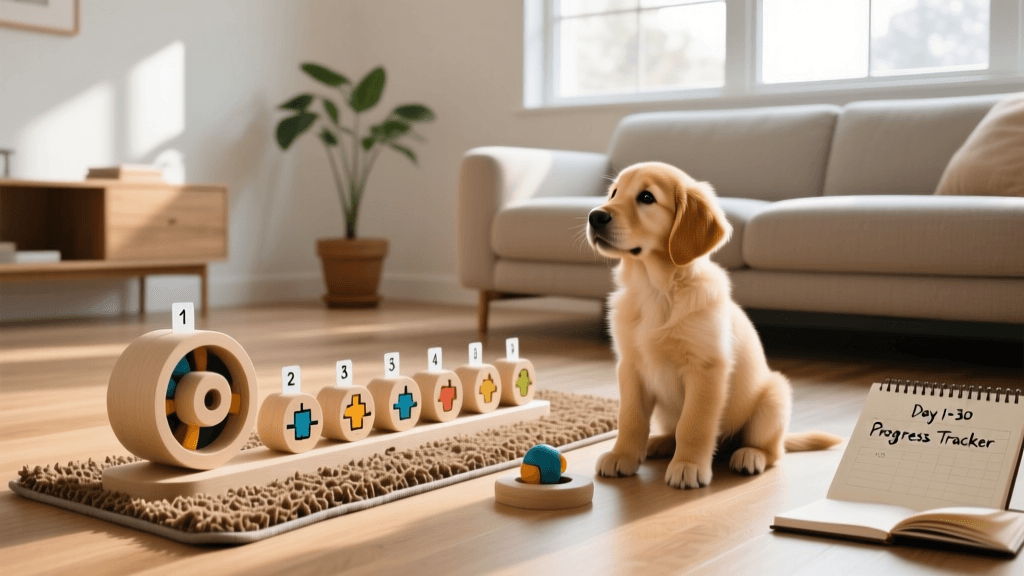
Before your dog arrives, designate a specific 'Brain Station' in your home. This should be a quiet, low-traffic area with a non-slip mat (like a rubber-backed rug or a specialized canine yoga mat). Having a dedicated space helps your dog understand that when they are on this mat, it is time to focus, forage, and relax. This is a foundational step in teaching the 'settle' cue, which is invaluable for new dog owners managing hyperactivity.
Nina Ottosson Puzzle Levels: A Buyer’s Comparison Chart
Nina Ottosson puzzles are the gold standard for canine cognitive enrichment. Their 2026 lineup features durable, BPA-free, phthalate-free composite materials that are easy to clean and safe for aggressive chewers. Here is a breakdown of their difficulty levels to help you stock your enrichment station appropriately for a new dog.
| Puzzle Level | Example Model (2026) | Primary Mechanism | Best For |
|---|---|---|---|
| Level 1 (Beginner) | Dog Smart Composite | Lifting removable bone-shaped pegs | Puppies, senior dogs, and highly anxious rescues needing quick wins. |
| Level 2 (Intermediate) | Dog Brick Puzzle | Sliding covers and flipping blocks | Dogs who have mastered basic scent work and need multi-step problems. |
| Level 3 (Advanced) | Outward Hound Casino | Sequential unlocking (pulling pins to release sliders) | Highly intelligent breeds (e.g., Border Collies, Poodles) and chronic puzzle-solvers. |
Note: Never skip Level 1, even if you are adopting a known 'smart' breed like a German Shepherd. Confidence building is more important than immediate difficulty when a dog is decompressing in a new home.
The First 30 Days: A Week-by-Week Puzzle Rotation Plan
The '3-3-3 Rule' of dog adoption dictates that a dog needs 3 days to decompress, 3 weeks to learn your routine, and 3 months to feel at home. Your puzzle rotation should mirror this biological and psychological timeline.
Week 1: Decompression and Scent Work
During the first week, avoid complex mechanical puzzles. Your dog is overwhelmed by new scents, sounds, and rules. Rely entirely on Snuffle Mats and Lickimats. Scatter their daily kibble ration into a dense, fleece snuffle mat. This encourages deep nasal breathing, which naturally lowers a dog's heart rate. Freeze low-sodium bone broth mixed with plain pumpkin puree in a textured silicone Lickimat to provide a soothing, endorphin-releasing activity when you need to step out of the room for the first time.
Week 2: Introduction to Mechanical Sliders
As your dog begins to settle, introduce the Nina Ottosson Level 1 (Dog Smart). Place high-value treats (like freeze-dried liver or boiled chicken) under the removable pegs. Initially, leave the pegs slightly askew so the dog can easily knock them over. The goal is to teach them the concept that manipulating the object yields a reward. Keep sessions short—no more than 5 to 10 minutes—to prevent frustration.
Week 3: Building Confidence with Multi-Step Puzzles
Transition to the Level 2 Dog Brick. This puzzle requires the dog to slide covers in different directions and lift hinged blocks. Demonstrate the sliding motion with your hand if they seem confused, but allow them to use their paws and snout to solve it. This week is critical for building problem-solving resilience. If your dog gets stuck, do not immediately solve it for them; instead, point to the mechanism and offer verbal encouragement. The ASPCA notes that allowing dogs to work through mild frustration builds emotional regulation, which is key to preventing reactive behaviors later on.
Week 4: Fostering Independent Problem Solving
By week four, your dog should be confidently engaging with Level 2 puzzles. Begin leaving them in their designated 'Brain Station' with a puzzle toy while you move to an adjacent room. This creates a positive association with your absence, laying the groundwork for healthy separation independence. According to The Humane Society of the United States, pairing departures with high-value enrichment activities is one of the most effective ways to stave off separation anxiety in newly adopted dogs.
Troubleshooting Puzzle Frustration in Newly Adopted Dogs
It is common for newly adopted dogs to exhibit frustration when introduced to puzzles, especially if they have never been asked to 'work' for their food. Signs of frustration include pawing aggressively at the toy, barking at the puzzle, or walking away entirely.
- If they paw aggressively: The puzzle is likely too difficult, or the treats are not high-value enough to sustain their focus. Downgrade to a Level 1 puzzle or a snuffle mat and use stronger-smelling treats like sardines or roast beef.
- If they walk away: Do not force the interaction. Pick the puzzle up and try again later when the dog is slightly hungrier. Never leave a puzzle out as a chew toy; it should only appear during active enrichment time.
- If they flip the board: Many Nina Ottosson models feature anti-slip rubber feet, but a highly motivated dog might still tip it. Place the puzzle against a wall or in a corner during the learning phase to limit the angles from which they can attack the board.
Safety, Hygiene, and Supervision Protocols
Mental enrichment requires strict safety oversight, particularly during the first month when you are still learning your dog's chewing habits. Never leave a newly adopted dog unsupervised with a mechanical puzzle toy until you are absolutely certain they will not attempt to ingest the plastic or composite moving parts.
Hygiene is equally important. In 2026, canine hygiene standards are higher than ever, and puzzle toys can quickly become breeding grounds for bacteria if raw meat or wet food is used. Wash your Nina Ottosson puzzles and snuffle mats weekly. Most modern composite puzzles are top-rack dishwasher safe, while fleece snuffle mats should be washed in a machine on a gentle cycle with a pet-safe, unscented detergent. Always inspect the toys for micro-cracks or loose parts before every single use.
By investing time in setting up a structured mental enrichment station before your new dog arrives, you are doing more than just buying toys. You are architecting a calm, confident, and deeply bonded relationship that will define your dog's life in your home for years to come. Getting a dog is a commitment to their physical health, but nurturing their mind is where true ownership begins.
aaron-whyte
All our authors care for dogs every day — read more of their work on the authors page.