Best Nina Ottosson Dog Puzzles 2026: Brick vs Hide N Slide
Compare the Nina Ottosson Dog Brick and Hide N' Slide puzzles for 2026. Discover which interactive toy best boosts your dog's mental enrichment.
The Rise of Canine Mental Enrichment in 2026
As we navigate through 2026, the veterinary and canine behavior communities have placed an unprecedented emphasis on mental enrichment. Gone are the days when a simple walk around the block was considered sufficient for a dog's daily exercise. Today, veterinary behaviorists recognize that cognitive stimulation is just as critical as physical exertion, particularly for preventing behavioral issues and delaying the onset of age-related cognitive decline. Interactive puzzle games have moved to the forefront of this wellness revolution, with Nina Ottosson (manufactured by Outward Hound) remaining the gold standard for canine brain games.
According to the American Kennel Club (AKC), Canine Cognitive Dysfunction (CCD) affects a significant percentage of senior dogs, manifesting in symptoms similar to Alzheimer's disease in humans. Engaging your dog in daily puzzle-solving activities helps build cognitive reserve, keeping neural pathways active and engaged. But with dozens of puzzles on the market, how do you choose the right one? In this comprehensive guide, we compare two of the most popular intermediate puzzles: the Nina Ottosson Dog Brick and the Nina Ottosson Hide N' Slide.
Deep Dive: Nina Ottosson Dog Brick Interactive Puzzle
The Dog Brick is a classic Level 2 intermediate puzzle that has been a staple in the canine enrichment community for years, and its 2026 iteration continues to impress with its durable, easy-to-clean composite materials. Priced at an accessible $16.99, it offers exceptional value for pet parents looking to introduce their dogs to multi-step problem-solving.
Design and Mechanics
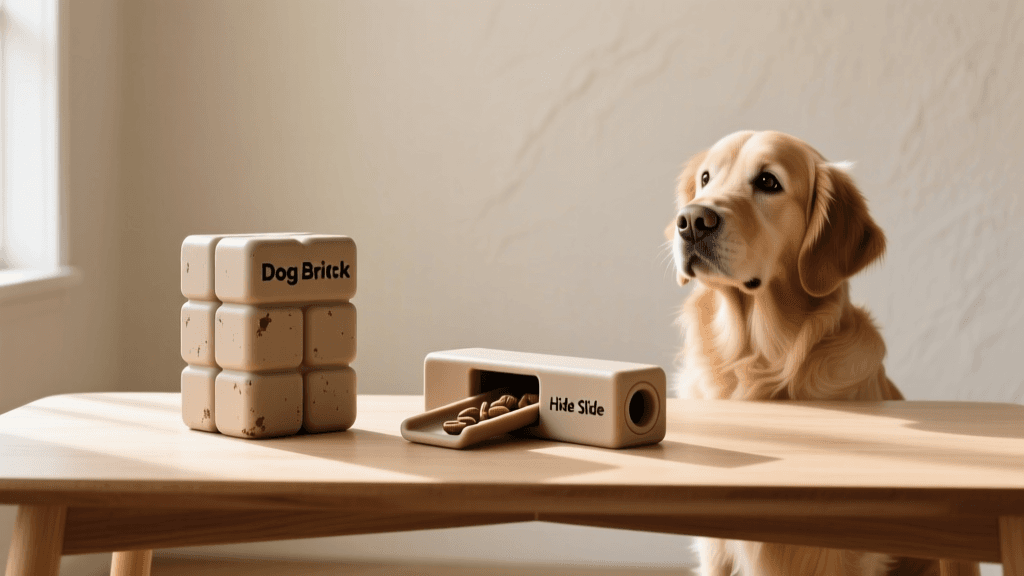
The Dog Brick features a vibrant blue and white color scheme that is visually appealing, though it is the mechanics that truly matter. The board contains three distinct types of challenges:
- Flip Lids: Hinged covers that the dog must use their nose or paws to flip open.
- Sliding Blocks: Bone-shaped covers that must be pushed along a track to reveal hidden compartments.
- Removable White Bones: These act as secondary obstacles. Your dog must remove the white bone pieces to unlock the sliding blocks beneath them.
This multi-tiered approach requires the dog to utilize different physical motions—flipping, sliding, and grasping—which engages various motor skills and prevents them from relying on a single brute-force tactic.
Pros and Cons of the Dog Brick
Pros:
- Excellent introduction to multi-step puzzles.
- Made from BPA-free, PVC-free, and phthalate-free materials, ensuring safety if your dog chews on the edges.
- Easy to disassemble and clean in the sink.
- Anti-slip rubber feet keep the board stable on hardwood floors.
Cons:
- Determined power chewers may eventually crack the removable white bones.
- The hinged flip lids can trap slobber and require thorough scrubbing.
Deep Dive: Nina Ottosson Hide N' Slide Puzzle
Stepping slightly up in complexity and aesthetic appeal, the Hide N' Slide is another Level 2 puzzle, but it feels closer to a Level 3 due to its unique mechanical layout. Retailing for around $21.99 in 2026, it features a beautiful wood-composite finish that blends seamlessly into modern home decor while remaining completely safe and non-toxic for dogs.
Design and Mechanics
The Hide N' Slide abandons the traditional removable pieces in favor of an integrated track system. This makes it an excellent choice for dogs who tend to pick up puzzle pieces and carry them away. The puzzle features:
- Linear Sliders: Compartments covered by wooden-textured blocks that slide horizontally.
- Swivel Flippers: Small fin-like levers on the top edge that must be swiveled out of the way before the main slider can be moved.
The requirement to swivel the top fin before sliding the bottom block introduces a sequential logic problem. The dog must understand that Action A (swiveling) enables Action B (sliding). This sequential processing is highly beneficial for canine cognitive development.
Pros and Cons of the Hide N' Slide
Pros:
- No removable parts, eliminating the choking hazard and the 'lost piece' frustration.
- Beautiful wood-grain aesthetic that looks great in living rooms.
- Sequential mechanics promote higher-level cognitive processing.
- Heavy base prevents the toy from sliding across the floor during enthusiastic play.
Cons:
- Slightly more expensive than the Dog Brick.
- The integrated tracks can be difficult to clean if wet food or peanut butter gets pushed deep into the corners.
Head-to-Head Comparison Table
To help you make the best decision for your dog's specific needs, here is a structured comparison of both puzzles based on 2026 specifications and user feedback.
| Feature | Dog Brick | Hide N' Slide |
|---|---|---|
| Retail Price (2026) | $16.99 | $21.99 |
| Difficulty Level | Level 2 (Intermediate) | Level 2 (Advanced Intermediate) |
| Material | Blue/White Plastic Composite | Wood-Textured Composite |
| Removable Parts | Yes (White Bone Pegs) | No (Fully Integrated) |
| Primary Motions | Flipping, Sliding, Lifting | Swiveling, Sliding |
| Best Suited For | Dogs needing motor skill variety | Dogs who chew/lose removable parts |
| Cleaning Ease | Moderate (Hinges trap debris) | Moderate (Tracks trap wet food) |
How to Progress Your Dog Through Puzzle Levels
Introducing a puzzle toy to a dog who has never experienced one can lead to frustration, which defeats the purpose of mental enrichment. The Humane Society emphasizes that enrichment activities should always be positive, confidence-building experiences. Here is a step-by-step progression guide to ensure your dog succeeds with either the Dog Brick or the Hide N' Slide.
Step 1: The 'Free Sample' Phase
For the first few sessions, do not hide the treats. Leave all lids flipped open and all sliders pushed back. Place high-value, strongly scented treats (like freeze-dried liver or small pieces of cheese) directly in the open compartments. Allow your dog to eat the treats freely. This teaches them that the puzzle is the source of the food.
Step 2: The 'Half-Hide' Phase
Once your dog is eagerly approaching the board, begin covering the treats only partially. Leave the sliders halfway open or the flip lids propped up. Your dog will quickly learn that a simple nudge of the nose or a swipe of the paw will fully reveal the reward. Use a marker word like 'Yes!' or a clicker the moment they move the piece to reinforce the behavior.
Step 3: Full Concealment and Sequential Logic
When your dog is confidently sliding and flipping, fully conceal the treats. If you are using the Dog Brick, place the white bone pegs over the sliders to introduce the multi-step requirement. If you are using the Hide N' Slide, ensure the top swivel fins are locked into place over the sliders. Sit with your dog and offer gentle verbal encouragement. If they become frustrated and start chewing the board, calmly remove the puzzle, revert to an easier step, and try again later.
Advanced Enrichment: Combining Puzzles with Scent Work
To maximize the mental fatigue and enrichment value in 2026, behaviorists recommend combining puzzle mechanics with olfactory stimulation. A dog's sense of smell is their primary way of interpreting the world. Before loading the Dog Brick or Hide N' Slide with treats, rub a small amount of the treat dust or a safe dog-friendly scent (like a tiny dab of peanut butter) on the outside of the sliders and lids. This forces the dog to use their nose to track the exact location of the hidden reward, rather than just relying on visual memory of where they saw you place it.
You can also incorporate the puzzle into a broader 'snuffle' routine. Hide the loaded puzzle in a room, ask your dog to 'stay' in another room, and then release them with a 'find it' command. This combines physical searching, scent tracking, and mechanical problem-solving into one comprehensive 15-minute brain workout.
Safety, Hygiene, and Maintenance Protocols
While Nina Ottosson puzzles are made from safe, non-toxic materials, they are not chew toys. They are designed for supervised interactive play. Always monitor your dog while they are using the puzzle. If your dog attempts to bite, crush, or ingest the plastic sliders or wooden composite pieces, immediately remove the toy. For aggressive chewers, mental enrichment might be better achieved through frozen Kongs, lick mats, or scent-work games that do not involve hard mechanical parts.
Cleaning Your Puzzles
Saliva, treat crumbs, and environmental dust can quickly accumulate in the tracks and hinges of these puzzles, creating a breeding ground for bacteria. Establish a weekly cleaning routine:
- Disassemble: Remove all white bone pegs from the Dog Brick.
- Wash: Use warm water and a mild, pet-safe dish soap. Avoid harsh chemical cleaners or bleach, as residues can be toxic to dogs and may degrade the composite materials over time.
- Scrub Tracks: Use an old toothbrush to gently scrub the sliding tracks and hinge joints where slobber accumulates.
- Dry Thoroughly: Allow all pieces to air dry completely before reassembling. Trapped moisture in the Hide N' Slide tracks can cause the composite material to warp or develop mold.
Final Verdict for 2026
Both the Nina Ottosson Dog Brick and the Hide N' Slide are exceptional tools for promoting canine cognitive health, reducing boredom-related destructive behaviors, and strengthening the bond between you and your dog. The Dog Brick remains the ultimate choice for dogs who benefit from a variety of physical manipulations (lifting, flipping, sliding) and for owners on a tighter budget. Conversely, the Hide N' Slide is the superior option for dogs who tend to lose or chew removable parts, and for owners who prefer a more aesthetically pleasing, wood-toned design that fits modern home decor.
By incorporating these puzzles into your dog's daily routine, you are investing in their long-term neurological health. Remember that the goal of mental enrichment is not to frustrate your dog, but to challenge them just enough to spark joy, curiosity, and that satisfying 'aha!' moment when they finally unlock the hidden reward.
aaron-whyte
All our authors care for dogs every day — read more of their work on the authors page.