Nina Ottosson Dog Brick Review: Senior Dog Brain Games 2026
Discover how the Nina Ottosson Dog Brick puzzle toy helps manage canine cognitive dysfunction in senior dogs with our expert 2026 review and training guide.
The Growing Importance of Canine Cognitive Health in 2026
As veterinary medicine continues to advance in 2026, our dogs are living longer, healthier lives than ever before. However, increased longevity brings a higher prevalence of age-related neurological conditions, most notably Canine Cognitive Dysfunction (CCD). Often compared to Alzheimer's disease in humans, CCD affects a significant percentage of senior dogs, manifesting as disorientation, altered sleep-wake cycles, and a decrease in purposeful activity. While pharmaceutical interventions exist, veterinary behaviorists overwhelmingly agree that proactive mental enrichment is the cornerstone of managing cognitive decline. This is where the Nina Ottosson Dog Brick puzzle toy has cemented its reputation as an essential tool for senior dog brain games.
According to the American Kennel Club's resources on senior dog dementia, maintaining neural pathways through structured problem-solving can significantly delay the progression of CCD symptoms. In this comprehensive 2026 review, we explore why the Dog Brick remains a top-tier recommendation for aging canines, how to properly introduce it to a senior dog, and how to pair it with age-appropriate nutritional rewards.
Understanding the Mechanics of the Nina Ottosson Dog Brick
The Nina Ottosson Dog Brick is classified as a Level 2 intermediate puzzle toy, but its genius lies in its adaptability. For senior dogs, a puzzle must strike a delicate balance: it needs to be challenging enough to stimulate neuroplasticity, yet accessible enough to prevent the frustration that can lead to stress-induced cortisol spikes. The Dog Brick achieves this through a multi-modal approach to foraging.
Three Distinct Problem-Solving Zones
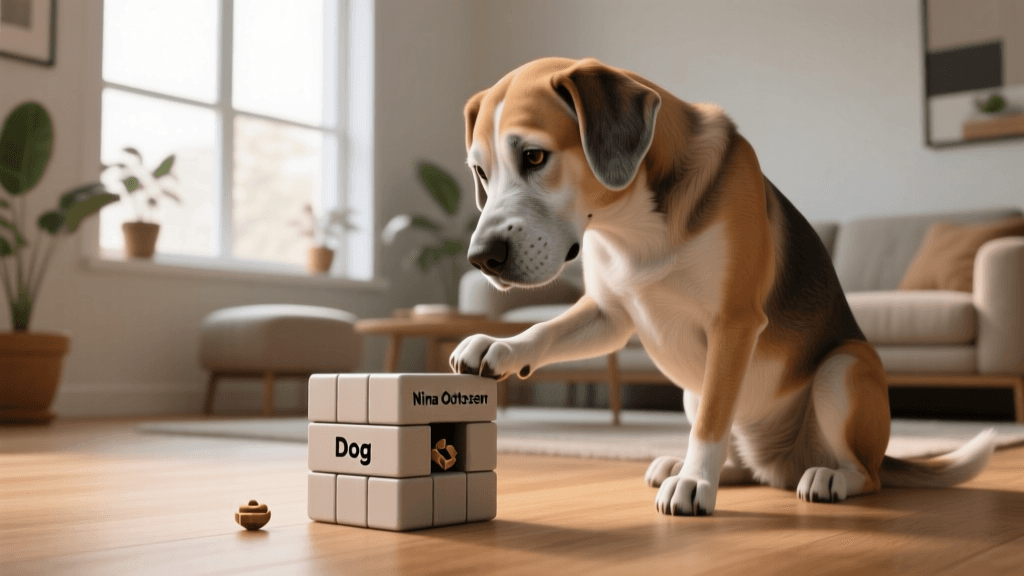
Unlike single-action toys that rely purely on chewing or batting, the Dog Brick requires a sequence of deliberate physical actions. The board features three primary treat-hiding mechanisms:
- Flip Lids: Hinged covers that the dog must lift using their nose or paw. This encourages fine motor control and targeted snout manipulation.
- Sliding Bone Covers: Bone-shaped blocks that sit in grooves over treat wells. The dog must apply lateral pressure to slide the block out of the way, promoting cross-hemisphere brain engagement.
- Removable White Bone Pegs: These act as obstacles. Dogs must learn to pull or lift these pegs out of their sockets before they can access the sliding covers beneath them, introducing a layer of sequential memory.
For aging dogs experiencing mild arthritis or decreased mobility, the Dog Brick is ideal because it can be placed on an elevated, non-slip feeding mat or a low table, eliminating the need for the dog to bend down to the floor or engage in high-impact physical movements.
Step-by-Step Guide: Introducing the Dog Brick to Seniors
Senior dogs, especially those in the early stages of cognitive decline, can become easily overwhelmed by novel objects. Throwing a fully loaded puzzle in front of them may result in avoidance or anxiety. The AKC's guide on puzzle toys emphasizes the importance of graduated exposure. Here is a proven 2026 protocol for introducing the Dog Brick to an aging dog.
Phase 1: Scent Mapping and Open Foraging (Days 1-3)
Begin by removing all the sliding bone covers and flip lids entirely. Place high-value, strongly scented treats directly into the open wells. Allow your dog to approach the board and eat the treats freely. This phase builds a positive association with the toy's scent and texture, teaching the dog that the plastic board is a source of rewards, not a threat.
Phase 2: Assisted Solving and Lateral Movement (Days 4-7)
Reintroduce the sliding bone covers, but only slide them halfway over the treat wells, leaving the high-value treat partially visible. Guide your dog's nose or gently demonstrate with your own hand how to nudge the bone cover sideways. Use a calm, encouraging marker word like 'find it' or 'search.' The goal is to build their confidence in manipulating the moving parts without requiring full blind-searching.
Phase 3: Sequential Problem Solving (Week 2 and Beyond)
Once your dog is confidently sliding the covers, introduce the white bone pegs as obstacles. Place a peg in front of a sliding cover. Your dog must now process a two-step sequence: remove the obstacle, then slide the cover. Keep these sessions strictly limited to 5 to 10 minutes. Mental fatigue in senior dogs sets in much faster than physical fatigue, and ending the session on a successful, positive note is vital for maintaining their enthusiasm.
Nutritional Considerations: Treats for Senior Puzzles
Because puzzle toys require repetitive treat consumption, caloric intake must be carefully monitored. Senior dogs have significantly slower metabolic rates and are prone to obesity, which exacerbates joint pain and cardiovascular strain. In 2026, veterinary nutritionists recommend utilizing low-calorie, high-olfactory-impact treats for enrichment activities.
Instead of standard training biscuits, consider using freeze-dried single-ingredient treats like beef liver or salmon. These offer a powerful scent profile that stimulates the dog's olfactory bulb—a brain region directly linked to memory and cognitive function—while keeping the caloric footprint minimal. Alternatively, you can use your dog's daily kibble ration, soaking it in low-sodium bone broth and placing small clumps into the Dog Brick's wells to encourage slower, more deliberate foraging.
Comparison Chart: Top 2026 Cognitive Toys for Seniors
While the Dog Brick is exceptional for sequential problem-solving, a well-rounded cognitive health routine should include various types of enrichment. Below is a comparison of the leading senior-friendly enrichment tools available this year.
| Enrichment Tool | Cognitive Demand | Physical Strain | 2026 Avg Price | Best For |
|---|---|---|---|---|
| Nina Ottosson Dog Brick | High (Sequential Logic) | Low (Nose/Paw nudging) | $16.99 | Dogs with mild CCD needing memory work |
| Silicone Lick Mat | Low (Soothing/Sensory) | Very Low (Licking) | $12.50 | Anxiety reduction and digestion support |
| Wool Snuffle Mat | Medium (Olfactory Search) | Low (Sniffing/Rooting) | $24.00 | Scent hounds and dogs with vision loss |
| Outward Hound Hide-A-Squirrel | Medium (Extraction) | Medium (Pulling/Shaking) | $15.99 | Dogs with high prey drive and good jaw health |
As the chart illustrates, the Dog Brick uniquely targets logical sequencing and spatial memory, making it the superior choice for dogs specifically showing signs of cognitive mapping issues, such as getting stuck in corners or forgetting the layout of their home.
Hygiene and Immune Health in Aging Dogs
Senior dogs often have compromised immune systems, making the sanitation of enrichment toys a critical health factor. The 2026 manufacturing standards for the Nina Ottosson Dog Brick ensure it is constructed from BPA-free, PVC-free, and phthalate-free composite materials. This is crucial, as older dogs with dental disease or gum inflammation are more susceptible to the bacteria that can harbor in porous, low-quality plastics.
To maintain optimal hygiene, the Dog Brick should be washed after every use. The removable components make this straightforward: simply discard any crumbs, wash the board and the individual bone pieces in warm water with a mild, pet-safe dish soap, and allow them to air dry completely. Avoid placing the toy in the dishwasher, as the extreme heat can warp the precision-fit grooves over time.
Expert Tips for Maximizing Cognitive Benefits
To get the most out of your senior dog's brain games, environment matters. Place the Dog Brick in a quiet, low-traffic area of your home. Aging dogs often experience a decline in their ability to filter out background noise, and a chaotic environment can distract them from the cognitive task at hand. Furthermore, rotate the placement of the puzzle toy. Moving it from the living room rug to a kitchen mat forces the dog to reorient their spatial memory, adding an invisible layer of neurological exercise to the physical puzzle.
Conclusion
Managing the golden years of our canine companions requires a proactive, multi-faceted approach to their health. While physical walks remain important, the mental walk provided by the Nina Ottosson Dog Brick is equally vital for preserving their quality of life. By incorporating this puzzle into a daily routine, utilizing high-scent, low-calorie rewards, and respecting their cognitive limits, you can provide your senior dog with the engaging, joyful stimulation they deserve. In 2026, we have the tools to keep our aging dogs sharp, happy, and deeply engaged with the world around them.
tom-renshaw
All our authors care for dogs every day — read more of their work on the authors page.